Painting / EN
The Bolshevik and the Weight of an Idea
On Revolution, Scale, and the Man Who Became Bigger Than the City
- Artist
- Boris Kustodiev
- Country
- Russia
- Year
- 1920
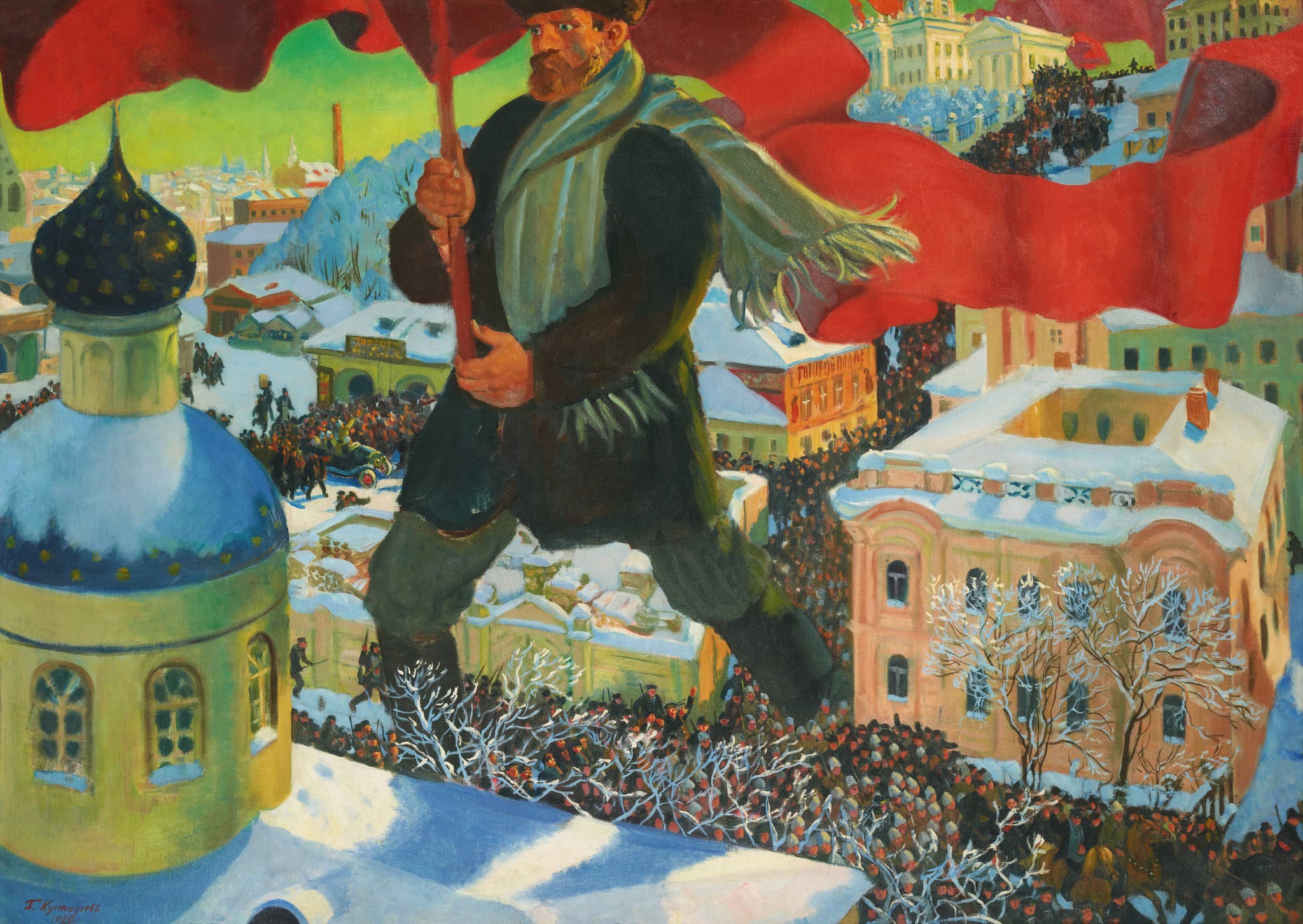
Boris Kustodiev's The Bolshevik asks one of the oldest political questions in the bluntest pictorial form imaginable: what happens when an idea becomes bigger than the world that produced it?
The figure at the center of the painting is not simply large. He is disproportional in a way that turns scale itself into ideology. He strides over rooftops with a red flag unfurling behind him, while below him the city contracts into miniature: streets, domes, houses, crowds, all rendered small enough that history appears to have changed species. The man is no longer merely in the city. He has become larger than its architecture, larger than its institutions, larger even than its sacred spaces.
That disproportion is the painting's intelligence.
If Kustodiev had painted the Bolshevik as a realistic marcher among other marchers, the image would have remained descriptive. By making him colossal, Kustodiev paints not a person but a historical sensation: the feeling that a force once contained within ordinary life has suddenly exceeded all previous measures. Revolution, in the painting, is not one event among others. It is a mutation of scale.
And yet the face matters. For all his enormity, the Bolshevik does not look abstract. He has a beard, a calm mouth, an almost gentle expression. He could be a schoolteacher, a printer, a provincial intellectual, one of the thousands of people history usually keeps small. That is what gives the image its tension. The giant is still recognizably human. He is not myth descending from above. He is the crowd's own figure, enlarged until he becomes almost unbearable to think with.
That enlargement is thrilling. It is also frightening.
Kustodiev understood both sides of that feeling. He was not a naive celebrant of power. He had spent years painting Russian daily life with an extraordinary sensitivity to texture: markets, merchant families, winter streets, rituals, appetite, provincial color. He knew what ordinary existence looked like at eye level. That is why The Bolshevik has more force than simple propaganda. It is painted by someone who understands what the city costs and therefore understands what it means to imagine a man becoming larger than it.
Look at the streets below. The crowd is dense, directional, collective. But it is also fragile. Once the figure above becomes that large, admiration and danger become inseparable. The same body that can embody the hope of mass awakening can also step on the city without noticing.
That ambiguity is what keeps the painting alive for me. Marxism, at least in its promise, is about the recognition that workers are larger than the systems that exploit them. The giant in Kustodiev's painting is that recognition made visible. The class that once seemed fragmented, local, and replaceable discovers its own scale. It discovers that it can fill the horizon. There is something genuinely moving in that transformation. It gives pictorial form to collective self-consciousness.
But the painting does not allow the feeling to remain innocent. Once a political subject becomes larger than the city, the question changes. It is no longer only: can he overthrow what dominated him? It becomes: what can he see from that height, and what can he no longer feel beneath his feet?
That question became tragically relevant to the twentieth century in ways Kustodiev could not fully foresee. Revolutions do not stay symbolic for long. Ideas that begin as liberation acquire institutions, police, bureaucracy, prisons, flags, official faces. The giant who once seemed like history's answer can become history's new problem.
I find The Bolshevik compelling because it seems to contain both the intoxication and the warning in embryo. The red flag splits the sky beautifully. The city below seems newly possible, newly historical. And yet the body carrying that possibility is already too large for comfort. Heroism and menace have not yet separated. They travel in the same stride.
Kustodiev painted this while physically confined, paralyzed from the waist down, working from a wheelchair. That biographical detail matters not because it makes the painting sentimental but because it clarifies its imagination. The revolution's bodily scale was inaccessible to him in the most literal sense. He could not march inside it. He had to imagine it. And perhaps that distance helped him paint not the event itself but its psychic magnitude.
The result is one of the most honest revolutionary images I know. Honest not because it takes a side outside history, but because it understands that history at revolutionary pitch is never only liberating or only terrifying. It is both at once, and often in the same body.
That body in Kustodiev's painting still walks across the city. The question it leaves behind is not whether the figure is admirable or dangerous.
The question is whether any political dream can grow that large without changing into something else under its own weight.