Painting / EN
Wanderer above the Sea of Fog
This is a painting by Caspar David Friedrich, titled 'Wanderer above the Sea of Fog'. It depicts a man standing upon a rocky precipice with his back to the viewer. He is wrapped in a dark green overcoat, and grips a walking stick in his right hand. His hair caught in a wind, the wanderer gazes out on a landscape covered in a thick sea of fog. In the far distance, obscured by misty peaks, we can just make out what appears to be the ocean.
- Artist
- Caspar David Friedrich
- Country
- Germany
- Year
- 1818
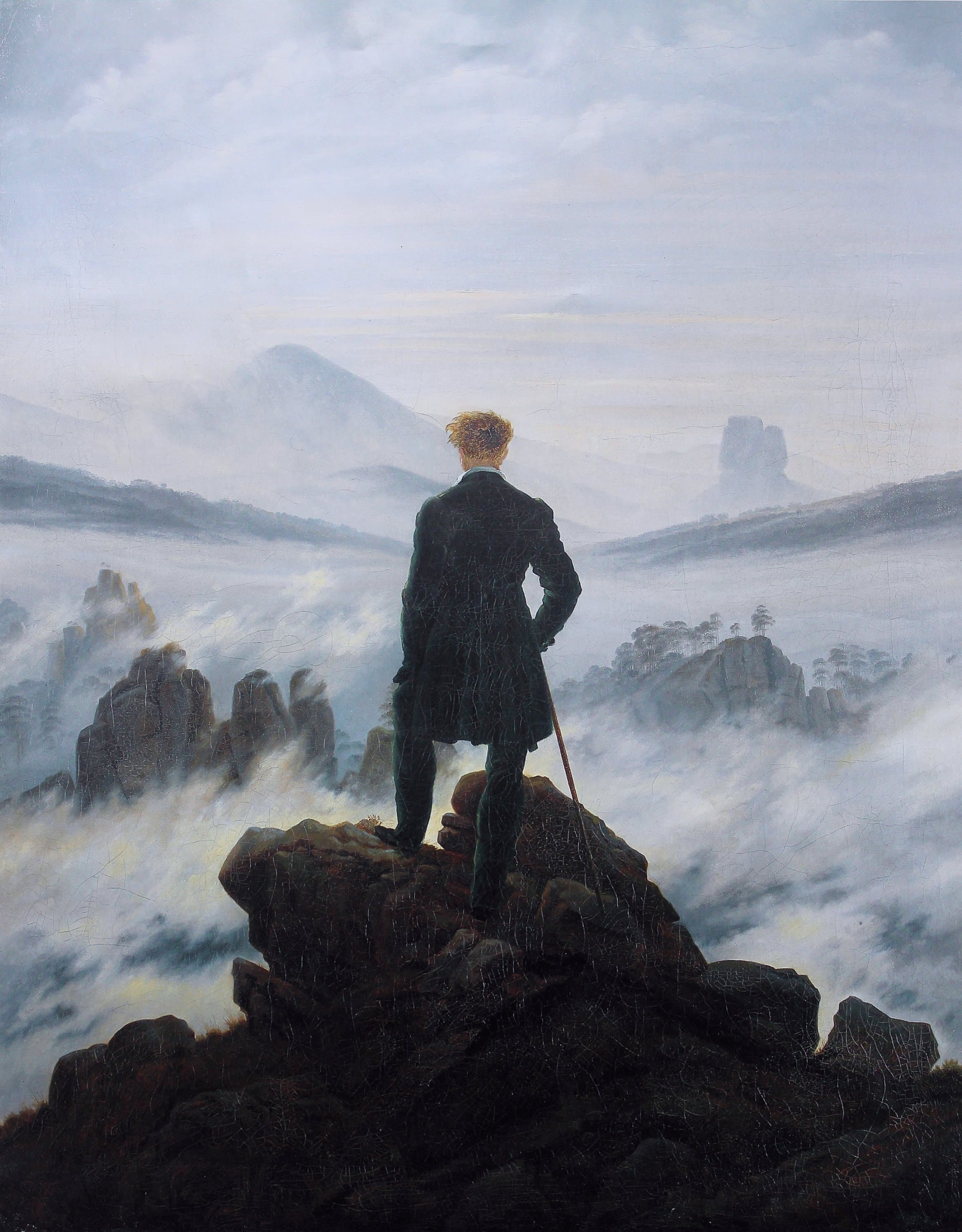
What has always disturbed me about this painting is the back. Friedrich does not give us a face to identify with, only a body halted on a ridge of broken stone, a dark green coat caught by the wind, a cane held as if it were both support and ritual. The man stands above the fog, but he does not conquer it. He stares into it. The painting is often treated as an anthem of Romantic individuality, the solitary self confronting the sublime. That reading is not wrong, but it is incomplete. What Friedrich paints here is not mastery over uncertainty. He paints the strange dignity of remaining before it.
The sea of fog is the first thing that captures the eye, but it is not really sea and not really emptiness. It covers the valleys while the mountain peaks puncture it like islands or thoughts that refuse to disappear. The world is there, but inaccessible. It exists in fragments. In that sense the painting feels less like an invitation to transcendence than a map of consciousness itself. We never encounter life as a totality. We encounter it in ridges, interruptions, glimpses, heights from which we still cannot see enough.
The wanderer is not placed in front of the landscape as a detached spectator. He is implicated in it. His boots are planted on jagged rock. His coat is folded by the same weather that shapes the cliffs. Even his upright stance has something precarious about it. He looks stable only because the painting arrests the moment before instability resumes. That is one reason the work has always felt so human to me. Most of what we call conviction is only a temporary posture taken on uncertain ground.
There is also a cruelty in the image. The man has climbed. He has done what one is supposed to do. He has reached the summit, or what feels like one, and still there is no revelation waiting for him. No horizon opens in full. No theology descends. No city appears below with its meaning intact. The reward for ascent is not clarity but a better view of obscurity. Friedrich understood something severe here: height does not abolish uncertainty. Sometimes it only makes uncertainty more beautiful.
That severity is part of why the painting has stayed with me. There are works that console by turning suffering into a lesson. This one does not. It does not promise that if one waits long enough the fog will clear. It does not even tell us whether the wanderer is hopeful, proud, exhausted, or lost. Friedrich withholds the face so that the painting cannot collapse into easy psychology. The scene remains ambiguous in exactly the way real life remains ambiguous. You stand there, carrying your history, and the world ahead of you does not explain itself.
This is why the painting belongs, for me, not to optimism but to lucidity. It resembles those periods when one has already left behind an old certainty and has not yet found another. A language falls away. A city stops recognizing you. A relationship ends, but not cleanly enough to become memory. One is suspended between forms. The fog in Friedrich is not only external weather; it is the medium of transition. The wanderer stands where an old ground has become visible only in fragments and a new one has not yet appeared.
I thought of this painting again while writing City. In both the poem and Friedrich's image, there is the same tension between motion and arrest. One keeps moving through streets, through thought, through history, but the mind remains fixed before some unresolved horizon. The achievement of "Wanderer above the Sea of Fog" is that it refuses to sentimentalize that condition. It does not turn uncertainty into branding for the adventurous soul. It presents uncertainty as a structure one must inhabit.
The cane, the coat, the rocks, the white immensity below: all of it gives the scene the gravity of a rite. But this rite has no priest and no conclusion. There is only a man with his back turned, standing above a world he cannot fully read. That, more than any heroic mythology of selfhood, is what makes the painting endure. It understands that consciousness is often nothing more glorious than this: remaining upright for a moment at the edge of what refuses to become clear.