Painting / EN
Berlin Street Scene
On the urban gaze, commodified visibility, and the violence of modern surfaces.
- Artist
- Ernst Ludwig Kirchner
- Country
- Germany
- Year
- 1913
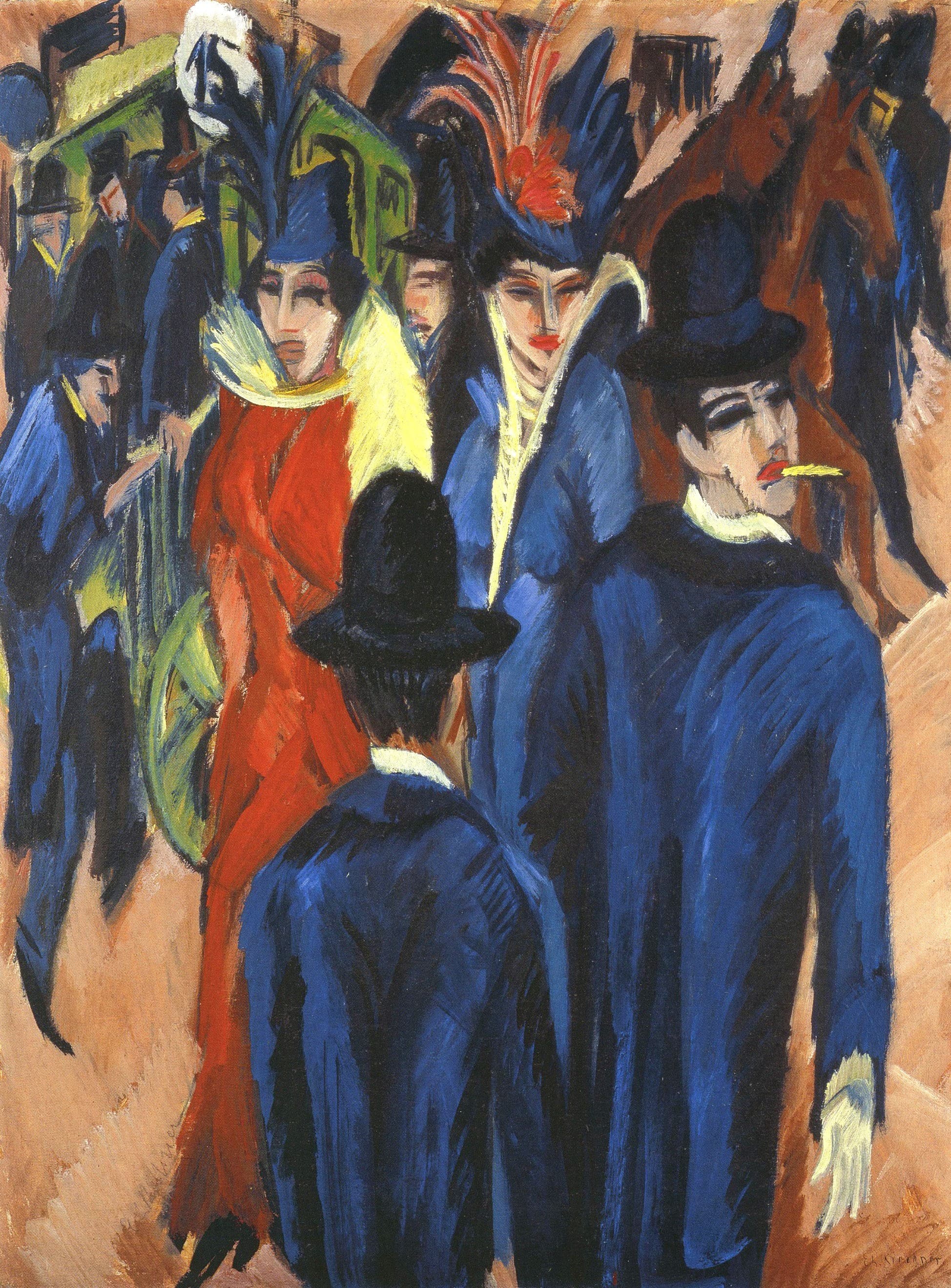
Kirchner's city does not welcome the eye. It cuts it. The two women in the foreground move through the painting like sharpened surfaces dressed in black, blue, and acidic pink, while the men around them seem less like companions than like a market of glances. The street is crowded, but crowd here does not mean community. It means exposure. Bodies pass one another under pressure, elongated into angular signs of themselves. Nobody in the painting appears sheltered from the gaze of everyone else.
That is why the painting feels so modern. Kirchner is not merely depicting urban life in the descriptive sense. He is painting what urban life does to perception when modernity becomes a regime of surfaces. Faces harden into masks. Bodies become silhouettes designed to be scanned quickly and judged more quickly still. The diagonal street does not guide you toward orientation; it accelerates disorientation. The entire composition vibrates with the anxiety of mutual visibility.
The color is essential to this violence. Kirchner does not use color to naturalize the scene. He uses it to estrange it. Flesh tones become greenish and unstable. Black clothing deepens into menace. Pink and blue no longer soothe; they flare. This is not a city rendered as atmosphere or civic pride. It is a city rendered as nervous intensity, where everything appears overlit and somehow unreadable at once. Even the elegance of the figures feels contaminated by unease.
I have often thought of this painting while walking through cities after some inner disturbance has made the ordinary world suddenly abrasive. In those states one notices how urban space compels performance. One adjusts posture, pace, expression, distance. One is never simply moving; one is being registered. Kirchner understood that the metropolis does not only offer anonymity. It also produces a relentless form of theatricality. You are free to disappear into the crowd, yes, but only by becoming one more surface within a field of surfaces.
This is why the painting speaks so closely to the themes I explored in City and later in The Stranger at the Feast. In both essays I kept returning to the idea that modern space often intensifies rather than dissolves estrangement. The city is full, but the fullness does not console. Kirchner's figures are near each other without becoming intimate. The street produces proximity and distance simultaneously. You are surrounded and still not held.
There is also a brutal lucidity in the way gender operates in the scene. The women dominate the foreground, but their prominence does not feel like sovereignty. It feels like exposure sharpened into style. They are spectacular and endangered at once, almost too composed for the environment they inhabit. The men around them do not form a coherent crowd; they form an atmosphere of evaluation. One senses money, transaction, desire, and boredom flowing through the same visual field. The modern city makes everyone visible, but not under equal terms.
What I admire in Kirchner is his refusal to sentimentalize alienation. He does not paint the city as tragic in a soft way. He paints it as abrasive, commercial, erotic, nervous, and thin-skinned. The brushwork does not smooth the world into melancholy. It leaves it jagged. That jaggedness is the truth of the painting. The metropolis is not simply a place where one loses oneself. It is a place where the self becomes too exposed to remain stable.
This is why Berlin Street Scene still feels contemporary. We still live inside economies of glances, attention, performance, and compressed judgment. The technologies have changed, but the basic psychic pressure is familiar. One moves through public space already half aware of how one appears, already negotiating how much surface to offer and how much inwardness to conceal. Kirchner saw that modernity would not only reorganize streets and commerce. It would reorganize the nerves.
So the painting stays with me as more than an image of Berlin in 1913. It is an image of what happens when visibility itself becomes a form of strain. The crowd closes in, the colors sharpen, the figures glide past one another with the stiffness of people who know they are being watched, and the city reveals its most intimate fact: not that it contains alienation, but that it manufactures it in public.