Painting / EN
Adele Bloch-Bauer I
On gold, assimilation, and the strange violence of being turned into ornament.
- Artist
- Gustav Klimt
- Country
- Austria
- Year
- 1907
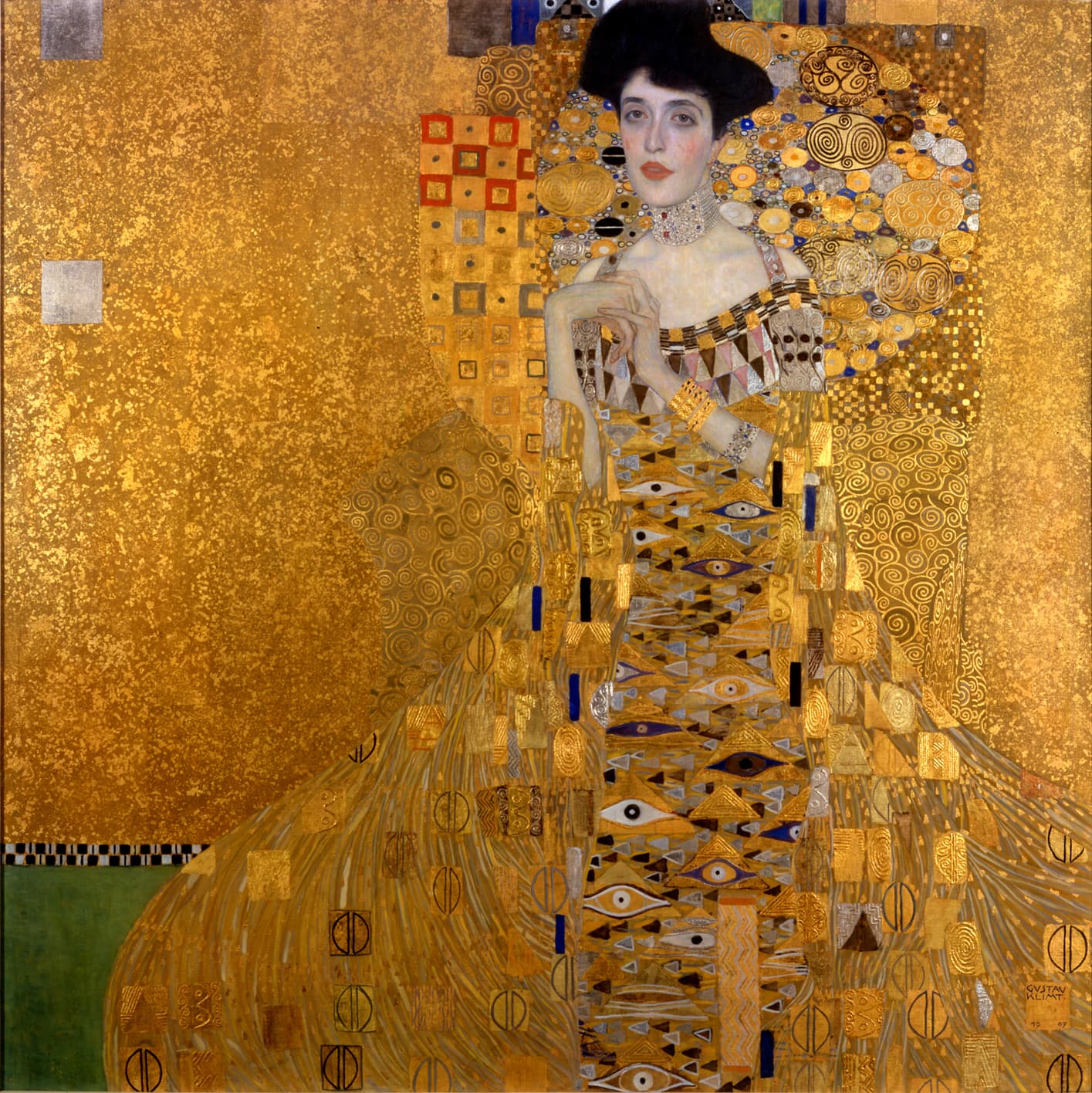
What first unsettles me in this painting is not the gold itself but the way Adele's face seems to emerge from it only provisionally, as if the ornament had almost succeeded in swallowing her whole. Klimt gives us a face, yes, and hands delicately clasped in front of her, but everything else trembles at the threshold between person and surface. The dress becomes mosaic. The chair disappears into pattern. Triangles, spirals, and eyes proliferate around her until the portrait begins to feel less like an image of a woman than a room designed to keep her visible and unreadable at the same time.
This is why I have never seen Adele Bloch-Bauer I as a straightforward celebration of luxury. The painting is too tense for that. The gold does not simply adorn her; it presses on her. Even her hands, one folded over the other with a slight awkwardness, feel less like a gesture of elegance than a bodily remainder, one of the last places where human vulnerability still resists the decorative program around it. Her face is pale, almost unguarded, and her eyes do not quite meet ours. She is the center of the image, yet she also seems displaced inside it.
Klimt borrowed the gold-leaf language of Byzantine icons, and that matters. Icons elevate, but they also formalize. They lift the body into sacred visibility while stripping away some of its ordinary contingency. Adele is not painted as a saint, of course, but she is subjected to a similar process of transfiguration. She is made precious by being made less available as a singular person. The result is magnificent and troubling at once. One can admire the brilliance of the surface and still feel that something intimate has been converted into style.
The painting becomes even more disturbing when one remembers who Adele Bloch-Bauer was and what Vienna was becoming. She was a Jewish woman thoroughly inside Viennese high culture, wealthy, cultivated, socially central, exactly the kind of person an assimilated empire liked to imagine it could absorb. Yet history would reveal the fragility of that belonging with extraordinary cruelty. After the Anschluss, the Nazis seized the portrait, and over time Adele's identity was blurred beneath the more neutral, glittering label Woman in Gold. It is difficult to imagine a more exact form of symbolic violence: the Jewish woman kept, displayed, admired, and renamed until she became a color.
That is why the gold in this painting does not read to me as simple splendor. It reads as the surface price of admission. To belong to a world that was never fully designed for you often means becoming legible in the forms that world already knows how to admire. You are welcomed, but conditionally. You may enter, but not in the density of your difference. You become elegant, acceptable, polished, translated. You become easier to display than to understand.
I have written at length about that feeling in The Stranger at the Feast, because Klimt's portrait is, for me, one of the clearest images of partial belonging ever painted. Adele is present beyond dispute, but her presence is overdetermined by the frame built around her. She is too visible not to be seen, and too ornamented to be encountered plainly. The painting captures that peculiar modern condition in which the subject is not excluded from the room but absorbed into it under terms that threaten to erase what made her singular in the first place.
The longer I look at the portrait, the more I distrust the usual opposition between adornment and imprisonment. Klimt's gold is both. It gives the work its radiance, but it also produces its claustrophobia. The beauty is real. So is the entombment. This is what makes the painting stronger than moral denunciation or simple praise. It does not ask us to choose between fascination and suspicion. It compels both.
And yet the painting does not entirely surrender Adele to the system that surrounds her. The face remains. The hands remain. The slight asymmetry of the body remains. These details matter because they are where the portrait resists becoming pure ornament. Beneath the gold there is still someone not fully reducible to what the world wanted from her. Perhaps that is the quiet force of the painting. It shows how surface can almost consume a person without ever completely finishing the job.
So I return to the portrait less for its opulence than for its tension. It understands that beauty can be a mode of pressure, that admiration can conceal erasure, and that belonging often arrives gilded. Adele sits in the middle of all that glitter, neither simply enthroned nor simply trapped, and that ambiguity is precisely what makes the painting endure. Klimt did not just paint a woman in gold. He painted the strange cruelty of becoming precious on terms you did not choose.