Painting / EN
Unexpected Visitors
On return, recognition, and the unbearable pause between appearance and acceptance.
- Artist
- Ilya Repin
- Country
- Ukraine
- Year
- 1888
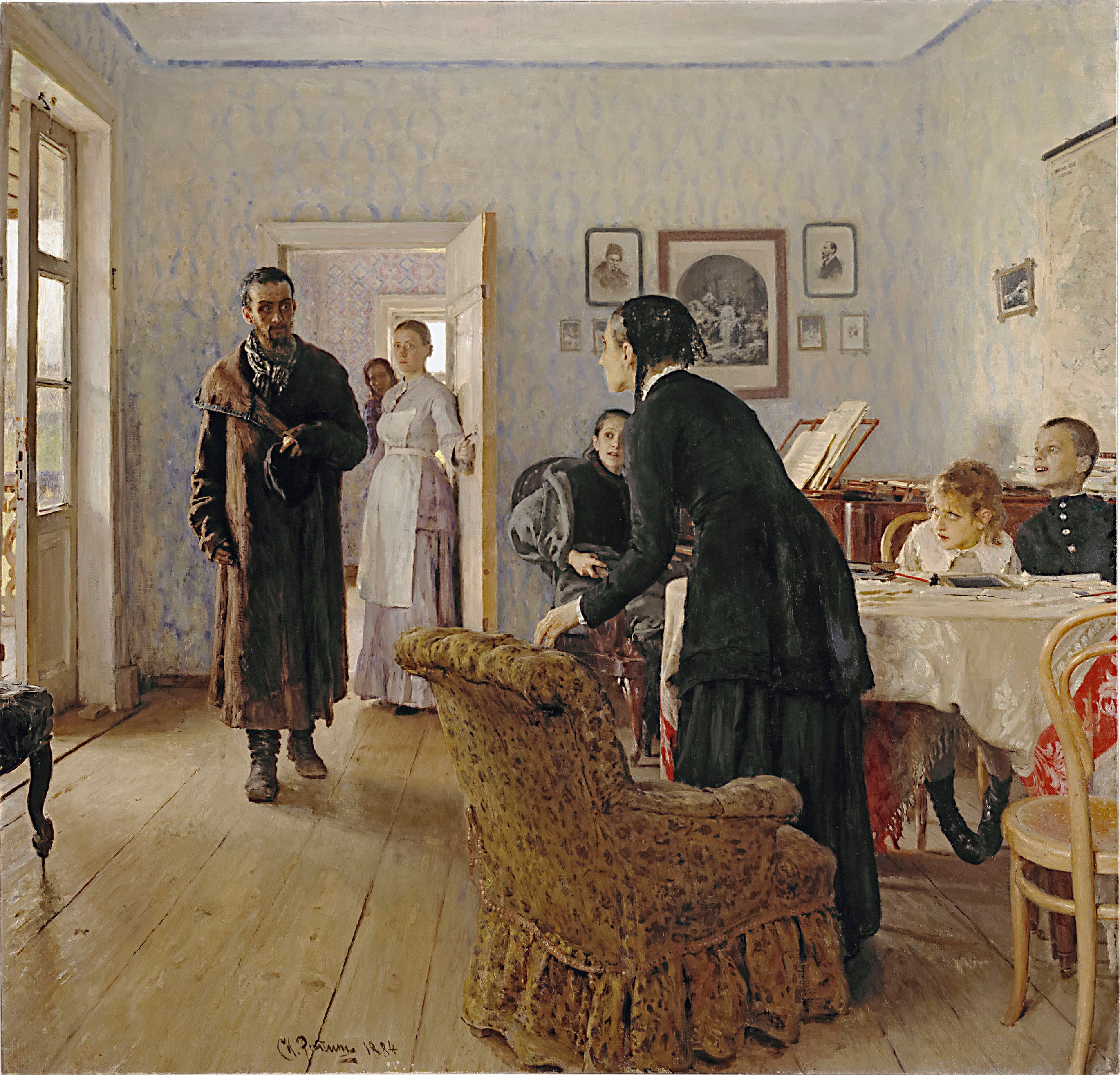
The entire drama of Repin's painting is contained in a threshold. A man stands in the doorway, still carrying the atmosphere of the outside world on his coat and posture, while the room into which he has entered has not yet decided what to do with him. That delay is everything. No one in the scene is fully still, yet nothing has quite moved into its new form. A chair has been pushed back. A figure begins to rise. A child looks on. Recognition is happening, but it has not yet completed itself. Repin paints not the reunion, but the suspended second before reunion becomes real.
This is what makes the work so piercing. Many paintings can show grief, joy, or surprise once those emotions have become visible and undeniable. Repin is interested in a narrower and more painful interval: the moment when the past suddenly steps back into a room that has already reorganized itself around its absence. The returning figure is not yet reabsorbed into the domestic world before him. He interrupts it. He appears almost like a question addressed to everyone present: do you still know me, and if you do, what happens now?
Repin's genius lies in making the room itself participate in the emotional tension. Light enters quietly, but nothing in the image feels calm. The domestic interior is orderly, almost modestly secure, and that order is exactly what the returning body disturbs. Every figure responds differently. One senses hope, fear, uncertainty, disbelief, perhaps even the old resentment that any return can awaken. Because the painting refuses to settle too quickly into sentiment, it feels more human than many theatrical reunions. Love does not erase time. Return does not restore innocence. Recognition arrives carrying all the years that have made it difficult.
This is why I find the painting so moving. It understands that absence is not neutral. It reshapes the people who remain. A home adjusts itself to a loss even when no one speaks of that adjustment aloud. Roles harden. Habits form around the empty place. Then one day the missing figure appears again, and the room must confront not only the person who has come back, but the form of life built in his absence. The shock is not merely emotional. It is structural.
That structural shock gives the work a political and psychic depth at once. Even without narrating the full story outside the frame, Repin makes return feel like a disturbance in historical time. The man at the door is not simply a guest. He is someone whose arrival carries consequences, memory, unfinished judgment. He brings with him the outside world, the world of distance, suffering, ideology, punishment, or survival. The interior cannot remain purely domestic once he appears. History has crossed the threshold.
I think that is why the painting belongs, in its own way, to the same emotional universe as many of the writers and artists I return to. Dostoevsky understood that encounters are often unbearable not because nothing is felt, but because too much is felt at once. Repin stages that overload without turning it into noise. The silence in this painting is almost unbearable. One imagines no one speaking immediately. The body knows first. The chair shifts. The eyes widen. The room draws breath.
There is also something profoundly ethical in the image. Repin does not reduce the scene to the triumph of the returning man. He allows the others their hesitation. This matters. Return is often narrated from the perspective of the one who has suffered outside. But the ones inside have also lived through time, fear, adaptation, perhaps compromise. Their uncertainty is not necessarily betrayal. It is the mark of reality. To welcome someone back is not to erase what his absence has done to you.
That is why Unexpected Visitors remains with me longer than more obvious dramatic paintings. It captures a truth most people know in some form: there are moments when life does not change gradually but enters the room all at once. A door opens. Someone appears. The familiar becomes impossible to inhabit in the old way. And for one suspended, luminous second, everyone present must stand before a question no one is ready to answer. Repin gives that second its full gravity. He lets return remain difficult, and because he does, he lets it remain true.