Painting / EN
Black Suprematic Square and the Intrusive Thoughts
A Deep Dive into the Abyss of Despair
- Artist
- Kazimir Malevich
- Country
- Ukraine
- Year
- 1915
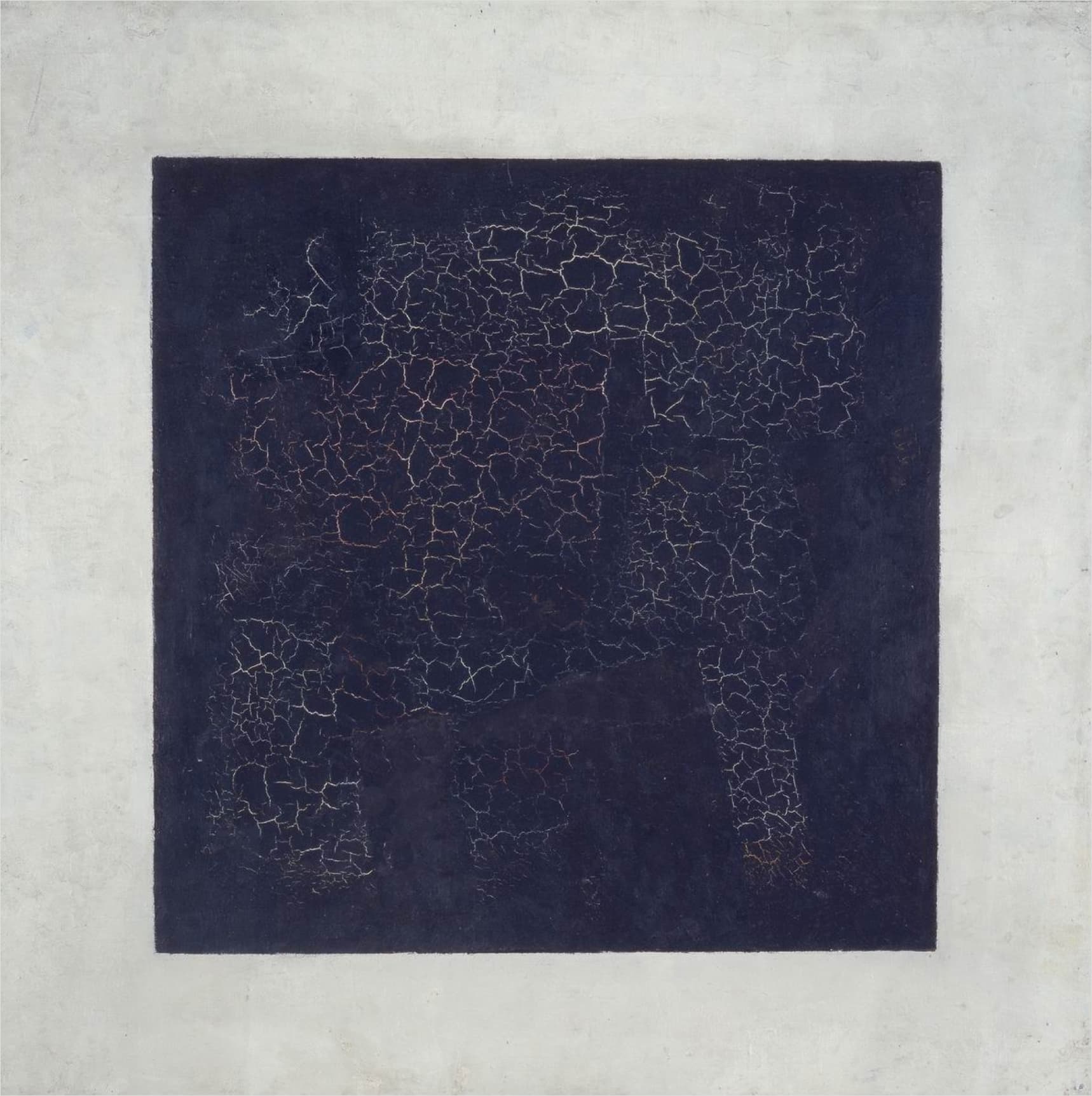
At first glance Malevich's "Black Square" seems almost too simple to deserve the fear it inspires. A dark form on a pale ground, slightly tilted, stripped of narrative, stripped of body, stripped even of the dignity of perfect geometry. But the longer I look at it, the less it resembles emptiness and the more it resembles a command. The square does not show us an object. It interrupts the need for objects. It cuts representation short and leaves the viewer alone with a surface that refuses to become image.
That is why I have never experienced this painting as a pure void. A void can still be romantic. It can still be imagined as freedom, silence, the sublime night into which one dissolves. Malevich gives us something harsher. The black shape presses forward like a sealed door or a wound that has scabbed over without healing. The white field around it is not clean serenity either. It is uneven, dirty, already troubled. Even the square itself is not really a square. Its sides wobble. Its borders tremble. The painting denies perfection at the same time that it denies the world of recognizable things.
This is one reason the painting feels so close to intrusive thought. An intrusive thought is rarely profound in content. Very often its force comes from repetition, starkness, and refusal. It arrives like a black form dropped into the field of consciousness. It does not persuade; it occupies. It flattens nuance. It turns the mind into a white room in which one shape keeps insisting on itself. Malevich did not paint psychology in any ordinary sense, but he painted a structure that psychology knows very well: the violence of reduction.
There is also the famous historical context. Malevich first exhibited the work in the icon corner, the place in a Russian home where a sacred image would traditionally hang. That gesture matters. The "Black Square" is not just abstraction. It is a secular icon, and perhaps a hostile one. Instead of the face of Christ, instead of a saint or a mother, there is a block that offers no reciprocity. It does not bless. It does not witness. It does not return the gaze. If older icons promised a world ordered by presence, this new icon announces a world in which transcendence has withdrawn and left behind only the formal shell of devotion.
That placement in the icon corner is what prevents me from reducing the painting to private despair. The work is historical as much as psychic. It emerges from a moment when the old religious and representational guarantees were collapsing, and with them the confidence that art had to imitate the world in order to matter. The square is therefore both inner and civilizational. It stages a crisis of vision. What happens when the inherited image no longer holds? What comes after the sacred face has been replaced by an opaque form?
Perhaps this is why the painting has always felt more honest to me than many therapeutic slogans about dark thoughts. It does not pretend that the mind can simply decorate its suffering into meaning. It offers no anecdote, no moral, no sentimental resolution. It only gives us the fact of obstruction. A shape has appeared. It holds the eye. It absorbs the desire to move elsewhere. That is often how despair begins: not with drama, but with the shrinking of the visible.
I thought about this often while writing The Gambler and the Black Square. Addiction and obsession do not only bind us to pleasure; they bind us to narrowness. The world loses depth. Everything becomes organized around one black necessity, one fixation that eclipses the surrounding field. Malevich's painting captures that eclipse without needing a roulette table, a body, or a confession. It shows what happens when life is reduced to a single insistent form.
Yet the painting is not defeated by that reduction. The cracked surface matters. Time has passed across it. The black is not absolute. The white has not disappeared. Seen closely, the work is full of wear, fragility, and material disturbance. Even this most severe image cannot escape history or matter. That is its final truth, and perhaps its only mercy. What looks from afar like perfect negation reveals, up close, the fact that negation itself is never pure. The square remains, but it remains as an unstable icon, a damaged command, a darkness that cannot quite succeed in becoming total.