Painting / EN
The Triumph of Death
Bruegel's terror lies not in massacre alone, but in the abolition of any possible outside.
- Artist
- Pieter Bruegel the Elder
- Country
- Netherlands
- Year
- 1562
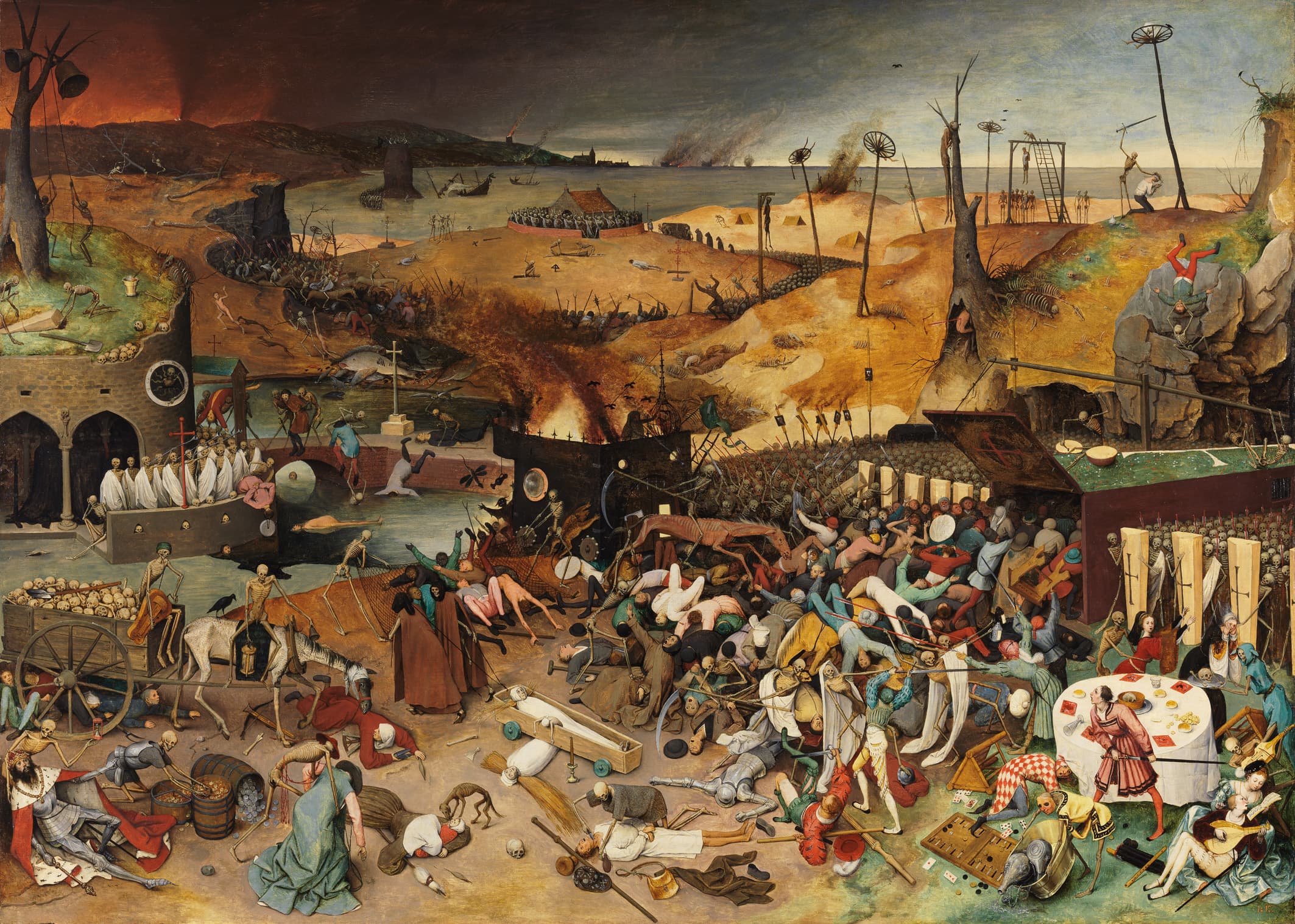
Pieter Bruegel's The Triumph of Death is terrifying not because it shows killing everywhere, but because it abolishes the idea that there could be an elsewhere. This is not a single battle, not a local plague, not even an apocalypse arriving from beyond the horizon. Death has already occupied the whole field.
Across the painting the world has been turned into administration. Ships burn on the water in the distance. Gallows and execution wheels stand on the hills as if they were part of the landscape. A black wagon rolls through the center like a moving coffin while skeletons herd the living toward its mouth. At the lower right, a banquet table remains laid out even as bodies fall beside it. Nearby, the lovers continue with their lute, as if music might delay what every other figure has already learned.
Even the king is not exempt. Gold spills from an open chest while a skeleton presents him with an hourglass. The money is still there; its power is gone. This is one of Bruegel's cruelest insights. He does not merely say that death comes for everyone. He stages the moment when every distinction - wealth, rank, appetite, military force, piety - is revealed as theatrically fragile.
The painting is overcrowded, yet the dominant emotion is not noise but system. Paths funnel bodies toward the same end. Fire answers fire across the horizon. The earth itself seems cleared of refuge. That is why the lovers matter so much. Their song does not stop death, but it reveals the last human temptation: to continue with gesture, appetite, flirtation, rhythm, as if the catastrophe were still happening somewhere else.
When I first stood before it at the Prado, what stayed with me was not the skeleton army but the absence of outside. Bruegel denies the spectator moral distance. You are not invited to judge the scene from safety. You are asked to recognize a world in which every institution has already failed: the feast, the army, the market, the crown.
That is why this painting keeps returning in my writing, especially near The Metamorphosis of Parsifal through "The Triumph of Death". It is not simply about mortality. It is about totality. Death triumphs here not because it is stronger than life in the abstract, but because it has learned to pass through every form life uses to defend itself.
The most unsettling image is not the skeleton. It is the couple still playing.