Painting / EN
The Demon Seated
Vrubel's Demon is less a monster than a figure of compressed exile and self-containment.
- Artist
- Mikhail Aleksandrovich Vrubel
- Country
- Russia
- Year
- 1890
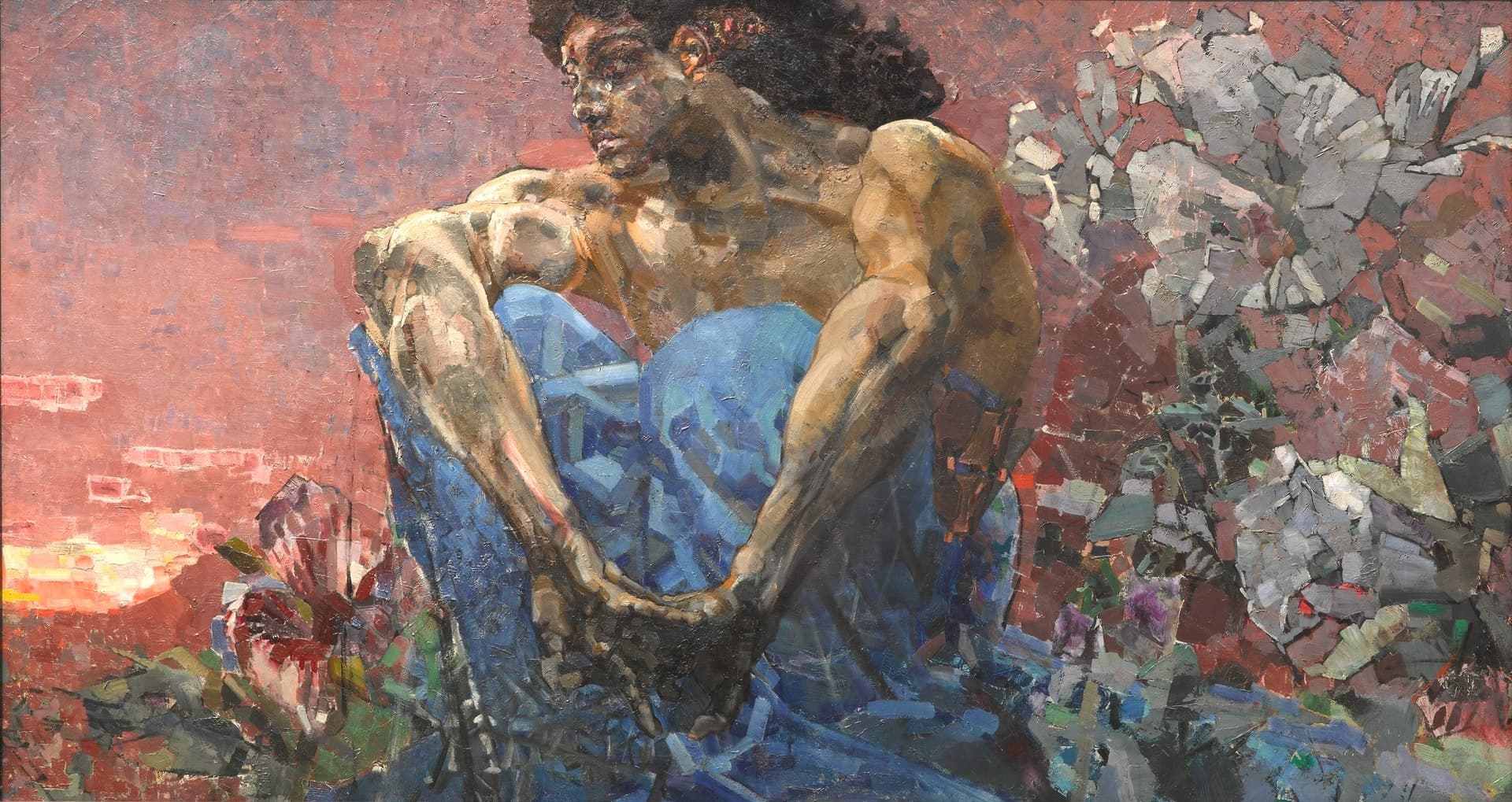
What makes Vrubel's The Demon Seated unbearable is not menace but compression. He looks too large for the ledge on which he sits, too heavy for his own posture, too inwardly burdened to occupy the world around him without bruising it.
The body is folded almost impossibly tight. Blue knees are drawn up toward the chest. Massive forearms descend in a curve toward hands locked around the feet. The pose suggests self-embrace, but not comfort. It looks like the effort required to keep from breaking apart. Around him the flowers have the faceted, crystalline quality Vrubel gives to matter when he wants beauty to feel dangerous. Behind him the sky glows in exhausted pinks and reds, as if evening itself had become mineral.
This is why the painting matters to me more than most "demonic" images in art. Vrubel's Demon is not staging evil. He is staging exile. The figure does not attack, tempt, or conquer. He sits. He endures. He carries a beauty that has already become burden.
The head turns away from the viewer, giving the impression that even the gaze has withdrawn. The Demon is in the frame but not available to it. That refusal creates the real tension of the picture. He is present and inaccessible at once.
I wrote at greater length about this figure in The Demon and the Melancholic. But even without the larger theoretical frame, the painting says something precise about inner life: melancholy is often posture before it becomes concept. A body curls around itself because the world no longer feels proportionate to what it carries.
Vrubel understood that stillness can be more violent than action. The hands closed around the feet do not resolve the figure. They only mark the point where containment becomes visible. The Demon is not saved by folding inward. He is simply held together for one more evening.