Essay / EN
Dancing to the Tune of Distraction
A Senate session collapses into theater, and the theater reveals what institutional politics has become.
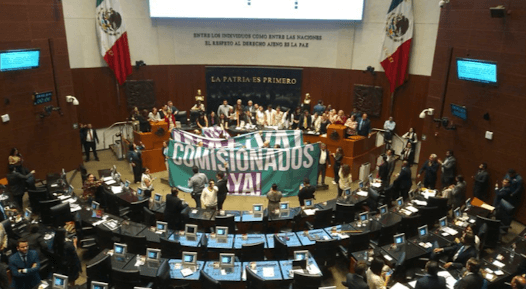
The image from that Senate session is difficult to forget: banners stretched across the rostrum, legislators occupying the chamber as if the institution had to be physically blocked in order to become visible, and the business of the republic suspended while everyone claimed to be defending it. At the center of the conflict was the appointment of an INAI commissioner, something technical enough to bore most people and important enough to reveal the entire structure of our public life. The scene looked disorderly, but it was in fact too orderly in another sense. Everyone knew their role. The opposition would convert paralysis into moral theater. Morena would convert ambiguity into plausible deniability. The institution itself would become a prop in a conflict where performance had already replaced trust.
The details matter. The Senate was expected to discuss the appointment of Ricardo Salgado Perrilliat, a technically capable candidate for one of the open seats at the National Institute for Transparency, Access to Information and Personal Data Protection. INAI was already weakened by vacancies, and the session took place on the edge of a four-month recess. Filling even one position mattered. Morena, after appearing willing to support the nomination, voted against it. The opposition responded by occupying the floor and halting the session. Twenty other issues were left in limbo. Each side then accused the other of irresponsibility, as if the entire structure did not depend on exactly this reciprocal accusation.
What interests me is not simply that politicians behave theatrically. Politics has always contained theater. The deeper problem is that theater has ceased to be a means and has become the substance itself. The modern institution survives only by constantly staging its own legitimacy. Transparency is defended through obstruction. Governance is asserted through procedural sabotage. Serious language remains in place, but its content has thinned out. What persists is the image of seriousness: the banner, the denunciation, the recess, the declaration that one is defending the rule of law by making the ordinary operation of the law impossible.
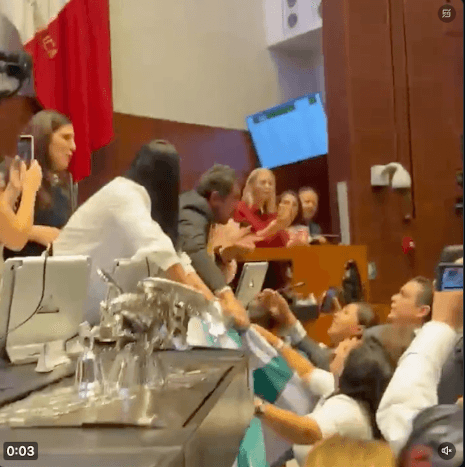
It would be convenient to tell this story as one of childish opposition senators ruining the work of state. But that would be too easy, and it would let Morena escape the structure it also inhabits. A party that negotiates, retreats, improvises, and weaponizes uncertainty cannot then present itself as the guardian of pure institutional order. The opposition's occupation of the Senate floor was not an alien interruption of politics. It was the visible continuation of a style of politics already normalized from above, one in which institutions are defended rhetorically while being emptied strategically.
This is why the event felt so familiar. We no longer expect institutional actors to solve crises cleanly. We expect them to convert crises into scenes. The camera is part of the chamber now. Every gesture anticipates circulation. To hold a banner is not only to make a demand; it is to produce an image that will live online detached from the tedious complexity of legislative procedure. To accuse the other side of hypocrisy is not only to make a claim; it is to feed the moral economy of outrage in which contemporary politics now breathes. The institution does not disappear under this logic. It remains standing, but as a stage set.
The tragedy of this particular case is that transparency itself became one more instrument in a struggle over symbolic possession. INAI should matter because access to information limits arbitrary power, because institutions that protect public scrutiny are fragile, because opacity always serves someone. Instead, the vacancy crisis became another occasion for both sides to prove something about themselves. The opposition wanted to display moral commitment through refusal. Morena wanted room to maneuver without bearing the full cost of that maneuver in public. Meanwhile the actual problem remained what it had been from the start: an institution weakened by political calculation.
There is also an enjoyment in this kind of paralysis that should not be ignored. One sees it whenever political actors prefer the purity of grievance to the dirtier labor of resolution. To solve the problem would deprive them of the posture that the problem makes possible. The blocked appointment, the occupied floor, the suspended session: all of these become sources of identity. One side becomes the side of betrayed legality, the other the side of strategic patience. The citizen, meanwhile, is asked to choose which performance of concern looks more credible.
This is not a uniquely Mexican pathology, but it is certainly one of the forms our democratic exhaustion now takes. Public life becomes harder to inhabit when every institution is simultaneously indispensable and instrumentalized, defended in principle and degraded in practice. The result is cynicism, but not only cynicism. It is also fatigue. Citizens are made to watch an endless sequence of scenes in which everyone invokes accountability while very few are accountable to anything beyond factional advantage.
What remains from that day is not only the image of senators confronting one another under banners. It is the image of an institution caught between necessity and performance, still functioning enough to command attention and hollow enough to require constant theatrical rescue. The Senate floor was occupied, the session recessed, the accusations multiplied, and the vacancy remained what it had been before the shouting began: a concrete problem buried beneath a more photogenic spectacle. That is the real scandal. Not that politics looked theatrical for a moment, but that theater has become the most reliable way politics now proves to itself that it still exists.
Filed under
Keep reading