Painting / EN
The Fortune Teller
A masterwork of Baroque realism depicting the seductive art of divination — a young Romani woman reads a nobleman's palm while subtly slipping his ring, transforming fortune telling into a metaphor for the illusionistic power of painting itself.
- Artist
- Michelangelo Merisi da Caravaggio
- Country
- Italy
- Year
- 1594
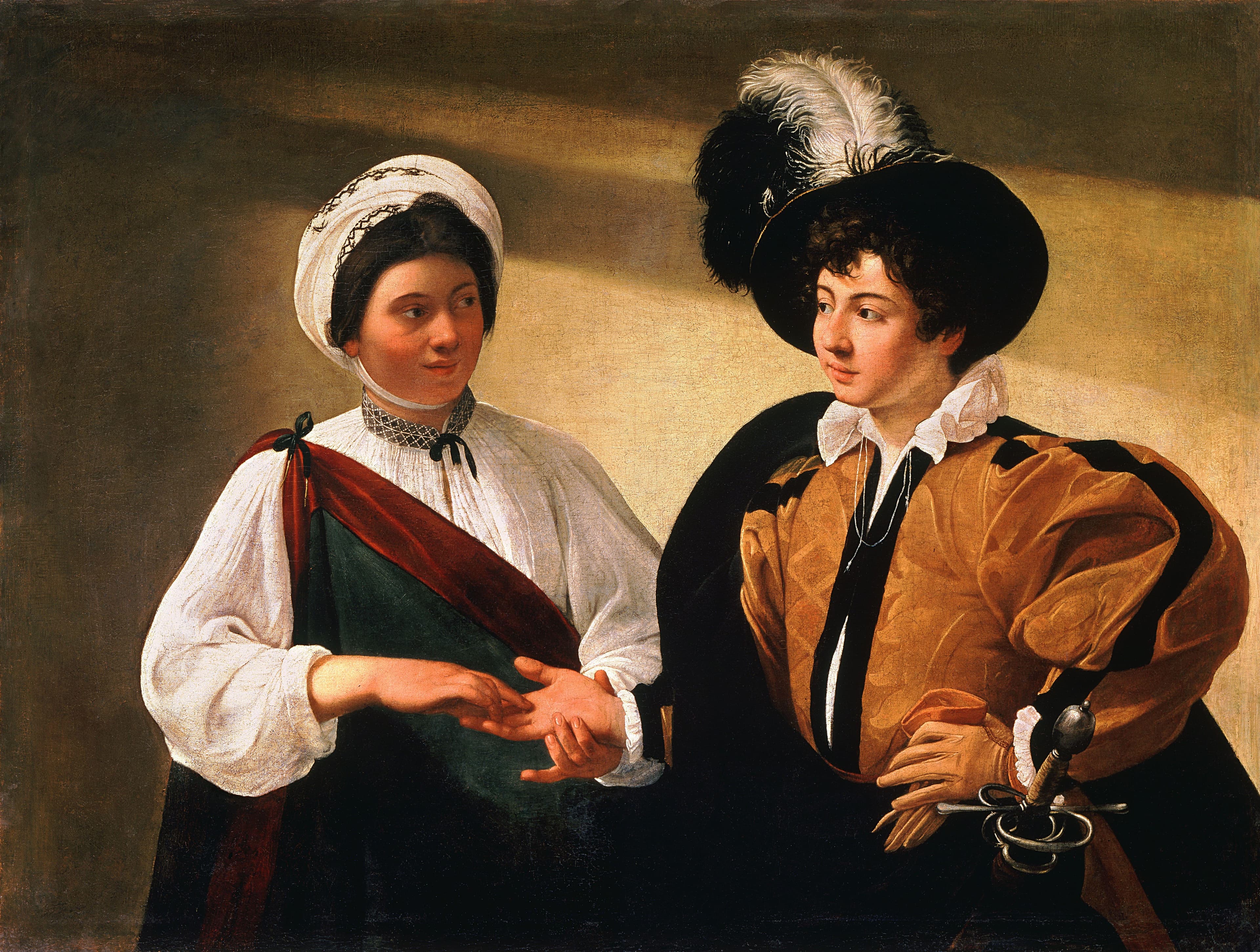
Caravaggio's The Fortune Teller is one of those paintings that teaches you how to look by humiliating you a little first. At a glance, the scene seems legible: a young nobleman offers his hand to a Romani fortune teller, she studies his palm, and the whole thing looks like an elegant genre scene from Rome. Then you notice the real action. Her fingers are sliding his ring from his hand while he is busy trying to hear his future.
That is the painting's governing cruelty: the young man thinks he is receiving hidden knowledge, but he is actually being relieved of property. Revelation and theft occur in the same gesture.
I do not think Caravaggio paints this simply to mock gullibility. The young man is vain, yes. His feathers, gloves, and polished confidence make him an easy mark. But the painting understands something harsher than vanity. It understands how badly people want a sign. They will offer their hands, their money, their dignity, even their attention, if someone promises to tell them what lies just beyond the veil. The fortune teller steals the ring because he has already surrendered the more valuable thing: his judgment.
What makes the painting so brilliant is that Caravaggio refuses melodrama. There is no exaggerated wink to the viewer. No villainous grin. No moral caption. The theft happens inside touch so delicate it could almost be tenderness. Her left hand cradles his palm. Her right hand loosens the ring. The whole deception depends on grace.
That grace is why the painting matters to me. Deception is rarely effective when it looks brutal. It works because it borrows the texture of care. The mark wants not only to know the future but to feel seen while hearing it. And the fortune teller gives him exactly that. She looks at him with an expression so careful that even now, centuries later, it is hard to decide whether she is merely performing insight or actually touched by something in him. Caravaggio leaves that ambiguity intact, and that is what prevents the scene from collapsing into satire.
The painting also stages a class encounter, and not a neutral one. The young aristocrat assumes the world is available to him as experience. The fortune teller, by contrast, must work through performance, reading, tactility, and speed. He comes to play with mystery. She comes to survive. One of them can afford to be fascinated. The other cannot afford slowness.
This, too, feels very Caravaggio. He painted saints like beggars and beggars like saints because he did not trust the official distribution of dignity. The Fortune Teller belongs to his early Roman period, when he was still painting from people he found on the street and scandalizing viewers who expected classical idealization. He preferred bodies with dirt still on them, faces with trade already inscribed in them. What offends polite taste in Caravaggio is precisely what gives him moral force: he insists that revelation, fraud, hunger, beauty, and performance all happen in the same social world and often in the same body.
I keep thinking about the hands. The whole painting lives there. Not in prophecy, but in contact. The palm is open. The fingers are occupied. The ring is leaving. There is something almost psychoanalytic about that structure. The visible story distracts from the actual transaction. The subject tells one story about why he came; something else is already being taken from him under cover of attention. That is how many of our most intimate deceptions work. We are not robbed in spite of wanting meaning. We are robbed through that want.
And yet the painting resists easy moral superiority. We are not outside the young man's error. We repeat it every time we mistake the performance of insight for insight itself, every time we become so eager for interpretation that we fail to notice what the scene is costing us. Caravaggio understood that spectatorship itself can be a form of vulnerability. The viewer approaches the image wanting to decode it and only then realizes he has entered the same structure as the boy: fascinated, absorbed, slightly behind the real event.
Maybe that is why the painting feels so modern. Not because people still believe in fortune tellers in the exact same way, but because the basic arrangement has survived. Promise revelation. Provide intimacy. Extract value. Repeat.
The fortune teller steals a ring, yes. But Caravaggio steals something else from the viewer: the comfort of thinking deception always arrives wearing an obvious face.
It usually arrives looking attentive.
And that, I think, is why the young man never had a chance.