Painting / EN
Man, Controller of the Universe and the Art of Resistance
On Muralism, Marxism, and the Painting That Was Destroyed and Reborn
- Artist
- Diego Rivera
- Country
- Mexico
- Year
- 1934
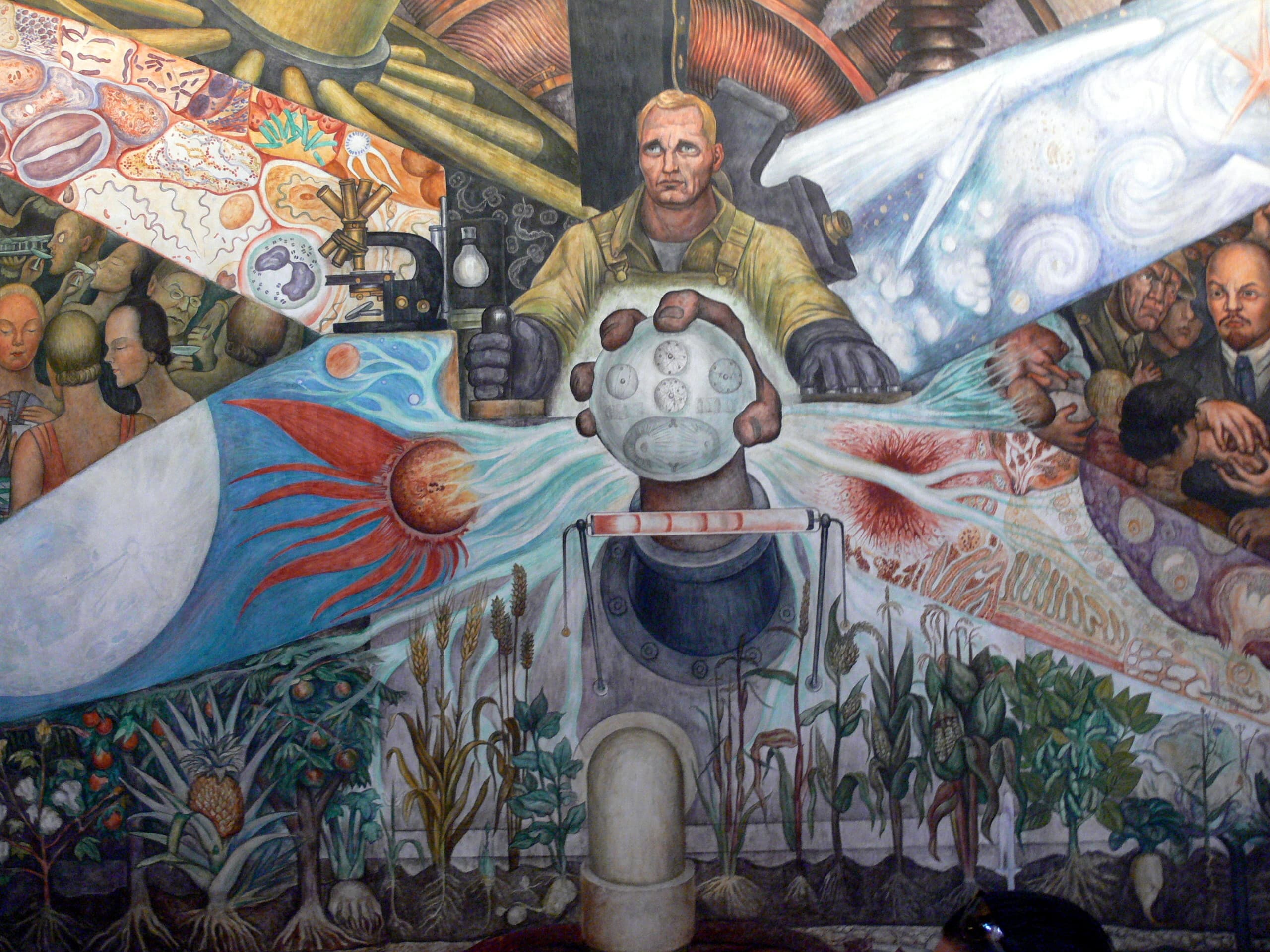
There are paintings that ask to be contemplated and murals that ask to be entered. Rivera's "Man, Controller of the Universe" belongs to the second category. Even in reproduction one feels its centrifugal force: the central worker gripping the controls of a machine, the giant elliptical lenses opening onto microscopic life and planetary motion, the opposing social orders unfolding to either side as if history itself had been cut open for inspection. Rivera does not paint neutrality. He paints the world as a conflict of systems and places labor at the center of the apparatus.
The history of the mural is already famous and still worth dwelling on. Rockefeller wanted a hopeful image for 30 Rockefeller Plaza. Rivera, who had never disguised his politics, accepted the commission and produced exactly what a Marxist muralist would produce if asked to paint the future: a world split by class antagonism, science placed at the service of collective life, and Lenin appearing not as a decorative scandal but as a principle of historical alignment. When Rockefeller demanded that Lenin be removed, Rivera refused. The mural was covered and eventually destroyed. Rivera then repainted it in Mexico City under its new title, turning censorship into one of the work's constitutive meanings.
What interests me most in the painting itself is not simply its ideological clarity but its spatial intelligence. The worker at the center is not portrayed as a romantic hero gazing into the distance. He is seated, focused, hands at the controls, almost swallowed by the machine he operates. Behind him, intersecting arcs and magnified cells suggest both modern science and the scale of forces that exceed any one individual. Rivera's wager is that human beings do not become free by escaping machinery, history, or matter. They become free by taking hold of them collectively.
To one side Rivera stages the grotesque theater of capitalist decadence: wealthy figures at leisure, soldiers and police enforcing order, the spectacle of privilege sustained by violence and disease. To the other he offers a competing image of solidarity: workers organized, May Day banners raised, Lenin joining hands across racial and national divisions. One can object, of course, that the mural is partisan. But that objection misses the point. Rivera is not pretending to stand above ideology. He is exposing the false innocence of the spaces that claim to be above it. Rockefeller's lobby was already ideological. It only became scandalized when that ideology was made visible.
That is what makes the destruction of the original mural so revealing. A capitalist patron commissioned public art and then discovered that public art might actually speak. The issue was never simply taste. It was power over visibility. Rivera understood that the ruling class will tolerate dissent more easily when dissent remains framed as culture, contained in museums, or admired as personality. What it cannot easily tolerate is a wall in the center of everyday circulation that reorganizes perception against it. A mural in a lobby is different from a painting in a salon because a mural occupies common space. It intercepts routine. It turns architecture into argument.
This is why Rivera matters so much in Mexico, and why he matters to me. He painted for publics, not for collectors alone. Even when one disagrees with his certainty, one has to respect the scale of his ambition. He believed that painting could still participate in the formation of historical consciousness. In Bellas Artes the remade mural stands not as a nostalgic replica but as proof that suppression does not always end a work. Sometimes it clarifies the work's truth. Rivera painted Marxism in Rockefeller Center and the building rejected it. He painted it again in Mexico and the mural remained, not purified of conflict but charged by it.
The title is crucial: "Man, Controller of the Universe." It sounds grandiose until one notices that the man in question is not a titan or billionaire but a worker in overalls, surrounded by instruments, matter, crowds, and antagonisms. The title is not about individual domination. It is about the question of who will direct the forces already directing us. Finance capital had one answer. Rivera had another. The mural endures because it refuses to hide that choice behind the language of progress. It leaves us with a worker still at the controls, history still divided on either side, and a public wall that remembers exactly who was afraid of letting that image remain visible.