Painting / EN
Liberty Leading the People and the Revolutionary Tradition
On Revolution, Class, and the People Who Take to the Streets
- Artist
- Eugène Delacroix
- Country
- France
- Year
- 1830
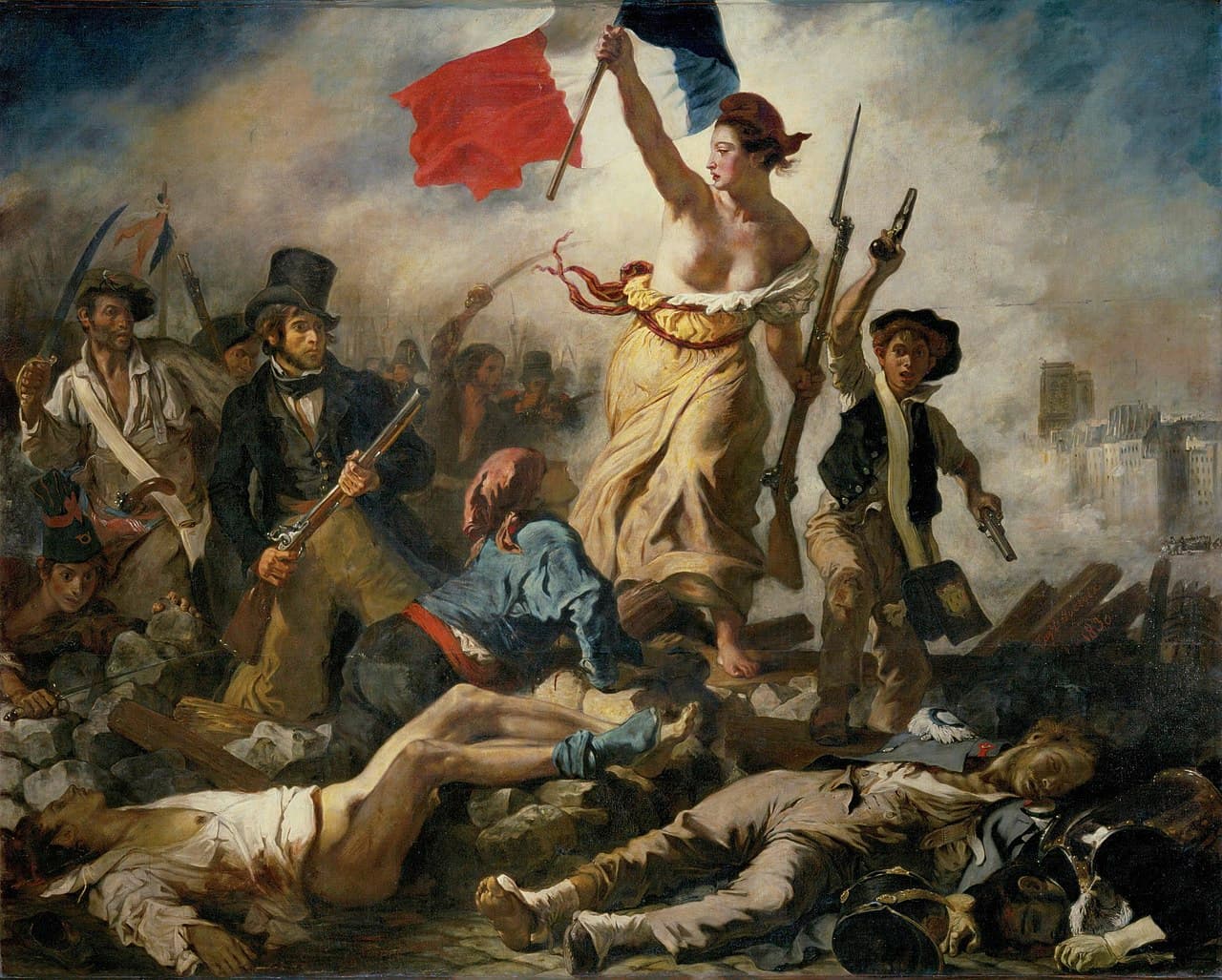
The first thing Delacroix asks us to accept is that liberty does not arrive clean. She climbs over bodies. Marianne, barefoot, bare-breasted, and smoke-stained, lifts the tricolor and advances across a barricade made of corpses, splintered wood, and debris. Around her surge men from different classes and different histories: the boy with pistols raised above his shoulders, the worker with his blouse and saber, the man in the top hat who looks half like a bourgeois spectator and half like a participant surprised by his own involvement. The painting is famous because it is dramatic, but what makes it endure is something colder. It understands that revolution is not purity. It is an unstable coalition moving through death.
That instability is the real subject of the canvas. Marianne may be an allegory, but the social types around her are concrete. Delacroix gives us not an abstract people but a temporary composition of the people. The child, the worker, the armed citizen, the dead half-naked men in the foreground, all occupy the same frame without dissolving into a harmonious whole. They are together, but they are not identical. This is exactly what makes the painting feel modern. It shows that a crowd capable of bringing down a regime is never simple. It is formed through pressure, not essence.
This is why the painting belongs not only to Romanticism but to political realism. The smoke and the flag lend it grandeur, yes, but the grandeur is continuously interrupted by the weight of bodies. In the foreground a dead man lies with his shirt stripped back, his flesh exposed to the public gaze. Another collapses face-down, still dressed like someone who had been living an ordinary life only moments before. Delacroix does not let liberty float above consequence. He roots her in the cost of collective action. Even the diagonals of the composition, so often admired for their energy, feel to me like the visual form of historical compulsion: once the movement begins, everyone is dragged into its line, whether upward or downward.
It is tempting to read the painting as a triumphant national image, and in one sense it is. The tricolor rises. The old order has been challenged. But the work is more interesting when one resists that easy triumph. The top-hatted figure has always fascinated me for this reason. He may represent the bourgeoisie, educated idealism, even Delacroix himself. Yet he does not control the scene. He is only one body among others, caught inside a force larger than his class self-image. Marx would later describe the way alliances between classes emerge under one historical pressure and dissolve under another. Delacroix gives us the visual version of that truth before it has been fully theorized.
The French revolutionary tradition, from 1789 through 1830 and beyond, left behind not only institutions and constitutions but a permanent image of politics as interruption. There are moments when the polite surface of society can no longer absorb its contradictions. Then the crowd becomes visible. Not the people in the abstract, not the nation in ceremonial dress, but the crowd in its uneven composition, with its children, workers, aspirational bourgeois, dead bodies, improvisations, and fury. "Liberty Leading the People" does not romanticize this fully, but neither does it retreat from it. It grants the crowd historical dignity without pretending that dignity is innocence.
That is what gives the painting its afterlife. It still speaks whenever power tries to present itself as natural and opposition as disorder. Delacroix reminds us that what is called disorder is often only history becoming visible. The barricade is ugly. The smoke obscures. The dead do not disappear. And yet Marianne keeps moving, one foot already on the rubble, flag lifted into air thick with residue. Liberty here is not a settled condition. She is a figure advancing through contradiction, asking whether those who march beside her will remain together once victory begins to sort itself into class.