Painting / EN
The Soothsayer's Recompense
A defining work of Metaphysical Art that depicts the sleeping Ariadne in an eerie, deserted piazza — connecting divination, the unconscious, and the uncanny stillness of dreams that influenced the entire Surrealist movement.
- Artist
- Giorgio de Chirico
- Country
- Italy
- Year
- 1913
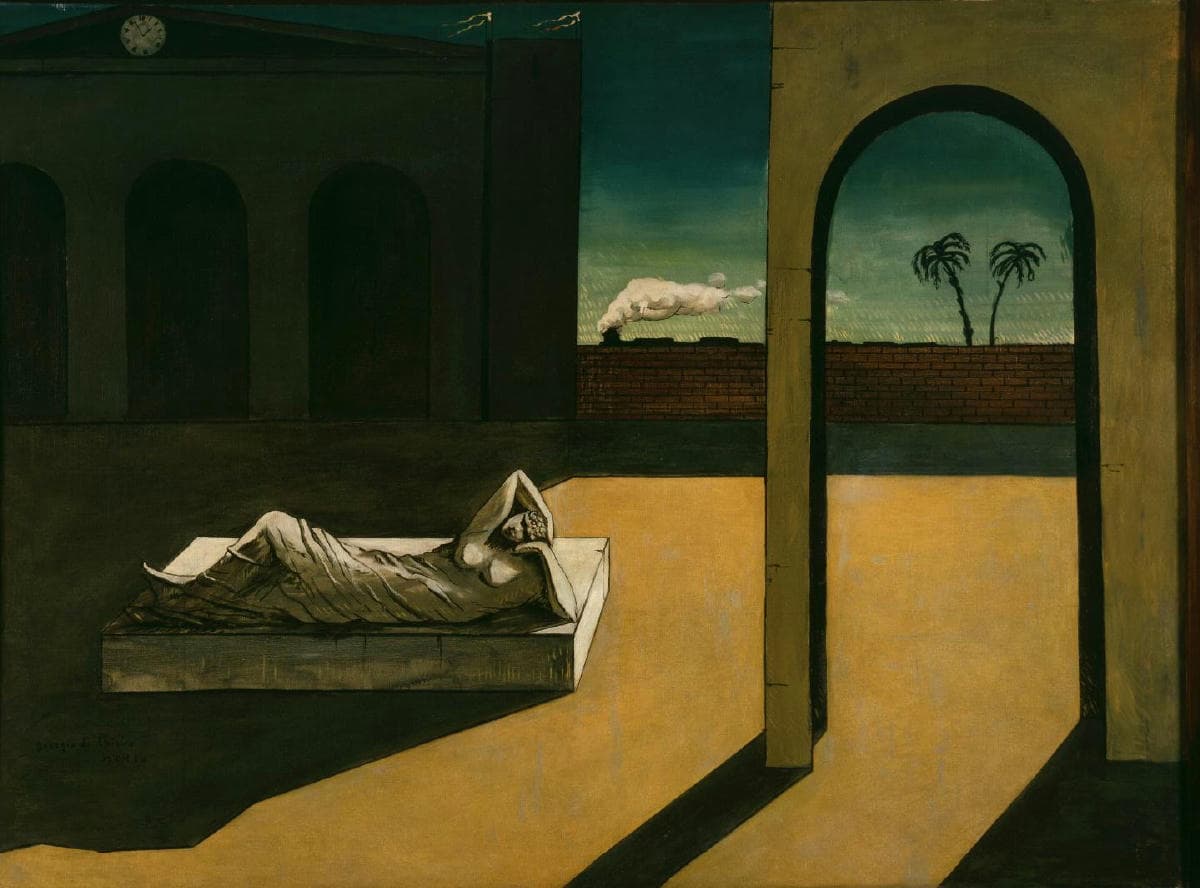
Giorgio de Chirico's The Soothsayer's Recompense feels like the aftermath of knowledge rather than its triumph.
The title promises revelation. A soothsayer is someone who sees. Recompense suggests payment, return, reward. But when you look at the painting, what you find is not the drama of vision fulfilled. You find a deserted piazza, an immobile statue-like Ariadne sleeping at the center, arcades sunk in shadow, a clock that measures time without reassuring anyone, and a train slipping away in the distance as if the painting itself had just missed something irreversible.
That is the brilliance of the work. De Chirico asks what it costs to see, and then refuses to answer with prestige or power. His answer is atmosphere.
Everything in the painting feels slightly displaced from the order it should inhabit. The shadows are too long, too hard, too certain. The piazza is too empty to be peaceful. The train is too small to dominate the image and too insistent to ignore. Ariadne is at the center and yet has no agency whatsoever; she sleeps through the very scene that has been arranged around her abandonment. The world is legible in fragments and unreachable as a whole.
That, to me, is the soothsayer's real recompense: not mastery, but estrangement.
De Chirico often gets described as a precursor to Surrealism, and that is true as far as chronology goes, but it risks making the work sound merely preparatory. What he actually achieved in paintings like this one was a full metaphysical mood. He discovered how to make space itself feel like an idea that had survived its explanation. His piazzas are not dreamscapes in the soft, fluid sense. They are sharper than dreams. More abandoned. More exact in their refusal to console.
Ariadne is the essential figure here. In myth, she gives Theseus the thread that lets him escape the labyrinth, and her reward is abandonment. She provides the key and loses the man. She makes navigation possible for someone else and is left behind on the shore. If any mythological figure deserves the title of wronged seer, it is Ariadne. She is the woman who makes meaning possible for others without being sheltered by that meaning herself.
That is why her placement matters. She lies in the center of the painting like a truth no one has come back for. The architecture surrounds her, but does not care for her. The train departs without her. The clock continues without her. Even the shadows seem to belong more to the structures than to the body on the ground.
I find that image almost unbearably exact as a figure for interpretation itself. There are people whose role in life is to notice patterns, to offer threads, to name what is happening before others are ready to hear it. Analysts do this. Writers do this. Sometimes the friend in the room does this. But seeing is not the same thing as being saved by what you see. Often it leaves you alone with the pattern for longer than is comfortable.
That is why the painting feels connected to divination without requiring belief in divination. The question is not whether anyone literally knows the future. The question is what kind of life results from seeing too much structure in the world. Does vision make one powerful? Or does it make one difficult to accompany?
De Chirico leans toward the second answer. The arcades recede into darkness with a confidence that feels almost cruel. They imply order, but they do not offer access. The train implies direction, but it is already leaving. The clock implies meaning, but not one that can be inhabited. Every formal device in the painting gives the sensation of intelligibility while withholding intimacy.
This is what makes the work uncanny in a deeper sense than mere strangeness. Nothing in it is impossible. Arcades exist. Trains exist. Public squares exist. Ariadne exists in myth. But when these elements are assembled here, they cease behaving like ordinary reality and start behaving like thought after loss. The world remains recognizable, yet no longer welcomes recognition as a form of belonging.
I think that is why I return to this painting whenever I think about what interpretation costs. To perceive connections, to notice absences, to understand that the train is leaving before others hear it — none of that guarantees reward. Sometimes it only clarifies your abandonment. Sometimes the thread leads out of the labyrinth for someone else and leaves you in the square, still, visible, waiting.
De Chirico does not offer redemption for that condition. He offers composition.
And maybe that is already a kind of mercy: to give loneliness such precise architecture that it no longer feels private, only ancient.