Painting / EN
Stańczyk
On the clown who sees the truth of the room and can no longer join its laughter.
- Artist
- Jan Matejko
- Country
- Poland
- Year
- 1862
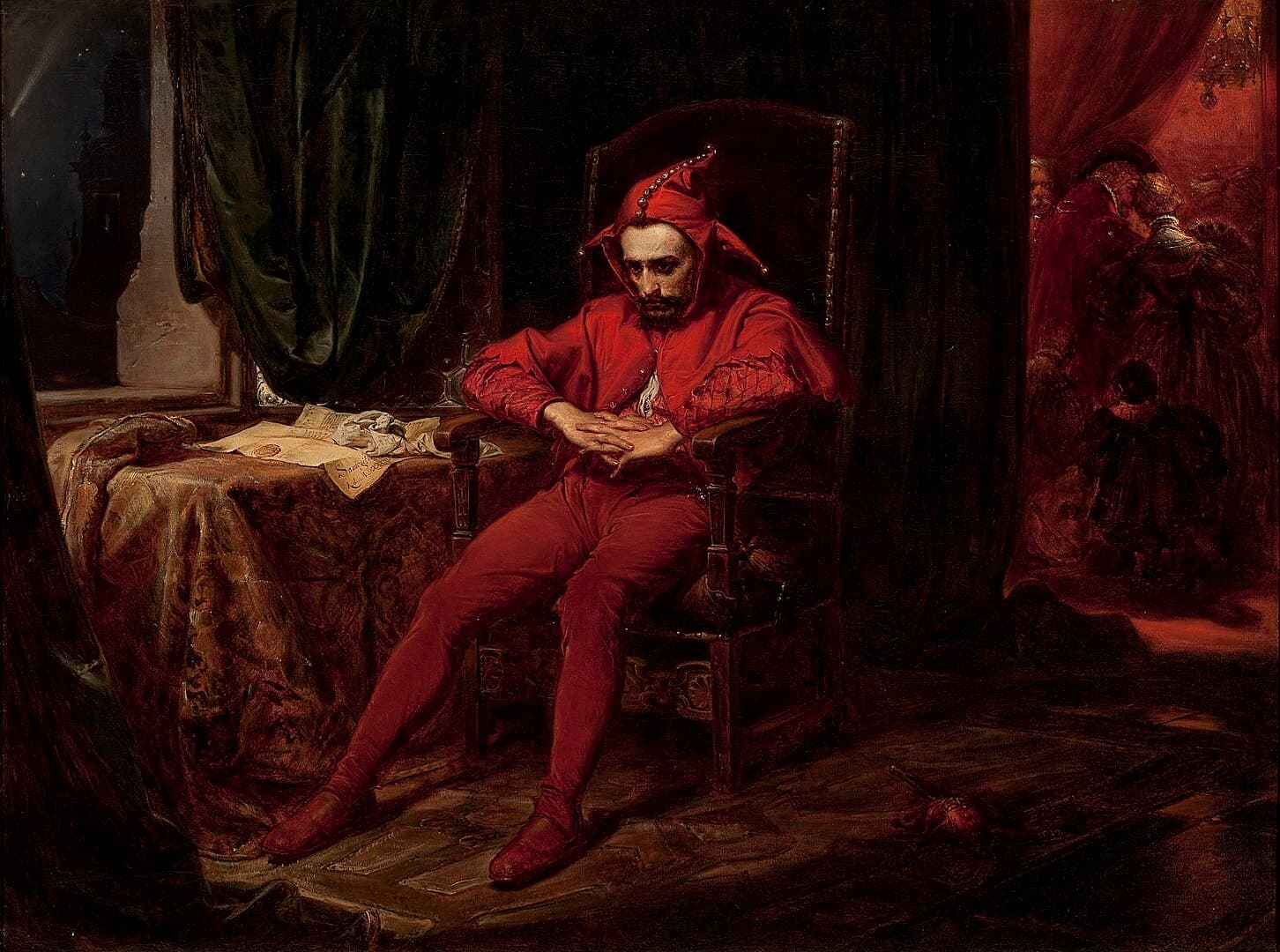
The entire painting turns on a cruel spatial fact: the party is still happening, but Stańczyk is no longer inside its emotional world. He sits in the foreground in a red costume that should make him the brightest figure in the room, yet the red reads less like festive color than like an opened wound. Behind him the court continues in light, movement, and music. In front of him there is a table, an open letter, a body that has ceased performing. Matejko does not paint the clown as comic. He paints him after comedy has failed.
That is why the work has always felt so exact to me. Most people think the paradox of the sad clown is merely that someone who makes others laugh may be privately unhappy. But the painting says something harsher. The clown is not simply unhappy in private. He is trapped in a role that makes his seriousness difficult for the room to register. His relation to the crowd is not accidental. He belongs to it under terms that prevent him from being fully met by it.
The details of the composition intensify that split. The carpet beneath him is disturbed, as if the scene had already suffered an invisible rupture. The letter on the table announces disaster. The dropped instrument is one of the painting's most devastating gestures, because it suggests that sound itself has lost its use. In the background a window opens onto the night, but it offers no real exit. Even the architecture seems to conspire in making Stańczyk remain where he is: near the feast, necessary to it, and cut off from its mood.
Historically the painting is associated with the loss of Smolensk, though Matejko compresses historical time in order to paint a national truth rather than a literal moment. What matters most to me is not whether every element obeys chronology but that the psychological arrangement is perfect. Stańczyk is the only one in the room who understands what has happened, and that knowledge isolates him more effectively than exile would. The others are still dancing because they have not yet been reached by the event. He has already been reached. The difference between him and the room is not intelligence alone. It is timing. He is already living in the after.
This is what makes the painting larger than its historical subject. Many people know the feeling of receiving news that makes the ongoing dance around them impossible. A city falls, a relationship ends, a humiliation lands, a name is mispronounced one time too many, and the room keeps functioning as if nothing essential has shifted. The pain is not only in the event itself. It is also in being unable to synchronize your inner weather with the social scene still unfolding around you.
Matejko gives that desynchronization a body. Stańczyk is seated, folded inward, not theatrically collapsed but exhausted. His face is not exaggerated. It is heavy. This restraint is part of the painting's force. The clown is often imagined as excess, gesture, noise, facial overproduction. Here the clown is reduced to stillness. The costume remains, but the performance has drained out of it. One can almost feel the weight of usefulness leaving the body and revealing what usefulness had concealed.
I wrote more broadly about this structure in Stańczyk and the Paradox of the Sad Clown, because the painting touches something I recognize too easily: the ability to turn awkwardness into laughter for others while remaining untouched by the relief that laughter gives them. The clown has access to the room because he can metabolize tension. But the room has no corresponding mechanism for metabolizing the clown's pain. That asymmetry is the tragedy.
There is, however, another truth in the image. Stańczyk's distance also gives him sight. He sees what the room does not yet see. He is cut off from the feast, but precisely because of that, he is no longer dissolved in its illusions. This does not redeem his sadness. I do not think pain deserves to be prettified into wisdom. But I do think Matejko understands that exclusion and perception often share a border. The person least able to join the laughter is sometimes the person most capable of hearing what the laughter is covering.
That is the part of the painting that stays with me. Not only the sadness, but the honesty of refusing the party's emotional demand. Stańczyk sits with his back partially turned to the festivities because the festivities can no longer tell the truth of his experience. The room glows behind him, but it cannot absorb what he now knows. In that sense the jester becomes something stranger and more serious than a clown. He becomes the figure who remains in costume after illusion has broken, carrying knowledge the room is not yet ready to bear.