Painting / EN
The Treasures of Satan
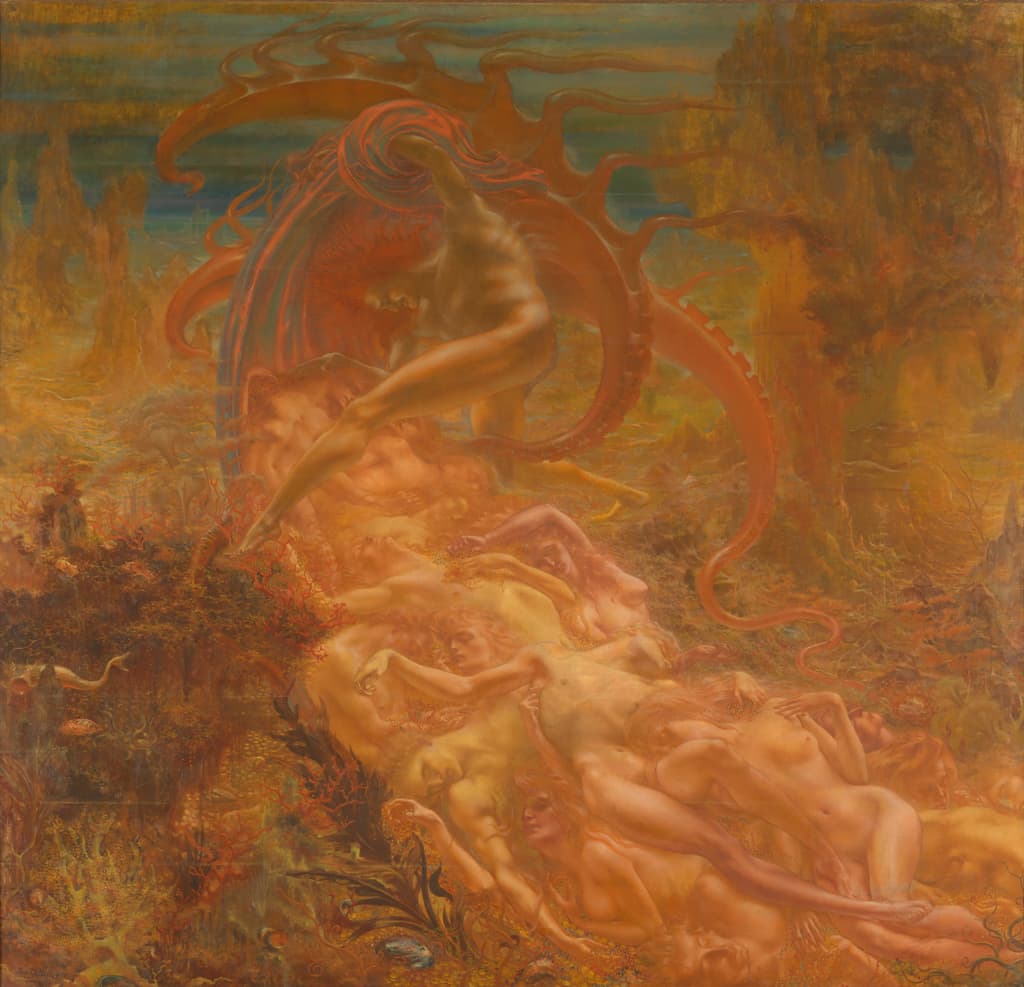
A monumental work by the Belgian Symbolist and Theosophist Jean Delville, depicting Satan hovering over an oceanic abyss of intertwined souls — a visual representation of the unconscious depths where desires and illusions hold the psyche captive.
- Artist
- Jean Delville
- Country
- Belgium
- Year
- 1895

Jean Delville's The Treasures of Satan understands something that moral art often fails to understand: if temptation were ugly, it would not work.
Satan hovers above an oceanic abyss of bodies, jewels, coral, pearl, and flesh. The souls beneath him are not being flayed or burned in the conventional infernal manner. They are reclining, draped, half-asleep inside abundance. Gold pools around them. Bodies tangle with one another so densely that individuality begins to soften into ornament. The scene is not one of obvious punishment. It is one of luxurious capture.
That is what makes the painting intelligent. Delville knows that bondage rarely presents itself as bondage. It presents itself as beauty, plenitude, arrival, satisfaction at last. The damned do not look like prisoners because they do not yet experience themselves as imprisoned. They look enchanted.
Delville was exactly the kind of painter who could render that enchantment convincingly because he believed in the invisible with embarrassing seriousness. He was not an ironist playing with occult furniture. He was a Symbolist, a Theosophist, a man who moved through esoteric circles convinced that art could make metaphysical realities visible. In weaker hands, that sort of conviction becomes costume. In Delville's hands, it becomes pressure. He paints as if the unseen really were leaning against the visible at every point.
Look at Satan's body. He is not the crude beast of popular piety. He is beautiful. Muscular, luminous, almost classical. The figure does not repel the eye. It gathers it. That matters because the painting is not trying to reassure us that evil is obviously monstrous. It is showing how easily grandeur and domination can share a silhouette.
The abyss below him is even more unsettling. The bodies are intertwined so tightly that they begin to resemble treasure themselves, as if desire had already accomplished its final trick: transforming persons into objects without ever making the transaction feel violent. Jewels lie against skin. Coral grows among limbs. Material abundance and bodily life have become visually inseparable. The result is not ecstasy but suspension.
This is where the painting becomes psychologically sharp. What Delville gives us is not simply sin. He gives us attachment.
That is why I cannot look at this painting without thinking of the Devil card in tarot. The card's power has never been that it depicts outright horror. Its power lies in the fact that the chained figures could, in most versions, remove their chains. What keeps them bound is not force alone but identification. They have come to think the structure that diminishes them is also the structure that defines them.
Delville paints that condition magnificently. The treasures are not lying beside the bodies as external temptations. They have entered the scene so fully that they seem to explain it. The abyss is made desirable from within. That is how psychic bondage works too. We do not always remain attached to what hurts us because we fail to see it hurts us. Sometimes we remain attached because we have built a self around the hurt.
Jung would later call that territory the Shadow: everything we refuse to acknowledge about ourselves, not because it is unreal, but because it threatens the image we prefer. What I find useful about Delville is that he refuses the lazy moral distinction between the beautiful and the dangerous. The Shadow is dangerous precisely because it is intimate and often radiant. The parts of us that bind us are rarely alien. They feel like home.
This is also why the painting resists simple condemnation. Delville does not paint the fallen souls contemptuously. He paints them tenderly. Their bodies are lovely. Their sleep is almost peaceful. Even Satan himself is rendered with a kind of terrible dignity. The painting does not sneer at desire. It asks a harder question: what happens when desire becomes an environment from which you no longer wish to escape?
The answer, I think, is visible in the stillness. Nothing in the painting truly moves. There is no drama of combat, no narrative of rescue, no sign that history is advancing. There is only endless suspension under the sign of magnificence. That is hell in one of its most convincing forms: not pain at its most intense, but enchantment that has gone on too long.
Maybe that is why the work stays with me. It refuses the childish fantasy that bondage is always obvious. It knows that most people are not dragged into illusion screaming. They drift into it while admiring the light on the water.
And once the water begins to glitter like treasure, even the chains can start to look decorative.