Painting / EN
The Cyclops
Odilon Redon transforms the myth of Polyphemus into a luminous vision of longing and mystery — the single enormous eye becoming an archetypal symbol of inner vision, clairvoyance, and the mystical gaze into the unseen.
- Artist
- Odilon Redon
- Country
- France
- Year
- 1914
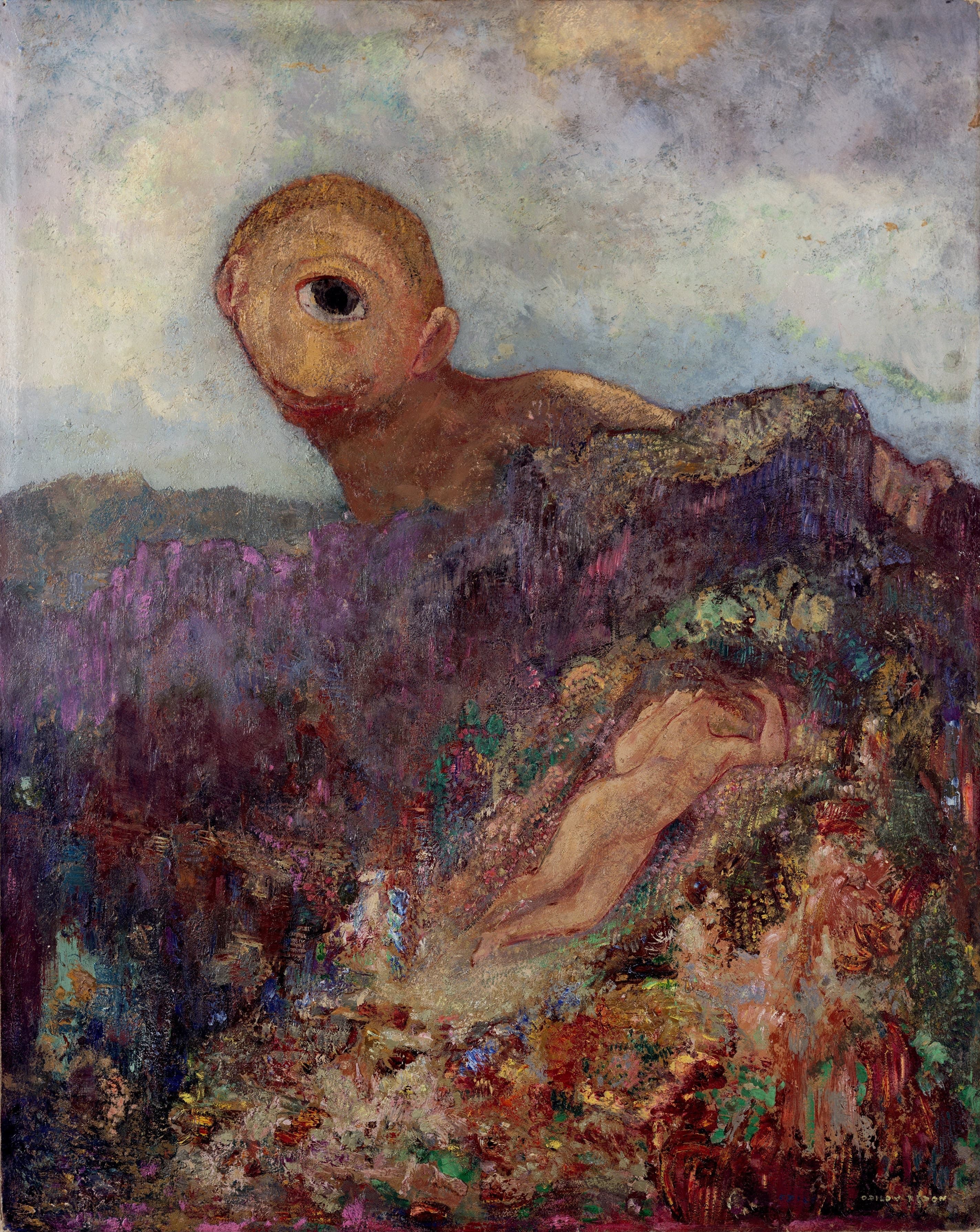
Odilon Redon's The Cyclops is one of the few paintings of a monster that seems less interested in monstrosity than in tenderness.
Polyphemus rises above the ridge like a secret too large for the landscape that is trying to hide it. His single eye peers down at Galatea, who sleeps below, pale and exposed and impossibly distant even at this physical nearness. In most tellings of the myth, Polyphemus is the brute, the one-eyed giant whose love curdles into violence. Redon does something stranger. He paints him as if he were capable of reverence.
That single eye matters more than anything else in the painting. Not simply because it makes the figure uncanny, but because it reorganizes the whole emotional field. A single eye is more concentrated than two. It suggests fixation, yes, but also singleness of vision, a form of seeing stripped of distraction. Polyphemus does not glance. He beholds.
What Redon understands is that beholding can be both gift and affliction.
The colors do much of the work. Nothing in the painting feels brutally real. Greens, golds, violets, and blues glow as if light were rising from inside the canvas rather than falling onto it from outside. The world has been softened into dream-material. Even the monstrous becomes luminous. This is typical Redon. He was never interested in surface reality as such. He painted the afterimage of thought, the forms that hover between vision and hallucination, the creatures that seem to have crossed over from the unconscious carrying traces of another law.
That is why The Cyclops feels less like an illustration of mythology than like the pictorial form of a psychic state. The giant is not only a mythic figure. He is the image of a desire that sees too much and can do nothing with what it sees.
There is something almost unbearable about Galatea's sleep. She does not return the gaze. She does not even know it is there. The asymmetry is total. He sees her. She remains inside her own dream. This is what gives the painting its sadness. The Cyclops is powerful in body and powerless in relation. He is close enough to look, too strange to touch, too singular to join the human world below him.
I think that is why the painting feels so different from ordinary representations of desire. Most images of desire are noisy. They announce appetite, pursuit, conquest, or union. Redon gives us desire as distance. The one who longs is separated from the beloved not only by circumstance but by ontology. He is a creature of another order. He can look, but he cannot cross.
This is where the painting becomes, for me, a meditation on inner vision. The Cyclops' eye has often been read symbolically as the third eye, the organ of intuition or mystical insight. That reading can become silly very quickly if handled with too much esoteric enthusiasm, but Redon earns it through atmosphere. The eye is not merely anatomical. It feels like a principle. A mode of apprehension. The Cyclops sees beyond ordinary seeing, and that very capacity isolates him from the world that sight reveals.
Artists know something about that isolation. So do analysts. So do anyone who has ever looked at a situation long enough for the pattern underneath it to become visible and then discovered that visibility does not equal power. To see clearly is not always to act effectively. Sometimes it only means you must remain longer in the knowledge of what cannot be changed.
Redon paints that loneliness without bitterness. That may be the most surprising thing about the work. There is no sneer in the Cyclops' face, no resentment in his watching. If anything, there is humility in it. A colossal creature reduced to the vulnerability of witness.
That is why I cannot read the painting as a simple allegory of desire frustrated. It feels closer to the condition of anyone whose deepest encounters with beauty occur through distance rather than possession. The beloved below the ridge could be a person, certainly. But she could also be meaning itself, peace itself, the life one watches from the edge of another order.
Redon does not solve that distance. He illuminates it.
And perhaps that is enough. The eye remains open. The beloved remains asleep. The world remains radiant and unreachable. The monster does not descend. He only looks.
Sometimes that is the most human thing in the painting.