Painting / EN
Guernica
An exploration of Pablo Picasso's Guernica and its relevance to the fascist dictatorship of its time.
- Artist
- Pablo Picasso
- Country
- Spain
- Year
- 1937
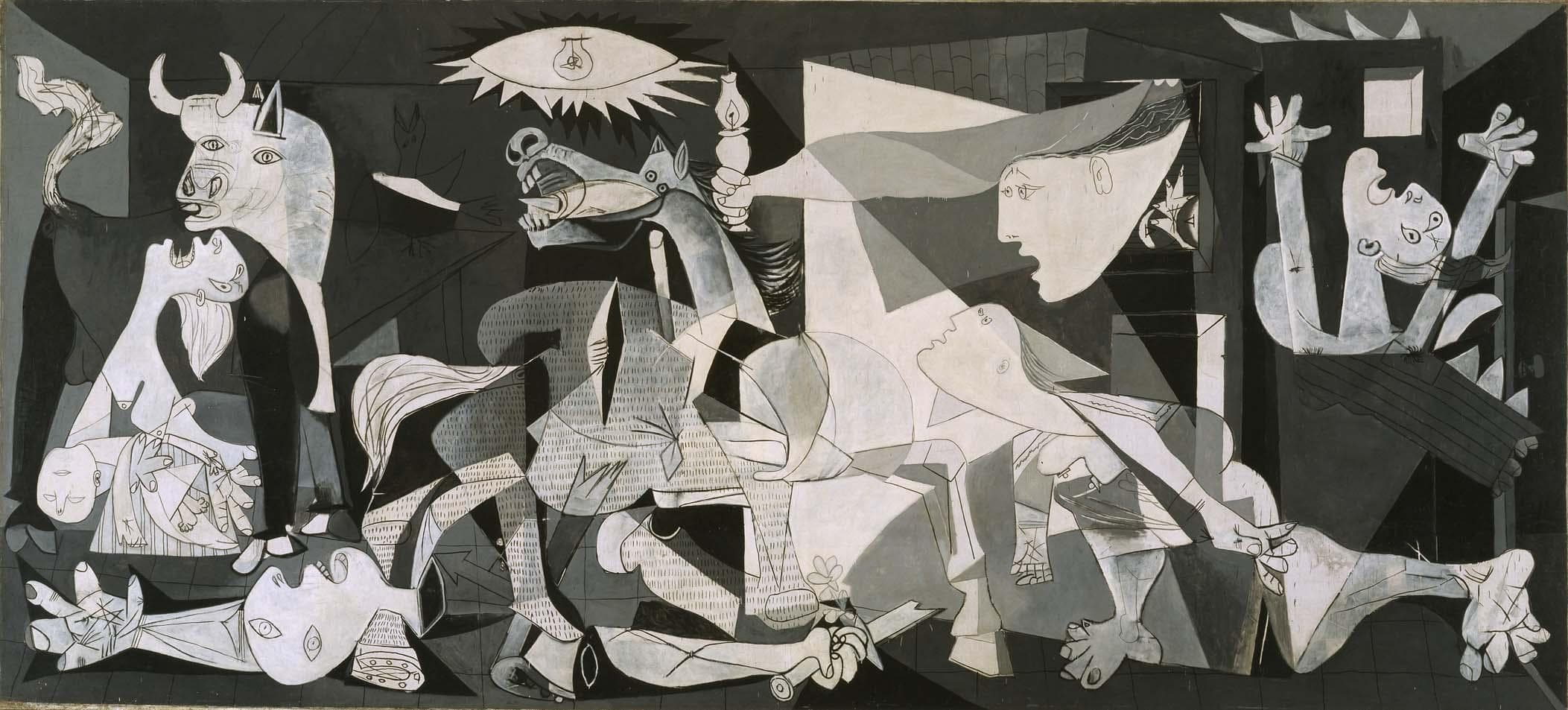
The first time I saw "Guernica" in Madrid, what struck me was not its fame but its refusal to compose itself into a single scene. One expects a monumental work to stabilize what it depicts, to organize suffering into a legible order. Picasso does the opposite. The painting is huge, but its scale does not monumentalize violence. It magnifies disorientation. Figures break apart before you can settle into them. Angles collide. Limbs arrive before bodies. Pain appears not as a story with a center, but as a shattered grammar.
That matters because fascist violence does not only kill; it disorders the field in which meaning becomes possible. The bombing of Guernica in 1937 was not simply an attack on a town. It was an attack on civilian life as such, on the assumption that there exists some boundary between the machinery of power and the ordinary world of mothers, animals, houses, markets, and sleep. Picasso understood that one cannot answer such violence with classical balance. One must let the brokenness invade the form itself.
Look at the horse in the center, its mouth split into a scream, its body pierced and fractured as if pain had become architecture. Above it hangs the harsh electric light, an eye and a bulb at once, cold and merciless, the opposite of divine illumination. To the left, the bull remains oddly steady amid the catastrophe, at once witness, brute force, Spain, masculinity, or something even less consoling: the fact that violence often persists with a terrible calm while everything human around it breaks. Below, the severed arm still grips a broken sword, and from beside it a small flower rises almost invisibly. It is one of the cruelest details in the painting because it refuses heroism. The flower is not victory. It is the persistence of life at the exact point where life has already been mutilated.
The most devastating figure for me has always been the mother with the dead child. Her neck is thrown back, her mouth opened into an impossible howl, and the child in her arms hangs with the terrible limpness that only painting, when it is ruthless enough, can make unbearable. There is no sentimentality in the scene. Picasso does not romanticize maternal grief. He renders it as an event that tears the face itself apart. This is why the monochrome palette is so important. By refusing the seductions of color, the painting feels closer to ash, newsprint, ruin, and mourning. It is as if the image already knows it will survive in reproduction, in documents, in political memory, in the black-and-white afterlife of catastrophe.
It would be easy to call "Guernica" an anti-war painting and leave it there. But what gives the work its enduring force is that it is also a painting about what power does to perception. Under extreme violence, the world no longer holds together in the familiar way. Home becomes debris. A lamp becomes surveillance. A body becomes fragments. Speech becomes a scream. Fascism is not only the open domination of one class or nation over another, though it is certainly that. It is also a regime of mutilated reality in which terror reorganizes what can be seen, felt, and shared.
That is why the painting still feels contemporary. Not because history repeats itself in identical costumes, but because the temptation to bombard reality into submission never disappears. States continue to speak the language of necessity while civilians absorb the consequences. Images continue to circulate after the fact, asking whether looking is enough. "Guernica" offers no comforting answer. It does not tell us that art redeems suffering. It only refuses the lie that suffering can be made clean, distant, or acceptable.
I left the Reina Sofia with the strange sensation that the painting had not shown me an event so much as a structure. The horse still screamed. The bulb still glared. The mother still held the dead child in an embrace that no politics can justify. That is Picasso's greatness here. He does not ask us to admire resistance from a safe moral altitude. He places us inside a field where everything is already broken and then asks whether we still recognize the world being destroyed.