Painting / EN
Inspection of the Old House
A dim interior becomes a meditation on belated return and the impossibility of inventorying loss.
- Artist
- Ivan Kramskoy (unconfirmed)
- Country
- Russia
- Year
- 1874
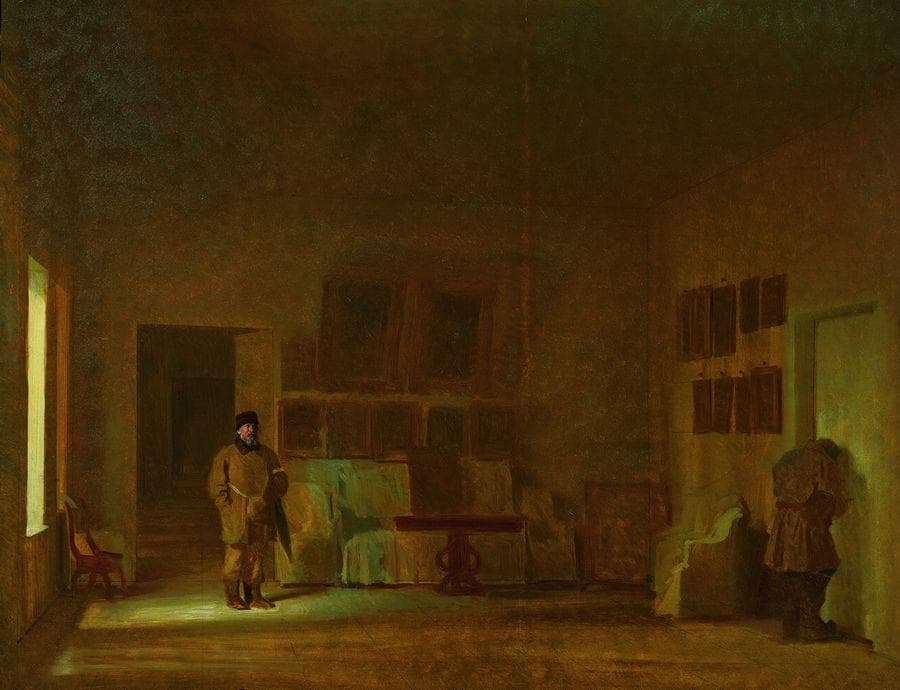
The title Inspection of the Old House sounds almost bureaucratic, and that is what makes the painting unsettling. We are not shown the house at the height of its life or in the drama of its collapse. We are shown the later moment, the colder one, when someone returns to take stock.
A pale rectangle of light enters from the left and stretches across the wooden floor. In that light stands a solitary man in a coat and dark cap, paused mid-room as if he has not yet decided whether he is inspecting property, memory, or damage. Around him the furniture is shrouded or stacked: chairs pushed aside, surfaces covered, the room still inhabited by objects but already emptied of use. Doorways open deeper into darkness. Near the right wall another figure - or perhaps only a bundled form, almost statue-like - turns away from us. The uncertainty matters. In abandoned interiors, people and things begin to resemble one another.
What moves me here is the refusal of theatrical ruin. There are no collapsed beams, no heroic weeds reclaiming the house. The devastation is quieter. Someone has gone. Warmth has gone. The house remains as structure, but not as world.
To inspect is to imagine that loss can be organized into an inventory: room, chair, cloth, threshold, door. Yet the most important thing in the scene is precisely what cannot be listed. The air has changed. The room no longer belongs to use, only to afterlife.
That is why the painting belongs near the archive's other meditations on ruin and repetition. The ruin is never only physical. It is the point at which a person returns too late and tries to understand what exactly has already ended. The room gives him light enough to see the objects, but not enough to recover the life that made them coherent.
In the end the floor holds more certainty than the man does. The light knows where to fall. He does not know what to do with what it reveals. That is the true inspection: not of the house, but of the self that has come back to it after the world inside has already gone cold.