Essay / EN
The Metamorphosis of Parsifal through "The Triumph of Death"
An analysis of Pieter Bruegel's masterpiece in the context of the myth of Parsifal
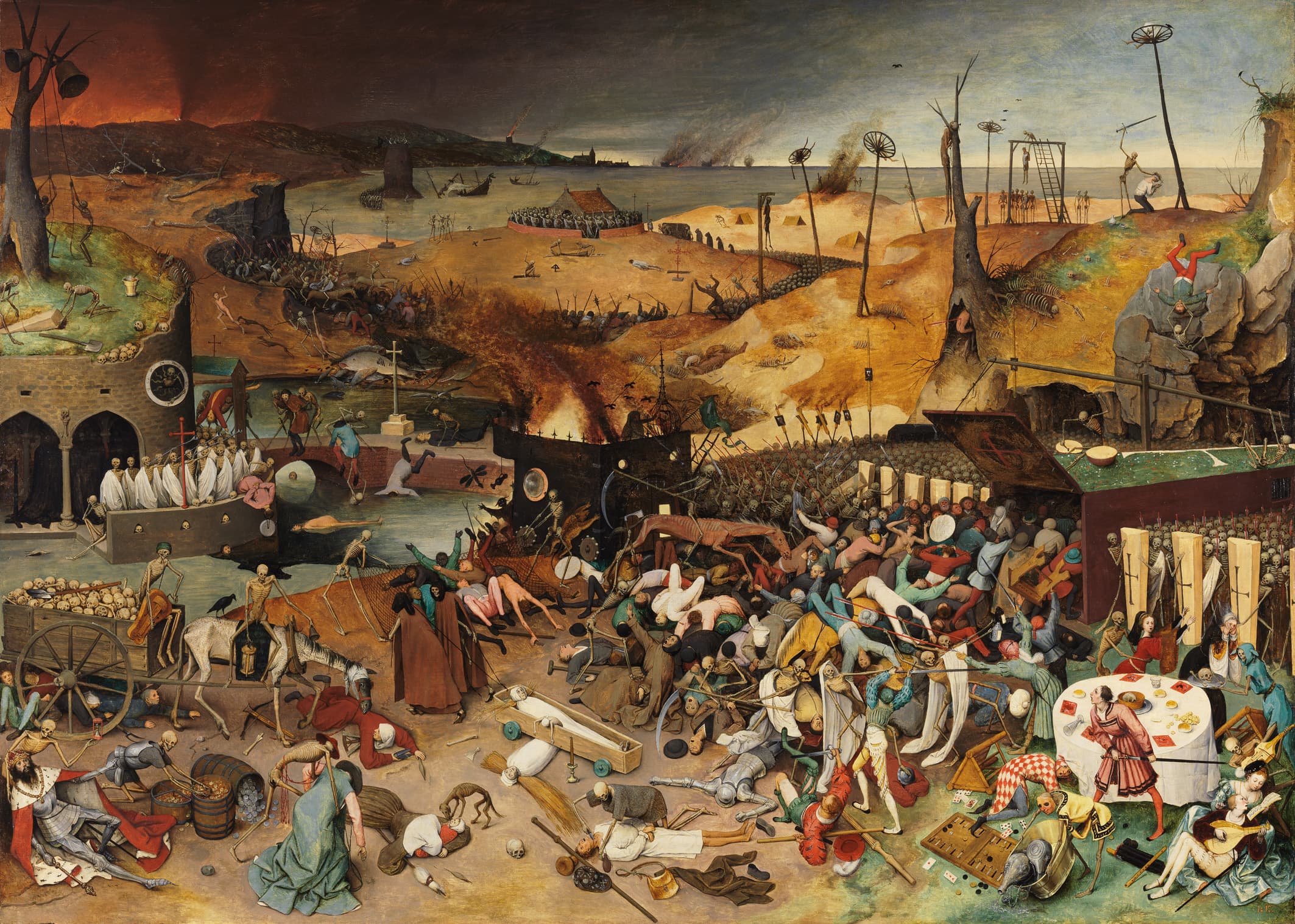
🇳🇱 Pieter Bruegel the Elder - The Triumph of Death (c. 1562)
Parsifal becomes a man not when he learns to fight, but when he learns to ask the right question in the presence of suffering.
That, at least, is the version of the myth that has always stayed with me. Parsifal begins as a boy protected from the world, raised in ignorance, almost preserved in innocence by force. When he finally leaves that enclosure, he does not step into wisdom. He steps into bewilderment. He sees armor, wounds, desire, failure, kingdoms in decline. He is not transformed by purity. He is transformed by exposure.
That is why Bruegel's The Triumph of Death feels so strangely appropriate beside the myth. The painting does not illustrate Parsifal. It does something more useful. It shows the kind of world through which a naive soul would have to pass if he were ever going to outgrow naivety.
Bruegel's canvas is a school of mortality. Not an abstract meditation on death, but an overcrowded, merciless education in what it means to live where death is public, ordinary, and structurally inescapable. The painting matters to Parsifal because Parsifal's task is not to remain innocent. It is to become capable of seeing suffering without turning away from it or romanticizing it.
Three details in Bruegel's painting make that education legible: the cart of skulls, the musical instruments turned against the living, and the burning horizon behind everything.
The Cart of Skulls
The first detail is the cart in the foreground, dragged forward as skeletons shovel human beings toward it. It is not only gruesome. It is administrative. Death in Bruegel is not a singular event or a noble duel. It is organized. It has wheels. It has labor. It has procedure.
That matters for Parsifal because the young fool of the legend initially misunderstands suffering as something episodic. He encounters the Fisher King and sees a wound, but he does not yet understand that the wound has become a whole environment. The king's body is injured, yes, but the kingdom has also been made sterile by that injury. The problem is no longer local. It has become structural.
Bruegel understands this perfectly. In The Triumph of Death, nobody is facing a private death. The entire world has become a wound-system. Kings, lovers, soldiers, peasants, clergy: all of them are caught in the same machinery. The cart of skulls is what happens when mortality ceases to feel like an exception and becomes the dominant logic of the world.
Parsifal must learn to read that logic. He must learn that one person's suffering can infect an entire order. Until he sees that, he remains immature. He remains someone dazzled by surfaces — by armor, ritual, chivalric glamour — rather than someone capable of perceiving what a wound has done to the land around it.
The Instruments of Pleasure
The second detail is one Bruegel renders with especially cruel intelligence: the way instruments of pleasure and culture remain present inside the scene, but no longer as consolations. There are lutes, songs, gestures of festivity, yet none of them rescue anyone. They survive only as evidence that the world of beauty does not exempt us from mortality.
This is important because myths of initiation are often sentimental about culture. They imagine that the right code, the right ritual, the right noble ideal will carry the hero into maturity. Bruegel offers no such comfort. In his painting, music remains in the scene, but it has lost sovereignty. Refinement does not save. Taste does not save. Performance does not save.
Parsifal needs precisely that lesson. The courtly world he enters is full of symbolic forms — kingship, ritual, sacred objects, codes of conduct — but those forms are not enough. In fact, they can delay understanding if they become substitutes for it. The hero's task is not to admire the theater of suffering. It is to respond to suffering with the right question.
That is why Bruegel's grotesque social mixture matters. The painting refuses to let the viewer hide in aesthetics. Every beautiful object has been dragged into the same crisis. The message is severe but necessary: if you want to become an adult in a broken world, you must stop believing that beauty is a shield.
The Burning Horizon
The third detail is the horizon. Fires burn in the distance. Ships are wrecked. The sky itself feels exhausted. Bruegel does not permit the eye any peaceful background in which to rest. Even what is far away has already been taken.
This is the detail that brings the painting closest to the inner logic of Parsifal's transformation. In the myth, the Fisher King's wound is devastating not only because it causes pain but because it radiates outward. It turns the whole kingdom into an afterlife of vitality. Nothing can properly grow. The environment itself becomes symptomatic.
Bruegel paints exactly that condition. Death is not arriving from outside the world. It has already entered the world's horizon. It colors the distance, contaminates the atmosphere, and abolishes the illusion that disaster is somewhere else. There is nowhere else.
Parsifal's maturity depends on learning this. He cannot heal the king by remaining abstract, detached, or ceremonially correct. He must become someone who understands that suffering is never neatly contained inside one body. It leaks into language, into land, into time. The question he fails to ask at first is not a failure of etiquette. It is a failure of perception. He has not yet learned to see how far the wound extends.
From Innocence to Responsibility
This is why I do not read Parsifal as a story about purity rewarded. I read it as a story about innocence losing its excuses.
The young Parsifal is naive enough to survive childhood, but that same naivety makes him inadequate to the world he enters. He sees but does not interpret. He witnesses but does not respond. His failure at the Grail Castle is, in that sense, the necessary failure of someone who still believes suffering can be observed without demanding anything from the observer.
Bruegel's painting annihilates that illusion. It does not allow spectatorship without implication. The eye moves across the canvas and finds no safe corner, no morally neutral distance. That is exactly the education Parsifal requires. Before he can ask the healing question, he must stop imagining that he is outside the field of pain.
Maturity, in both the myth and the painting, is not optimism. It is not mastery. It is the terrible acquisition of seriousness.
To become capable of compassion, Parsifal must first become incapable of innocence in the old sense. He must see the cart of skulls and understand structure. He must see the broken prestige of music and understand that beauty does not save by itself. He must see the burning horizon and understand that a wound can become a world.
Only then can he ask the question that matters.
That is why The Triumph of Death feels less like an illustration than like an initiation chamber. Bruegel provides the landscape through which the fool must pass if he is ever going to become worthy of the Grail's demand. The painting teaches, with unbearable clarity, that growth is not a matter of acquiring heroic qualities. It is a matter of learning to remain present in the face of devastation without reducing devastation to spectacle.
Parsifal becomes Parsifal when he stops looking at suffering as scenery.
Bruegel, I think, would have understood that immediately.
🇬🇧 Thank you for reading
Filed under
Keep reading