Painting / EN
The Garden of Earthly Delights
On paradise, compulsion, and the slow slide from delight into psychic catastrophe.
- Artist
- Hieronymus Bosch
- Country
- Netherlands
- Year
- 1500
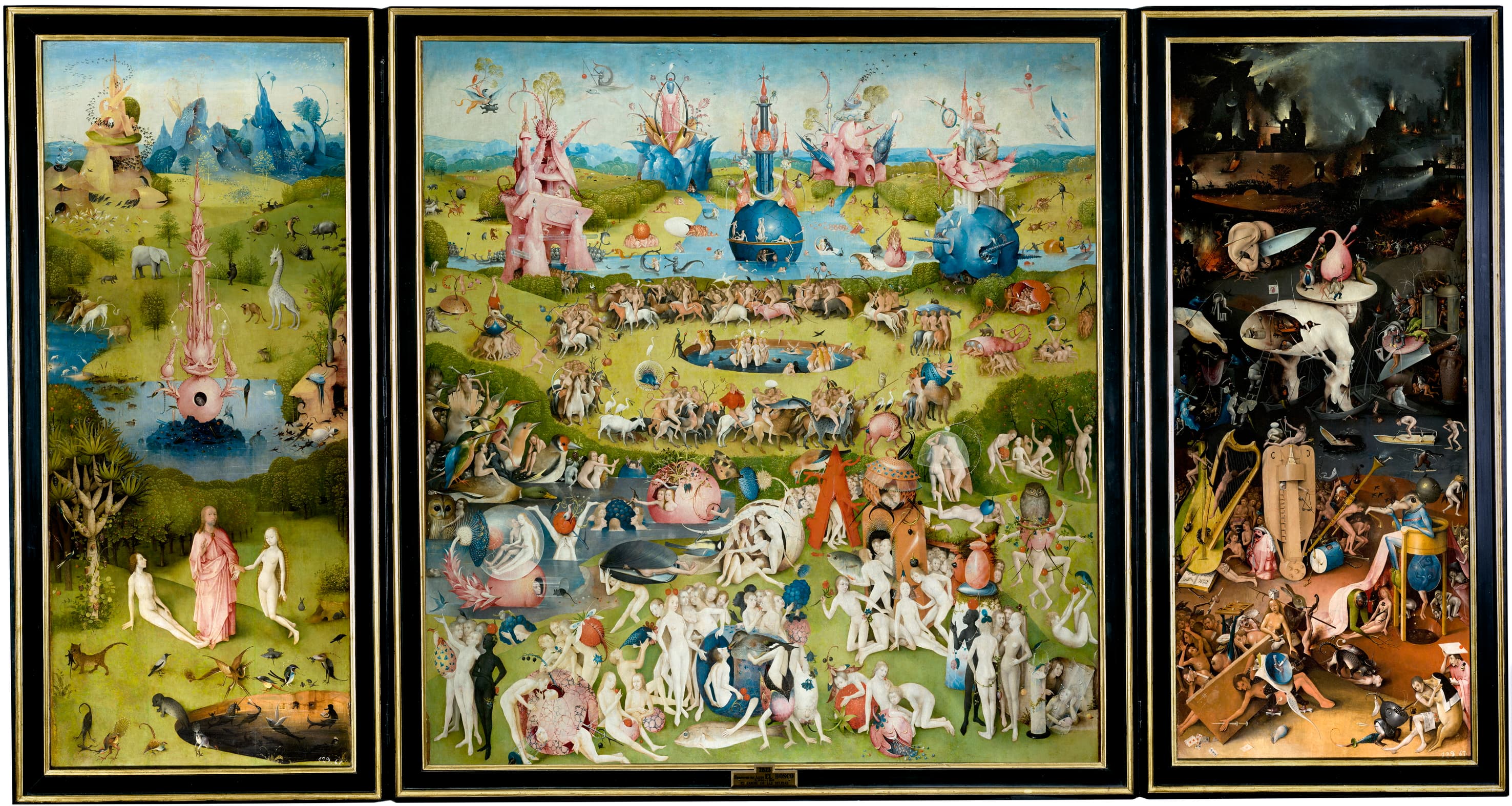
Bosch's triptych overwhelms before it explains. You do not look at The Garden of Earthly Delights so much as enter a visual climate in which every form seems to be mutating into another. A pink fountain rises in paradise like a ceremonial organ built out of dream matter. Naked bodies slide around giant berries in the center panel with the intensity of people obeying a pleasure they no longer control. In hell, instruments become machines of torture and a pair of severed ears walks across the landscape with a knife between them. The painting does not ask for calm contemplation. It ambushes the eye.
What makes the work endure is that Bosch never lets it settle into a simple moral lesson. People often want the triptych to say something straightforward: paradise on the left, sin in the center, punishment on the right. But the painting is stranger than that. The center panel is not just vice. It is fascination. Its bodies are not only condemned; they are absorbed in an endless present tense of appetite, touch, repetition, and spectacle. Bosch understands that desire is not persuasive because it is good. It is persuasive because it is vivid.
The left panel matters because it stages a world before compulsion has hardened into pattern. God presents Eve to Adam. Strange animals gather around water. Everything still appears open, as if creation had not yet decided what it was becoming. This is not innocence in the sentimental sense. Bosch's Eden is already unsettling. Even there, the forms feel too strange, too unstable, too charged with future metamorphosis. Paradise is present, but the seeds of distortion are already in the ground.
Then the center panel arrives, and with it one of the greatest images of excess ever painted. Figures ride birds too large for the world, disappear inside transparent spheres, carry fruit that looks half erotic and half ridiculous, bend themselves toward one another in arrangements that feel both playful and mechanical. The delight on offer is undeniable, but it already carries the logic of exhaustion. Nobody appears satisfied. Everyone is in motion, and the motion does not seem to lead anywhere beyond itself. That is why the panel feels so modern to me. Bosch paints pleasure not as completion but as circulation.
I wrote about that circulation at greater length in The Garden of Earthly Delights and the Underground Man, because the triptych seems to understand something psychoanalysis would only later formalize: enjoyment easily passes beyond pleasure into compulsion. The center panel is full of bodies doing things, but very few of those bodies seem inwardly present to what they are doing. They resemble people caught in the ritual of satisfaction after satisfaction has already disappeared. The image does not condemn desire from above. It shows desire curdling from within.
That is why the right panel is so devastating. Hell in Bosch is not merely fire and demons. It is the return of the familiar in mutilated form. Musical instruments become instruments of punishment. The things that once accompanied leisure are transformed into mechanisms of pain. This reversal is essential. Bosch suggests that catastrophe is not the opposite of delight but one of its possible continuations. The same structures that organized pleasure can come back as its parody, its recoil, its reckoning.
And yet I do not think the painting is finally pessimistic in a simple way. It is too intelligent for that. Bosch does not divide the world neatly into good beginning, bad middle, worse end. He paints human desire as something excessive, imaginative, vulnerable to distortion, and constitutively unstable. The beauty of the triptych lies in that refusal of simplification. The bodies in the center panel are absurd, comic, erotic, and tragic all at once. The hell panel is horrific, but it is also full of black humor. Even judgment, here, is baroque.
Perhaps that is why the work never becomes old. Every age finds its own mirror in the center panel: courtly excess, religious anxiety, consumer compulsion, digital overstimulation, erotic spectacle, endless scrolling. The costumes change, but the structure remains recognizable. One keeps moving from stimulus to stimulus in the hope that the next arrangement will complete something the last one left open. Bosch understood that the danger was never pleasure itself. The danger was the inability to stop converting life into an ever more crowded theater of appetite.
So I return to the triptych not because it flatters morality, but because it diagnoses the volatility of human wanting with almost unbearable precision. It shows a world in which paradise is already unstable, delight is already restless, and punishment emerges less as external sentence than as the internal logic of a life organized entirely around intensification. Bosch does not simply paint a fall. He paints the strange persistence of desire after it has ceased to know what it is seeking.