Essay / EN
The Garden of Earthly Delights and the Underground Man
On Jouissance, Self-Destruction, and the Paradox of Consciousness
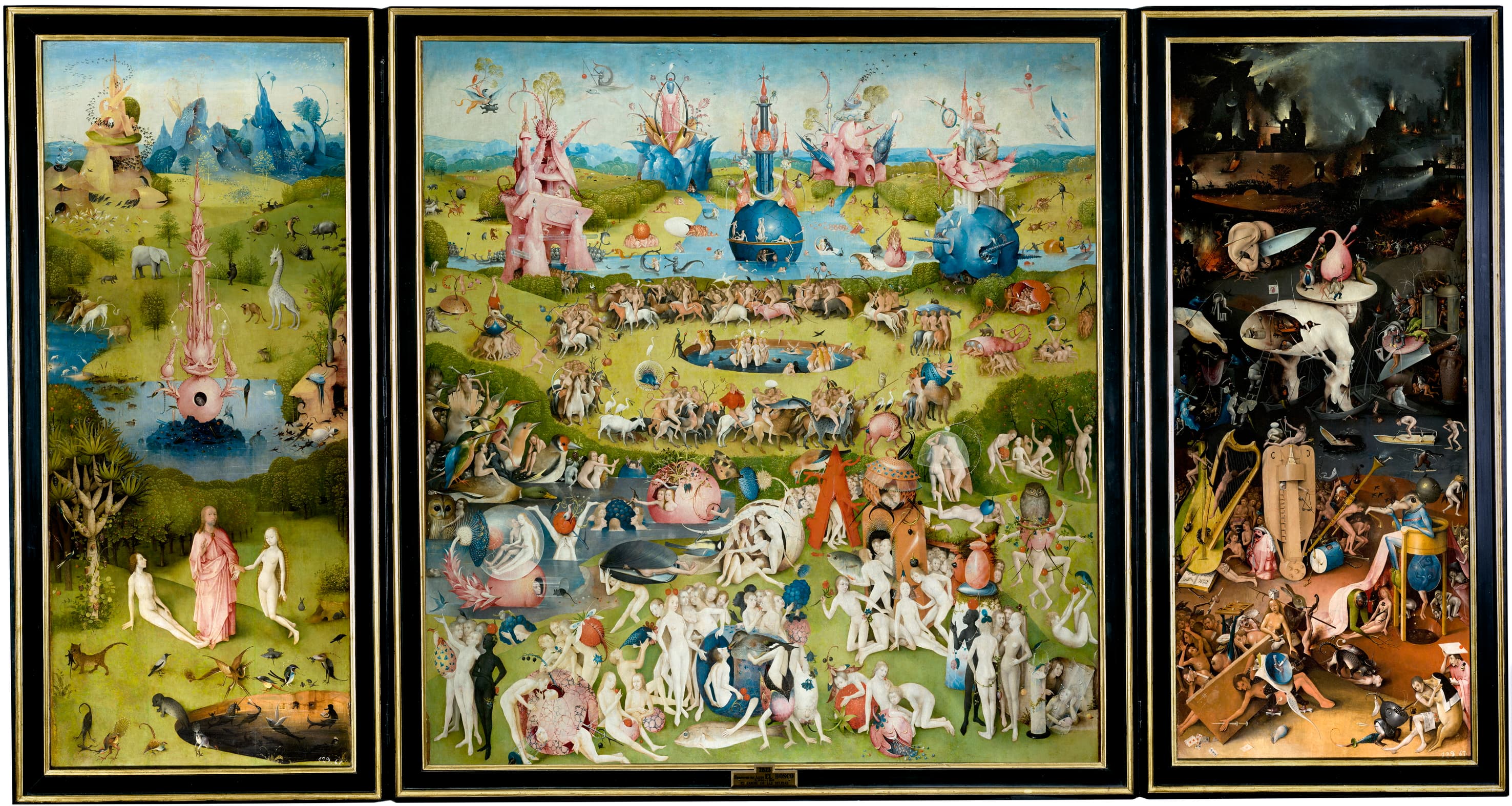
🇳🇱 Hieronymus Bosch - The Garden of Earthly Delights (c. 1490-1510)
It was three in the morning and I was still scrolling. Not reading, not searching for anything, just scrolling. My thumb moved on its own, like a machine that had forgotten why it was turned on. The glow of the screen was the only light in my room, and I remember thinking — or maybe not thinking, maybe just feeling — that I looked like Vrubel's Demon, hunched over, staring into something that gave nothing back. I had finished reading "Notes from Underground" by Dostoevsky earlier that night, and the book had left me in a state I can only describe as recognition. Not shock, not sadness — recognition. Like looking into a mirror you've been avoiding.
The Underground Man says, at one point, something that hit me so hard I had to put the book down: "I found pleasure in the degradation." And there I was, three in the morning, scrolling through nothing, finding some kind of dark comfort in the act of wasting my own time, my own life, one swipe at a time.
I want to talk about that feeling. Not the scrolling itself — that's just the latest costume it wears — but the thing underneath. The thing that Dostoevsky understood better than anyone, and that Hieronymus Bosch painted five hundred years ago on three wooden panels that still make people stand in silence at the Museo del Prado.
The Left Panel: Paradise, or What We Could Have Been
The first thing you see when you look at Bosch's triptych from left to right is paradise. Eden. God presents Eve to Adam in a landscape that is impossibly lush, impossibly peaceful. Strange animals lower their heads into clear water. A pink fountain rises in the distance like an organ made of coral and dream logic. Everything is new. Everything is possible.
This is what Jacques Lacan would call the Imaginary order — that brief, prelapsarian moment before the subject enters language, before desire fractures everything. In the mirror stage, the infant sees itself as whole for the first time and mistakes that image for the truth. "That's me," the child thinks, not knowing that this wholeness is an illusion, that from this moment forward, there will always be a gap between who we are and who we think we are.
The Underground Man knows this gap intimately. In the second part of "Notes from Underground," he recounts his youth — those moments when he still believed he could become something. He imagined himself a hero, a lover, a great man. He would walk down Nevsky Prospect dreaming of glory, only to step aside for an officer who didn't even notice him. The paradise of potential. The unbearable lightness of not having ruined everything yet.
I know this feeling. I think everyone does. There is a version of yourself that lives in the left panel of the triptych — the one who would have done everything differently, who would have said the right thing, who wouldn't have scrolled until three in the morning. Who wouldn't have cut his own hair during an anxiety attack in a Belgian apartment. Who would have been brave enough to stay at the party in Peñón Blanco without running into the forest crying. That version of you is standing in Bosch's garden, untouched, unnamed, whole.
But you don't live there. Nobody does. That's the cruelty of the left panel — it exists only to show you what you've lost.
The Center Panel: Earthly Delights, or the Scroll That Never Ends
The center panel is where most people's eyes go first, and I understand why. It is chaos. It is pleasure. It is hundreds of naked bodies intertwined with giant strawberries, sealed inside glass globes, balancing on birds too large to be credible, slipping in and out of pools whose blue looks chemically bright even after five centuries. There is no narrative, no direction — just an endless present tense in which appetite has replaced purpose. Everyone is doing something, but nobody seems to know why.
This is what Lacan called jouissance — and I need to be careful here because jouissance is one of those words that doesn't translate well, not even from French to Spanish, and I speak Spanish. It's not pleasure. Pleasure, for Lacan, is what we feel when tension is released — you eat when you're hungry, you rest when you're tired. Jouissance is what happens when you go beyond pleasure, when the act becomes compulsive, when you keep eating even though you're sick, keep scrolling even though your eyes burn, keep gambling even though you've lost everything.
In my previous article about Dostoevsky, The Gambler and the Black Square, I wrote about Alexei and his inability to stop gambling. "One has never won anything in his life but yet he felt like a champion every day." That phrase has stayed with me because it describes jouissance perfectly — a painful enjoyment, a pleasure that hurts, a victory that is also a defeat. The center panel of Bosch's triptych is jouissance made visible: a garden of delights where delight has become its own prison.
The Underground Man is the philosopher of jouissance. He doesn't just experience it — he theorizes it, celebrates it, drowns in it. "I found pleasure in the degradation," he says, and this is not a confession of weakness. It is almost a manifesto. He takes pleasure in his own toothache. He takes pleasure in being humiliated at a dinner party. He takes pleasure in his spite, his resentment, his refusal to act. This is what the Russians call надрыв — nadryv — a word that has no equivalent in English or Spanish, a word that means something like emotional self-laceration, the act of tearing yourself apart and watching yourself do it, and finding in that watching a terrible kind of satisfaction.
I think about nadryv when I think about scrolling. Not because the phone is the same thing as Bosch's garden, but because the logic is the same: a compulsive movement from stimulus to stimulus in the hope that one more image will save you from yourself. Your eyes hurt. Your neck hurts. The content has already dissolved into mush. But you don't stop, because stopping would mean finding yourself alone again.
Look at Bosch's figures again. They are smiling, but do they look happy? They are touching each other, but do they look connected? There is something mechanical about their pleasure, something hollow. They are performing delight, not experiencing it. They are the ancestors of every person who has ever posted a photo to look happy, liked a post to feel seen, scrolled to feel less alone, and ended up feeling more alone than before.
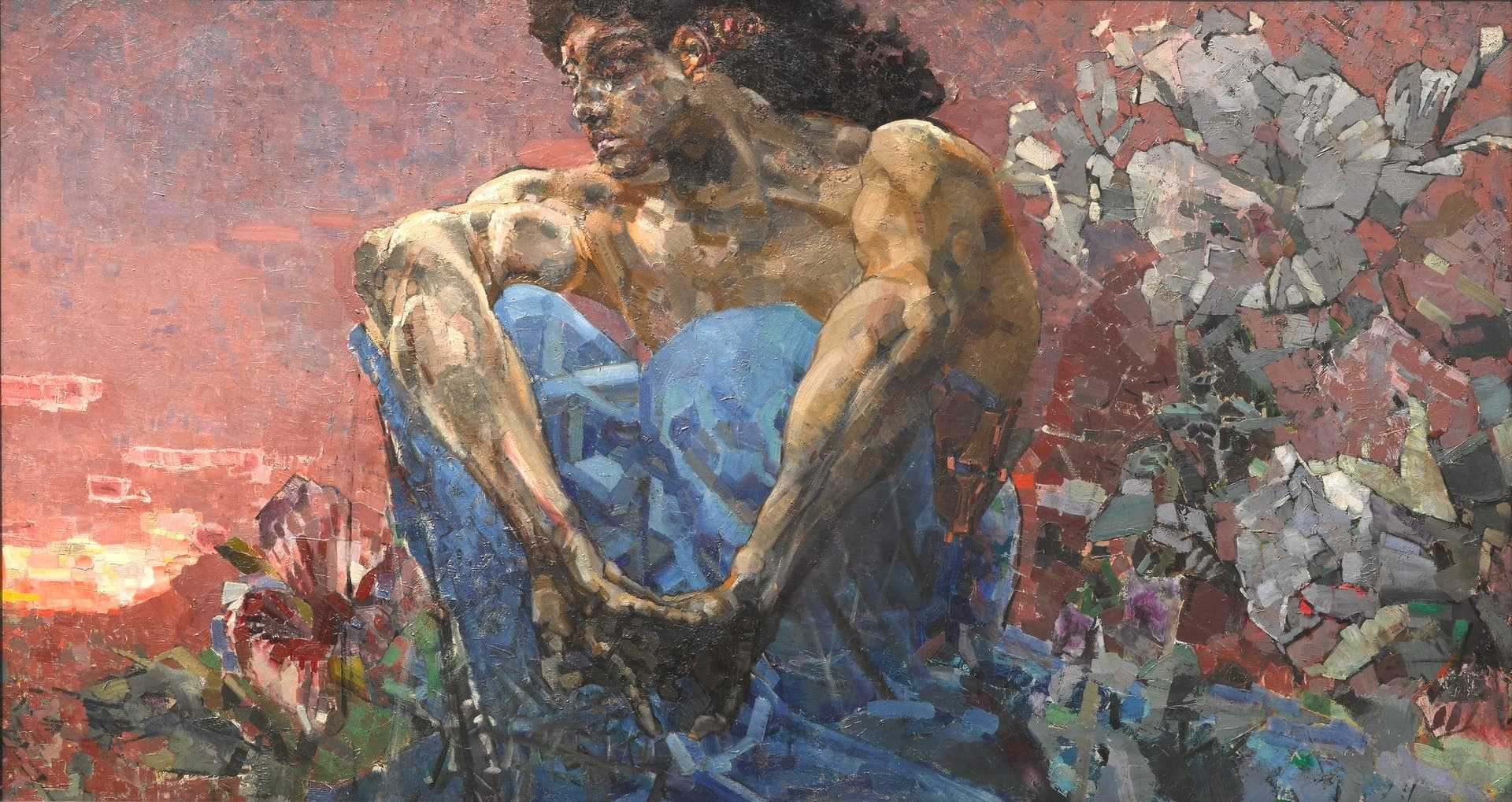
🇷🇺 Михаил Врубель - Демон сидячий (Mikhail Vrubel - The Demon Seated) (1890)
And then there is Vrubel's Demon, sitting outside the garden entirely. Not participating in the frenzy, but not free of it either. Just sitting there, surrounded by crushed flowers, brooding. The Demon is the Underground Man at the end of the party — the one who went, who saw, who participated in his own way, and who came back with nothing but a deeper kind of emptiness.
The Right Panel: Hell, or the 3 AM Reckoning
The right panel is hell.
But it's not the hell you might expect. There are no classical demons with pitchforks, no lakes of fire in the traditional sense. Bosch's hell is something far more disturbing: it is a world where familiar things have become instruments of torture. A lute has become a rack. A harp has become a cage. Musical notation is written on flesh as if pleasure itself had turned prosecutor. And then there are those giant ears, split by a knife, moving across the panel like a machine built out of violated listening.
This is what Freud would later call das Unheimliche — the Uncanny. Not the terrifying stranger, but the terrifying familiar. The horror that comes not from something unknown but from something known that has been twisted, made wrong. The instrument you once played for joy now plays you for pain. The city you once loved now chases you like a hungry dog. The screen you once used to connect now traps you in isolation.
I wrote about this feeling in Stańczyk and the Paradox of the Sad Clown — the moment when the thing that is supposed to bring joy becomes the source of suffering. Stańczyk makes everyone laugh but cannot laugh himself. The Underground Man knows exactly what would make him happy but deliberately chooses misery. The doomscroller knows that putting the phone down would bring relief but picks it up again anyway. The instrument has become the instrument of torture.
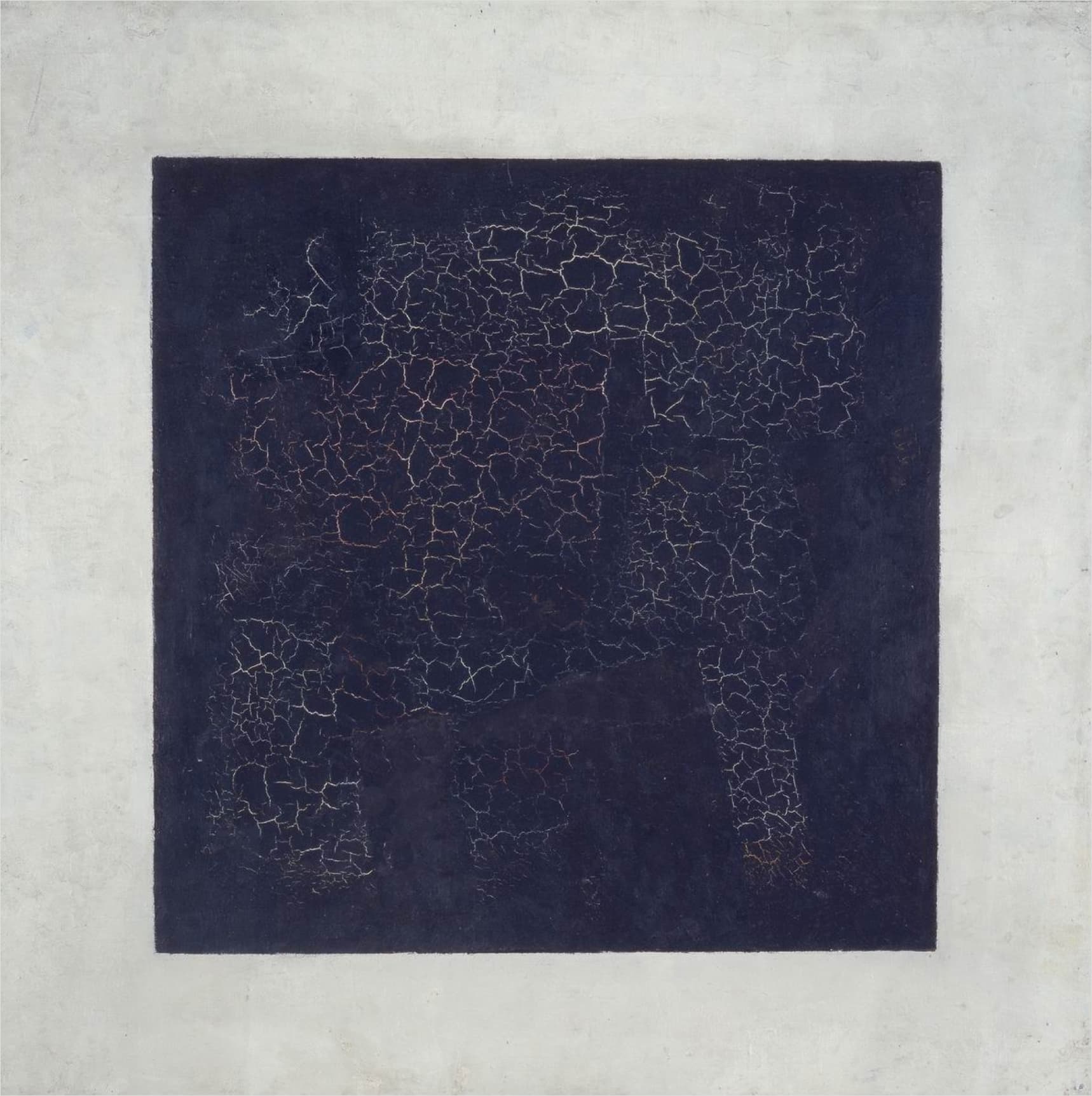
🇺🇦 Kazimir Malevich - Black Suprematic Square (1915)
And at the end, what is left? The Black Square. The void that I explored in my article about The Gambler and the Black Square. Malevich painted what the Underground Man describes: the total emptiness that follows the exhaustion of all pleasure, all spite, all nadryv. The gambler who has lost everything. The scroller who has seen everything. The lover who has pushed everyone away. What remains is a black square on a white canvas — nothing decorated, nothing distracting, just the truth of what's left when jouissance has consumed everything.
The Underground Man's final words are devastating in their simplicity. After all his grand theorizing, his bitter monologues, his masochistic adventures, he essentially says: leave me alone. "I can't go on writing from the underground." He doesn't have an epiphany. He doesn't change. He just... runs out. Like a phone battery at four in the morning.
The Triptych as Diagnosis
What makes Bosch's painting so devastating — and so relevant, five centuries later — is that it is not a morality tale. It is not saying "pleasure is bad" or "you will be punished for your desires." It is doing something much more sophisticated: it is showing the internal logic of jouissance, the way pleasure curdles into compulsion, the way innocence doesn't fall into sin but slides into it so gradually that by the time you're in hell, you can't remember how you got there.
The Underground Man understands this perfectly. He is not a villain. He is not even a bad person. He is simply someone who has become conscious of the mechanisms of his own suffering — and that consciousness, rather than liberating him, has become another trap. He knows he is destroying himself. He knows his spite is pointless. He knows that Liza genuinely loved him and he pushed her away. But knowing changes nothing. In fact, knowing makes it worse, because now he can watch himself fail, and watching himself fail becomes its own form of jouissance.
This is the paradox of consciousness that connects Bosch's triptych to Dostoevsky's underground: the more aware you become, the more trapped you are. The figures in the center panel don't know they're heading toward hell. The Underground Man knows — and he goes anyway. The scroller knows — puts the phone down, picks it up again three minutes later, and knows, and scrolls.
A Personal Reckoning
I am not going to pretend I have solved this. I haven't. I still scroll. I still find myself at three in the morning with nothing to show for the hours I've spent staring at a glowing rectangle. I still have nights where the nadryv takes over, where I pick at my own wounds not because it helps but because not picking at them would require a kind of peace I haven't learned yet.
But I think there is something valuable in naming the thing. In saying: this is jouissance. This is the drive that goes beyond pleasure. This is the underground. And this is the garden — beautiful, chaotic, full of strange bodies and stranger pleasures, leading somewhere I'd rather not go.
Dostoevsky wrote "Notes from Underground" in 1864. Bosch painted his triptych around 1500. And here I am, in 2024, recognizing myself in both of them, which either means that nothing has changed about human nature in five hundred years, or that the underground is not a place but a condition — something we carry with us, something that opens up beneath our feet whenever we stop moving long enough to notice.
The left panel is still there, dear reader. Paradise. The version of us that could have been. And maybe — this is the part I'm still working on — maybe the point isn't to get back to the garden. Maybe the point is to stop pretending we were ever there in the first place. Maybe the point is to close the triptych, put the phone down, and sit with the silence. Not because the silence is comfortable, but because it is, at least, real.
And reality, even when it hurts, is better than the garden of earthly delights. At least that's what I'm telling myself tonight, as I write this instead of scrolling. Which, I suppose, is its own kind of progress.
🇬🇧 Thank you for reading
Filed under
Keep reading