Essay / EN
The Stranger at the Feast
On Being Seen, Being Misread, and the Golden Cage of Belonging
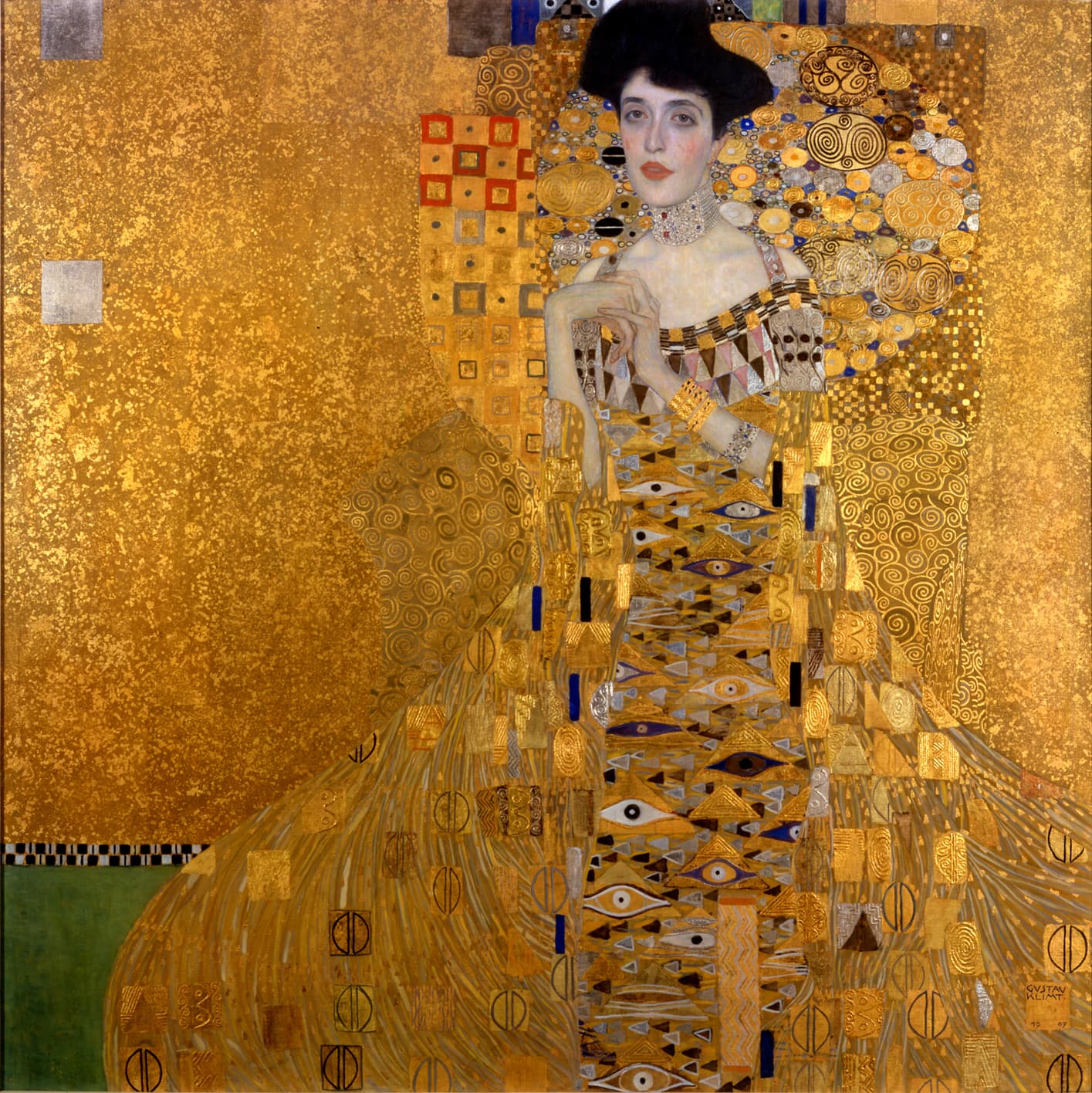
🇦🇹 Gustav Klimt - Portrait of Adele Bloch-Bauer I (1907)
I want to tell you about a party I went to once. I don't remember whose it was — a coworker's, maybe, or a friend of a friend's. This was in Antwerp, during my time in Belgium. I arrived on time, which I later learned was a mistake in Belgian social culture, where arriving on time means arriving too early. So I stood near the entrance for what felt like twenty minutes, holding a beer I didn't particularly want, watching people filter in and greet each other with that ease that some people carry like a second skin — the ease of belonging.
Someone eventually spoke to me. They asked where I was from. "Mexico," I said. They looked at me, at my face, at my name tag — because there were name tags, this was that kind of party — and they said, "No, but where are you really from?" And I felt it again. That familiar thing. Not anger exactly, not sadness exactly, but something heavier. The feeling of being looked at and being seen wrong. Of being present in a room and absent from it at the same time.
Years later, in a museum I can't remember the name of, I stood in front of Klimt's portrait of Adele Bloch-Bauer, and I felt something similar. Adele is there. She is undeniably, magnificently there — her face rendered in meticulous detail, her hands clasped, her eyes looking slightly away from you. But she is also drowning. The gold that surrounds her — the ornamental spirals, the geometric patterns, the shimmering Byzantine excess — is consuming her. She is simultaneously the most visible thing in the room and the most invisible. She is seen by everyone and known by no one. She is entombed in gold.
This article is about that feeling. About being the stranger at the feast. About being looked at and being looked through. About the golden cage of partial belonging.
The Woman in Gold
Let me tell you about Adele. She was born Adele Bauer in 1881, in Vienna, into a wealthy Jewish banking family. She married Ferdinand Bloch, who added her surname to his own, becoming Bloch-Bauer. She was intelligent, cultured, and by all accounts, restless — she hosted a salon that attracted some of Vienna's most prominent intellectuals. She was, in the language of her time, perfectly assimilated. She dressed right, spoke right, moved in the right circles. She was Viennese.
And yet. She was Jewish in a city that would, within three decades of her death, enthusiastically participate in the annihilation of its Jewish population. She belonged and she didn't belong. She was inside the room and outside the room at the same time.
Klimt painted her twice. The first portrait — the one we're looking at — was completed in 1907. It took three years. Klimt made over one hundred preparatory sketches. And what he produced was not so much a portrait as a gilded cage. The gold leaf technique Klimt used was borrowed from Byzantine iconography — the same technique used to paint saints and madonnas. Klimt turned Adele into an icon. He made her sacred. But in doing so, he made her less human. The gold covers her body, merges with her dress, absorbs the chair she sits in until there is no boundary between the woman and the decoration. Where does Adele end and the ornament begin?
And the painting's history only makes that question crueler. After the Anschluss, Ferdinand Bloch-Bauer fled Austria. The Nazis seized the portrait. Adele's name was slowly stripped away from the work, replaced by the neutral, glittering title "Woman in Gold," as if the easiest way to erase a Jewish woman were to turn her into a color. Even after death, even after paint had dried, she could be kept and misnamed at the same time.
This is the visual equivalent of what Georg Simmel, the German sociologist, described in his 1908 essay "The Stranger" — a concept I didn't learn about in school, because I didn't study sociology, but that I stumbled upon one night while reading something else entirely, and it hit me the way certain things hit you when you've been carrying them without knowing their name.
Simmel's Stranger
Simmel's stranger is not the outsider who has never been part of the group. That would be too simple. The stranger, Simmel says, is someone who comes today and stays tomorrow — who is part of the group but not entirely of it. The stranger is both near and far, present and absent, inside and outside. They share the space with everyone else but they are not rooted in it the way the others are. They arrived from somewhere else, and that somewhere else clings to them like a smell, like an accent, like a name.
I have been the stranger everywhere I have gone.
In Mexico, I was the kid with the Arabic name. Abdul Hamid. Try carrying that through a schoolyard in Durango. Try carrying that through a piñata party in Peñón Blanco, which I wrote about in Stańczyk and the Paradox of the Sad Clown — the party where I fell and everyone laughed, and I ran crying into the forest because I couldn't bear the weight of being the wrong kind of person in a room full of people who fit effortlessly into each other's worlds. "The terrorist." "The Muslim." "The foreigner." In my own country. In my own state. In my own language.
In Belgium, the dynamic inverted but the result was the same. Now I was Mexican. Now I was the Latin American. Now I was the one who spoke funny and ate strange food and didn't know how to order a beer in Flemish. "Where are you really from?" In Belgium, the question came in a friendlier tone but it had the same blade underneath: you are not from here. You will never be from here. No matter how good your English is, no matter how many winters you survive, no matter how many friends you make at Winkelhaak, you carry your elsewhere with you.
Simmel said something that broke me open when I read it: the stranger is "the person who comes today and stays tomorrow." Not the wanderer who leaves — the one who stays. That's what makes the stranger so threatening and so useful to the group. The stranger is close enough to observe the group's inner workings but distant enough to never be fully absorbed. The group needs the stranger precisely because the stranger sees what the insiders cannot.
I think about this when I think about Adele. She was the stranger in gold. The Jewish woman in Vienna who belonged so thoroughly to the culture that she was literally gilded by its most celebrated painter — and who, three decades later, would have her painting stolen by the Nazis, her identity erased, the portrait renamed "Woman in Gold" to strip it of its Jewish specificity. She was seen and unseen. Present and absent. The stranger at the feast.
Sartre's Look
Jean-Paul Sartre, in "Being and Nothingness," described what he called le regard — the Look. The moment when another person's gaze falls on you and you become, in that instant, an object. Before the Look, you exist for yourself — you are a subject, a consciousness, a freedom. After the Look, you become a thing that is seen. You become what the other person sees.
I think about the Look when I think about name tags. When I think about customs officers. When I think about the way a room subtly rearranges itself when you enter it and people register your face, your name, your accent, and construct a version of you that has nothing to do with you.
I remember standing in an airport — I don't remember which one, maybe Brussels, maybe Mexico City — and being pulled aside for additional screening. The officer looked at my passport, looked at my face, looked at my passport again. Abdul Hamid Sánchez García. The name didn't compute. It didn't fit into the categories. Mexican passport, Arabic first name, Spanish surnames. The Look lasted maybe five seconds, but in those five seconds I was not a person. I was a discrepancy. I was something that needed to be resolved.
This is what Sartre means. The Look reduces you. It takes the infinite complexity of your inner life — your memories, your fears, your love of Dostoevsky and Vrubel and the way the light hits Guadalajara's Providencia neighborhood at five in the afternoon — and it compresses all of that into a category. Foreign. Suspicious. Other. And the worst part is that in the moment of being seen that way, you start to see yourself that way. Sartre called this "bad faith" — the temptation to accept the identity that others project onto you, to become the object of their gaze instead of the subject of your own life.
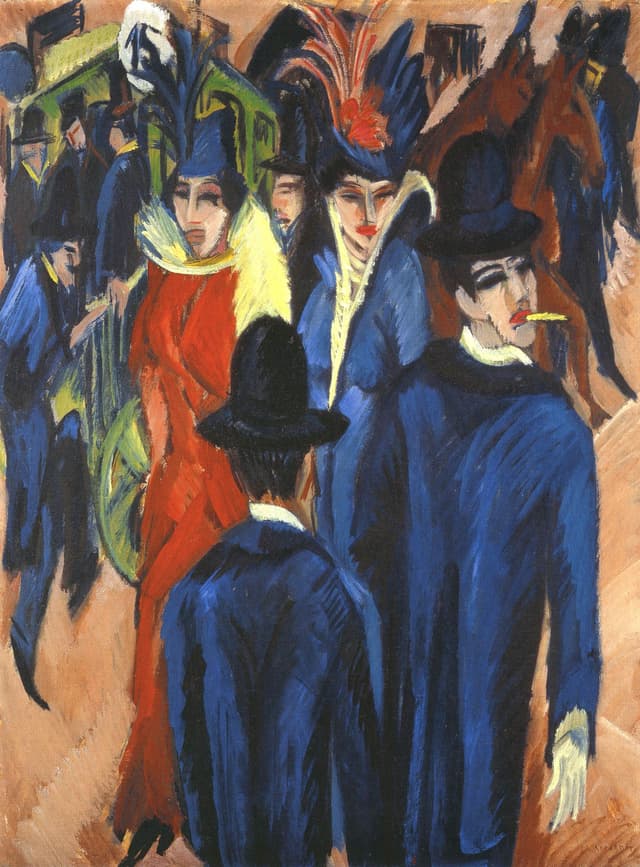
🇩🇪 Ernst Ludwig Kirchner - Berlin Street Scene (1913)
Kirchner's "Berlin Street Scene" captures this perfectly. Everyone in the painting is performing for everyone else. The figures are elongated, angular, almost inhuman — they are not people so much as surfaces designed to be seen. They walk past each other on a street that vibrates with the anxiety of mutual observation. Nobody is at home. Everybody is on display. I wrote about this painting in City, in the context of urban alienation. But looking at it now, through the lens of Sartre and Simmel, I see something else: a street full of strangers, each one trapped in the Look of the others, each one performing a self that isn't quite their own.
Lacan's Gaze
Lacan took Sartre's Look and went deeper. For Lacan, the Gaze is not just the moment of being seen by another person. The Gaze is structural. It is the feeling of being watched by something you can't see — the sense that the world itself is looking at you, that there is an eye somewhere that you can never locate but that is always, always there.
This is the Gaze that Klimt painted. Look at Adele again. Her eyes are not looking at you. They are looking slightly to the side, slightly down. But you feel watched. The painting watches you. The gold watches you. The ornamental spirals and triangles are like a thousand eyes, decorative but relentless. This is what Lacan means by the scopic drive — the drive to see and to be seen, and the anxiety that comes with knowing that you are always already being looked at, that you can never escape the Gaze, that there is no position from which you are not observed.
For the stranger, this Gaze is intensified. The insider can forget they are being watched because the Gaze confirms their belonging — they are seen as they expect to be seen. The stranger can never forget, because the Gaze always reveals the gap between who they are and who they are perceived to be. The stranger lives in that gap. The stranger is that gap.
I live in that gap. I live between Abdul and Abdo, between Mexico and elsewhere, between Spanish and English and Russian — which I learned not because I needed to but because it felt like a language that understood melancholy, that had been built to hold the kind of sadness I was carrying. I write this blog in three languages not because I have three audiences but because I am three audiences. Because no single language contains all of who I am. Because the act of translation — the constant, exhausting act of carrying meaning from one world to another — is the condition I live in, not a choice I made.
The Golden Cage
Let me return to Klimt. Let me return to the gold.
There is a reading of this painting that sees the gold as celebration — Klimt honoring Adele, crowning her in the visual language of sacred art, elevating her to the status of a Byzantine Madonna. And that reading is not wrong. But there is another reading, the one that interests me more, which sees the gold as a trap. As a gilded cage. As the price of belonging.
Adele belonged to Viennese society. She was accepted, admired, celebrated. But the price of that acceptance was this: she had to become gold. She had to become ornament. She had to allow herself to be absorbed into the decorative surface, to let the patterns and spirals and geometric shapes consume her individual features until she was less a person and more a beautiful thing. This is what Bourdieu would call symbolic violence — the violence that is done to you when you accept the terms of a field that wasn't designed for you, when you play a game whose rules require you to erase the parts of yourself that don't fit.
I know this violence. Every immigrant knows it. Every person with a name that doesn't match their face knows it. You learn to code-switch. You learn to laugh at the jokes about your name. You learn to pronounce your own name the way others find comfortable — "Just call me Abdo, it's easier" — and something inside you folds a little bit every time you do it. You become gold. You become ornament. You become the acceptable version of yourself, and the unacceptable version — the one who prays in a language no one around you speaks, or doesn't pray at all but carries the name of someone who did — that version sits somewhere in the background, like Stańczyk sitting behind the party, unable to participate.
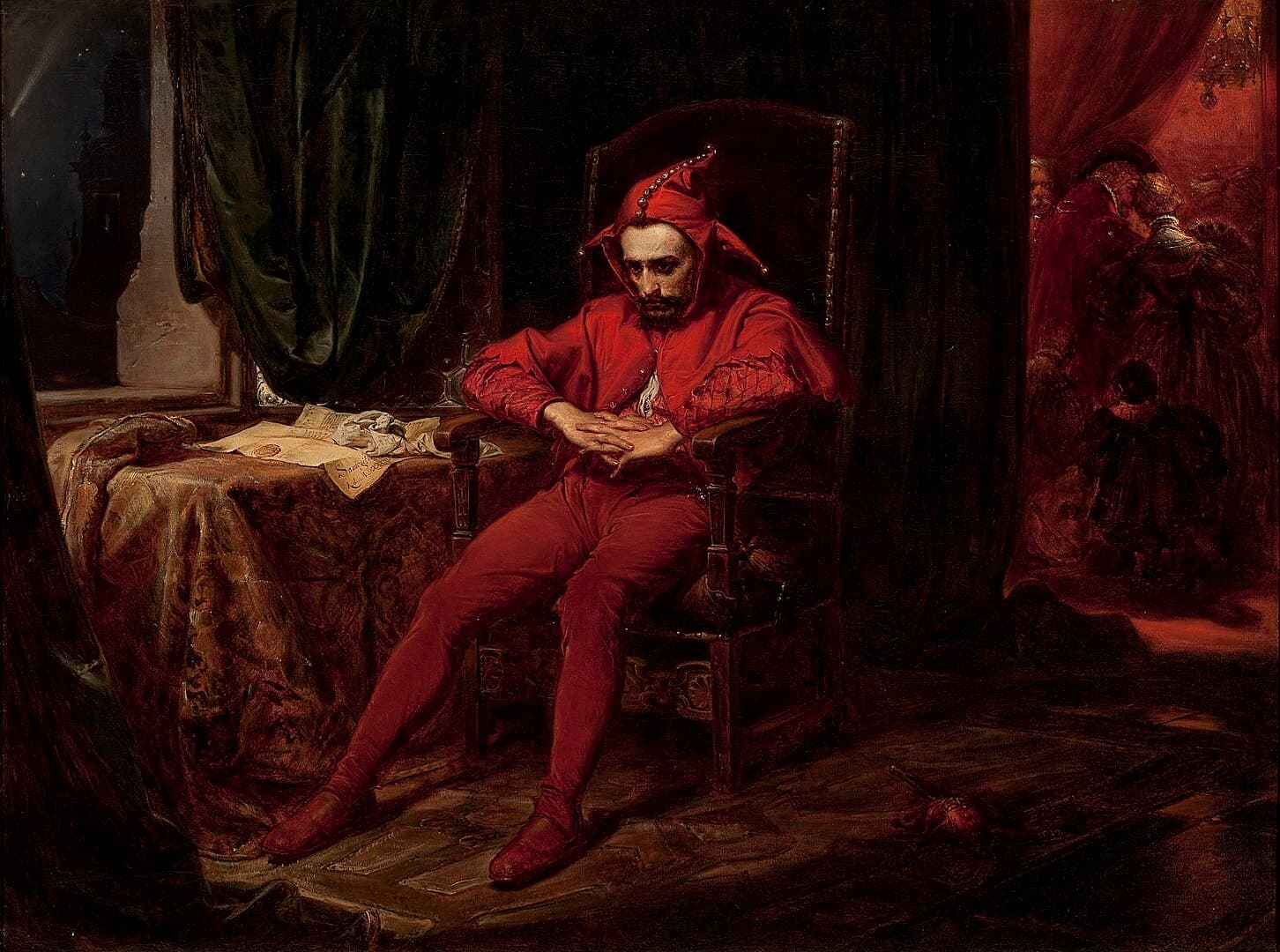
🇵🇱 Jan Matejko - Stańczyk (1862)
I wrote about Stańczyk as the sad clown, the jester who cannot cheer himself up. But looking at him now, I see something else. Stańczyk is the stranger at the feast. He is present — he is literally at the party — but he is not part of it. He sees what no one else sees: that the city has fallen, that the kingdom is in danger, that the celebration is a lie. And he can't say anything because his role — like the immigrant's role, like Adele's role — is to perform. To entertain. To be the version of himself that the room requires.
The Stranger's Gift
But here is the thing that Simmel understood, and that Sartre and Lacan, for all their brilliance, sometimes forgot: the stranger's position is not only suffering. It is also sight.
The stranger sees what the native cannot see. Because the stranger has nothing invested in the group's illusions, the stranger can perceive the structures that the insiders take for granted. The stranger can say: the emperor has no clothes. The stranger can look at the golden surface and see the cage underneath. The stranger can sit at the feast and notice that the music is covering up the silence.
This is, I think, why I write. Not in spite of being the stranger but because of it. The blog you're reading — this strange, trilingual, obsessively art-paired, deeply personal thing — could only have been written by someone who doesn't fully belong anywhere. Who moves between cultures the way you move between rooms in a house that isn't yours — carefully, attentively, noticing the details that the people who live there have long stopped seeing.
Every article I've written has been, in some way, about the stranger's perspective. The Gambler was about watching someone destroy himself from the perspective of someone who recognized the pattern. City was about walking through a familiar city and feeling like an intruder. Stańczyk was about performing for a room that doesn't know you're suffering. And this article — well, this article is the one where I stop talking around it and say it directly: I am the stranger at the feast. I have always been the stranger at the feast. And I am tired of pretending otherwise, and I am also, in some strange way, grateful for it, because the stranger is the one who writes. The native lives. The stranger watches and writes.
Klimt's Adele looks slightly away from us. She doesn't meet our gaze. And I used to think this was sadness — the sadness of the beautiful woman trapped in gold. But maybe it's something else. Maybe she's looking at something we can't see. Maybe she's looking at the world from the angle that only the stranger has access to — the angle that reveals the gold for what it is. Not a crown. Not a cage. Just gold. Just ornament. Just the surface that the world puts on things when it doesn't know what to do with them.
And beneath the gold, dear reader, there is still a face. There are still hands, clasped, waiting. There is still someone in there, looking slightly away, seeing something we can't see. And maybe that's enough. Maybe being the stranger at the feast, seeing what no one else sees, carrying a name that doesn't fit and a face that confuses and a heart that beats in three languages — maybe that's not a curse. Maybe it's the only angle from which the truth is visible.
At least that's what I'm telling myself tonight.
🇬🇧 Thank you for reading
Filed under
Keep reading