Essay / EN
City
A poem of Vladimir Kotlyarov from Pornofilmy
There is a particular emptiness that follows therapy. Not peace. Not relief. Something stranger. The session ends, you step back into the city, and the world looks both newly exposed and aggressively ordinary, as if the streets had overheard everything and decided to keep pretending they were only streets.
That was the mood I was in when I put on Vladimir Kotlyarov's "City" and started walking down Montevideo Avenue in Guadalajara. Cars moved past me. People stood outside cafes. Traffic lights kept performing their small bureaucratic miracles. Nothing in the city had changed. And yet the song made it all feel predatory, as if the neighborhood had suddenly revealed the teeth hidden inside its routines.
Kotlyarov's city is not a backdrop. It is not scenery. It is a creature. A hungry dog. It follows the speaker everywhere, and that is what struck me most when I first heard it: the city in the song does not merely contain alienation. It behaves like alienation. It pursues. It clings. It turns even ordinary movement into a relation of pressure.
Walking home that day, I realized the song was not describing urban life in the sociological sense. It was describing what happens when the city becomes the external organ of an inner disturbance. The buildings do not simply surround you; they begin to echo you. The noise does not only irritate; it starts to think in your rhythm. The city becomes the form your psychic weather takes in public.
That is why three paintings kept insisting themselves into the walk: Kirchner's Berlin Street Scene, Friedrich's Wanderer above the Sea of Fog, and Picasso's Guernica. Not because the song can be neatly illustrated, but because each painting captures a different pressure the poem puts on the speaker: pursuit, loss, and catastrophe.
The Hungry Dog
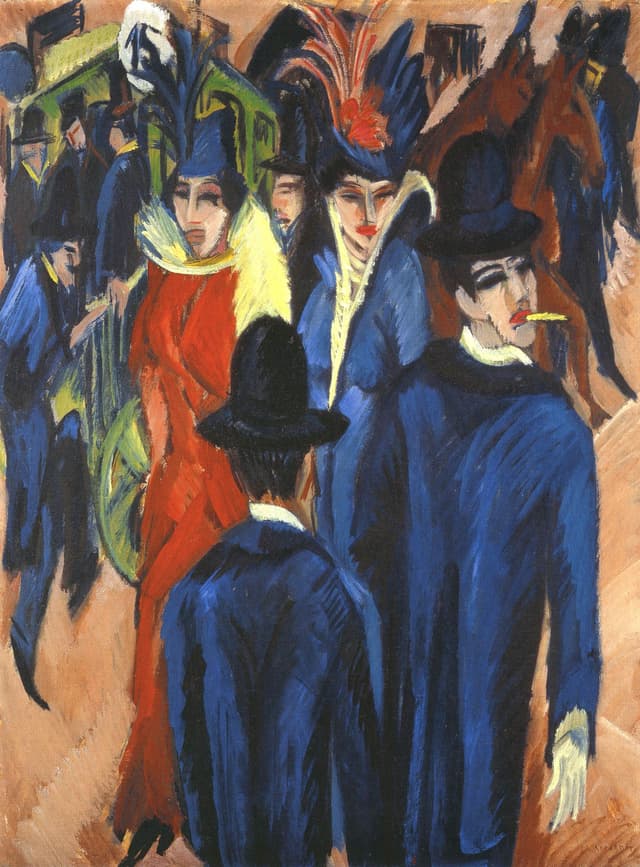
🇩🇪 Ernst Ludwig Kirchner - Berlin Street Scene (1913)
Kirchner's city never looks neutral. Even when it is only showing pedestrians, it feels aggressive. The figures are elongated, sharp, almost cut out of anxiety itself. Their faces do not invite recognition; they repel it. The street does not gather people into community. It stretches them into surfaces moving past one another under electric pressure.
That is the first truth of Kotlyarov's poem. The city is full, but it does not console. You are surrounded and still pursued. In fact, the two may be the same condition. The crowd becomes the medium through which the city chases you, because every passing face reminds you that life is proceeding elsewhere with an ease you do not presently possess.
I felt that on Montevideo Avenue. Therapy had made everything more audible. The engines, the footsteps, the fragments of conversation, the dogs barking behind gates, the thin music leaking out of shops. None of it was unbearable by itself. But together it formed a pressure system. The city did not feel like a place I was walking through. It felt like something walking beside me, refusing to let me disappear into private thought.
That is why the metaphor of the hungry dog is so exact. A dog does not only chase. It persists. It stays near enough that you cannot forget it. It turns the space behind you into a threat. In the poem, the city behaves like that: faithful in the most sinister sense, unwilling to leave you alone even when you are no longer sure whether you are fleeing danger or only your own mind.
The Death of Nature
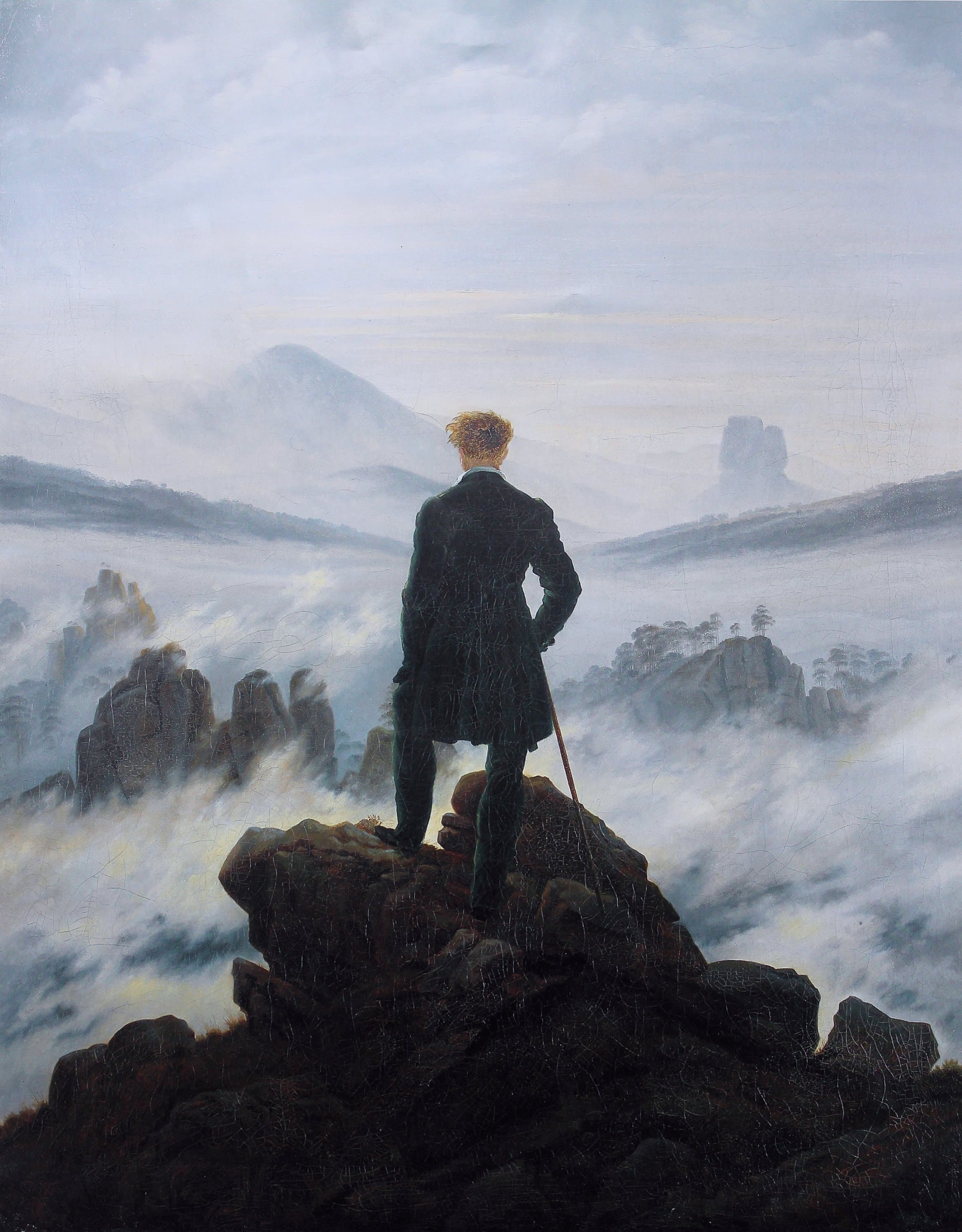
🇩🇪 Caspar David Friedrich - Wanderer above the Sea of Fog (1818)
One of the most devastating gestures in the song is the way it speaks of nature as something already dead, already buried, already metabolized by the urban machine. Kotlyarov does not present ecological ruin as an abstract issue or a future warning. He presents it as a fact the city has already incorporated into its metabolism.
That is where Friedrich enters, not as a cheerful opposite but as a lost possibility. His wanderer stands above mist and mountain in a posture of sublime confrontation. He is solitary, yes, but his solitude still presumes a world large enough to answer him. The landscape retains mystery. The self is not yet entirely enclosed by the systems it has built.
In Kotlyarov's city, that answer has been withdrawn. The natural world no longer appears as a horizon of transcendence but as a memory of scale. The speaker is not standing above the fog; he is being swallowed by exhaust, concrete, noise, debt, and repetition. Nature survives only as a negative image, an afterlife inside language.
This is what the therapy walk made visible to me. Not simply that cities are crowded or ugly or environmentally destructive — all of which would be too easy — but that urban life can slowly teach the body to distrust stillness. The more intensely one lives inside asphalt rhythms, the more impossible silence begins to feel. The city colonizes not only space but tempo.
And once tempo has been colonized, even your inner life starts to move like traffic.
Fear in the Sky
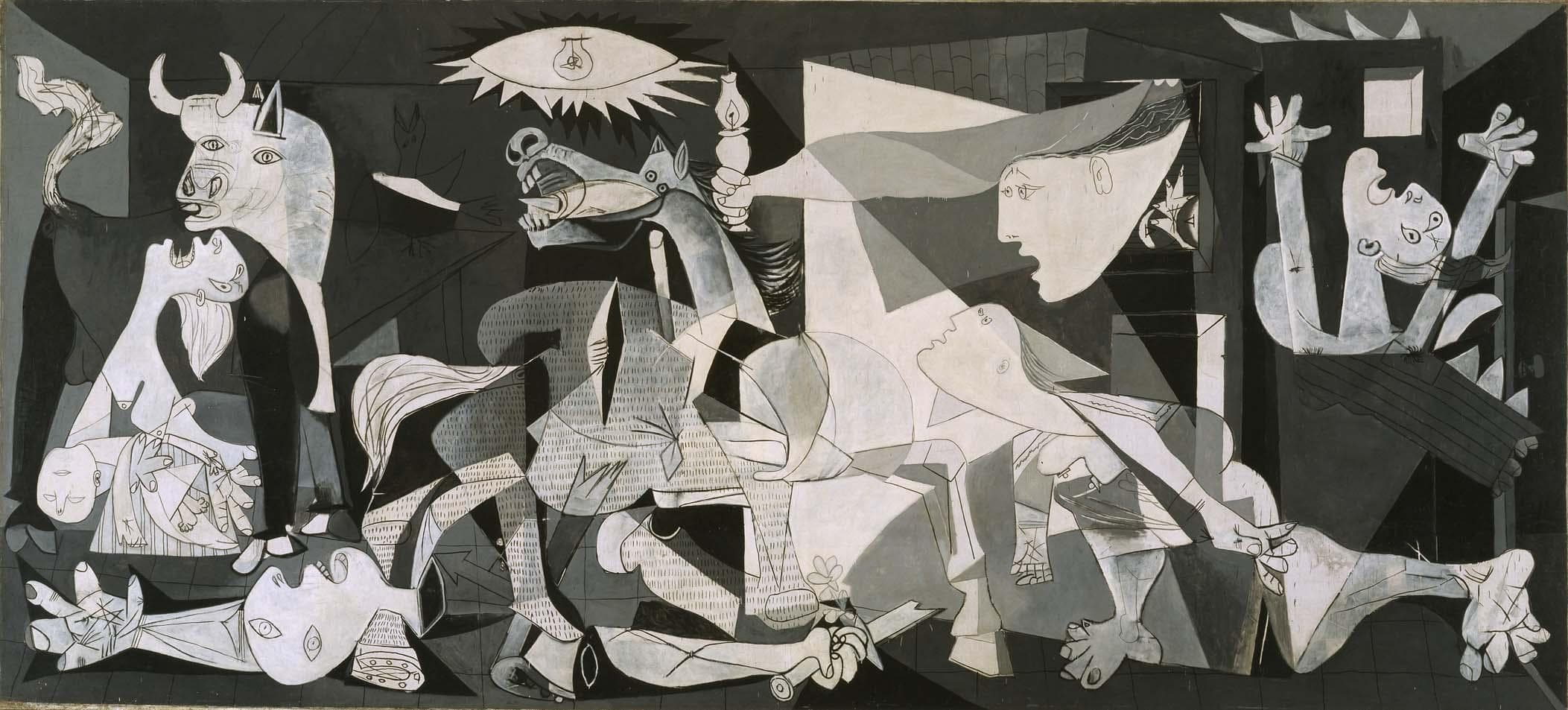
🇪🇸 Pablo Picasso - Guernica (1937)
The song's world is not only crowded and contaminated. It is also threatened. Explosions, white powder, fear in the sky: the poem keeps lifting its gaze upward only to discover that even the heavens have been drafted into catastrophe.
That is why Guernica belongs here. Picasso's painting does not depict war from the safe distance of history painting. It depicts war as psychic shrapnel. The broken horse, the screaming mouths, the dismembered light, the bodies that look less killed than fractured by a force they cannot comprehend: all of it feels like reality after coherence has been bombed out of it.
Kotlyarov's city has that same vibration. Not because the poem is literally about the Spanish Civil War or even literally about one event, but because it captures a consciousness in which disaster is ambient. The city is no longer just where things happen. It is where danger accumulates in advance, where one learns to breathe inside permanent low-level alarm.
That may be why the poem affected me so strongly after therapy. Therapy often returns you to the world with your nervous system temporarily stripped of its usual defenses. Things arrive more nakedly. A siren is not background. A crowd is not neutral. A memory does not stay politely in the past. On that walk, the song and the city began reflecting each other so perfectly that I could not tell whether Guadalajara had become Kotlyarov's landscape or whether the poem had simply given me the language for the city I was already carrying in my body.
The City as Psychic Weather
What stays with me about the song is not only its anger but its precision. It understands that urban life is never merely external. The city gets into your posture, your pace, your breathing, your capacity for solitude. It follows you home. It keeps moving inside you after the walk is over.
That is why I do not hear "City" as a protest song alone, though there is protest in it. I hear it as a diagnosis of psychic weather under modern conditions. The city is the place where private pain and public catastrophe start borrowing each other's language. Ecological dread, political dread, personal dread: they stop arriving separately. They merge into atmosphere.
I reached home that day still hearing the song. The avenue was behind me, but not really. The city had followed me the way the poem said it would. Maybe that is what good art does when it catches you at the right moment: it does not decorate experience. It reveals the form experience was already taking before you knew how to look at it.
And so the city remained what Kotlyarov said it was: not just architecture, not just traffic, not just a social arrangement, but a hungry animal pacing just behind thought.
I wish I could say it stopped at my door.
It didn't.
🇬🇧 Thank you for reading
Filed under
Keep reading