Essay / EN
The Demon and the Melancholic
On Mourning, Madness, and the Things We Cannot Put Down
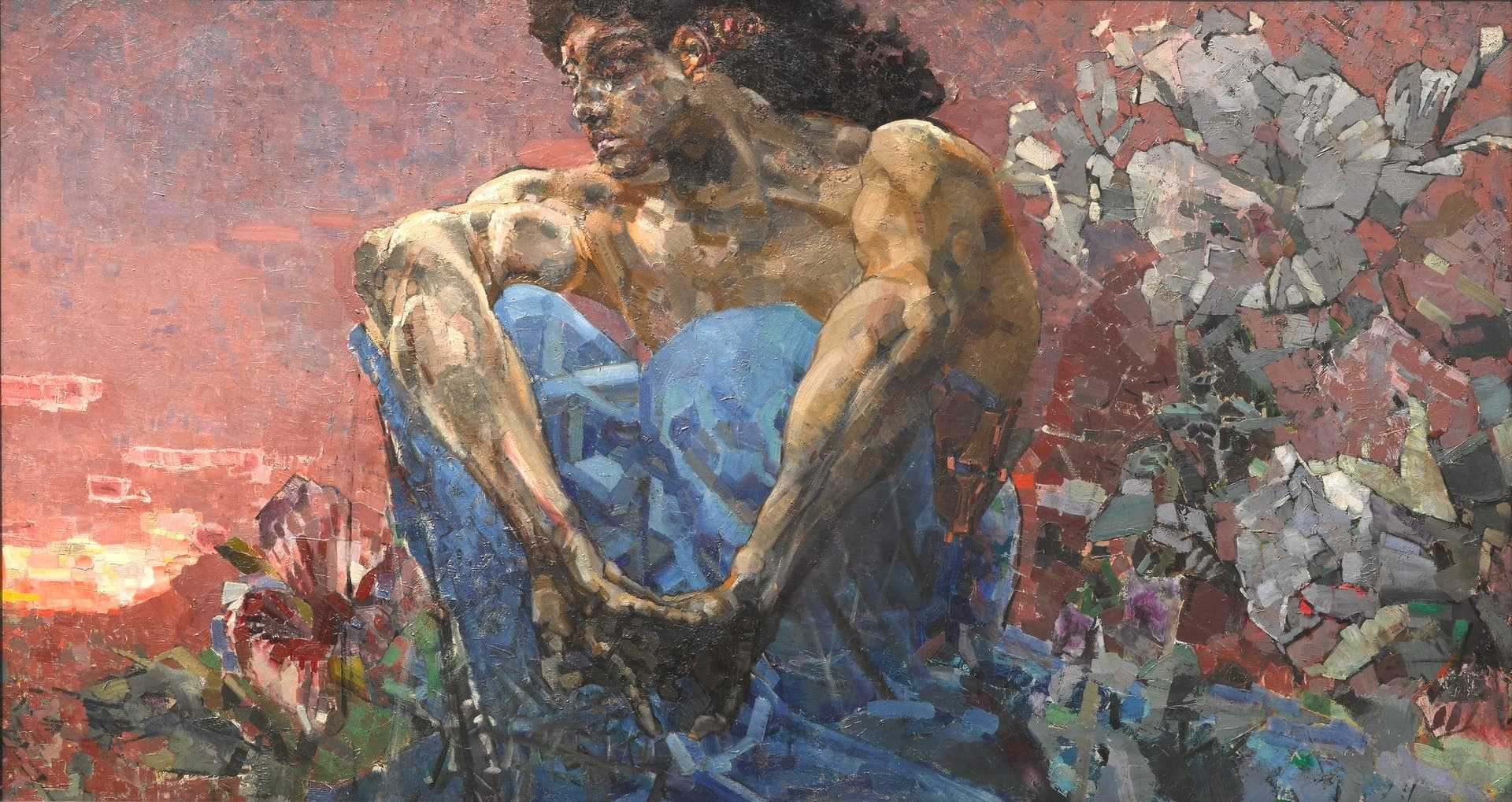
🇷🇺 Михаил Врубель - Демон сидячий (Mikhail Vrubel - The Demon Seated) (1890)
There is a kind of sadness that doesn't have a name. Not in English, not in Spanish. Maybe in Russian — the Russians have always been better at naming the things that hurt. But even in Russian, what I'm trying to describe sits somewhere between тоска and печаль, between longing and grief, in a place where you can't tell whether you're missing something specific or just missing in general.
I first saw Vrubel's "Demon Seated" in a reproduction inside a book about Russian art that I found in a secondhand bookstore in Guadalajara. It was maybe two inches wide on the page, and it stopped me completely. The Demon sits on a mountain of crushed flowers, his enormous arms wrapped around his knees, his face turned to the side as if he can't bear to look at you. Or maybe as if he's looking at something you can't see. Something that isn't there anymore.
I recognized that posture immediately. I had been sitting like that for weeks.
I had recently come back from Belgium, and everything was different and nothing was different. The streets were the same streets, the food was the same food, the sky was the same sky, but something inside me had shifted in a way I couldn't articulate. It wasn't that I was sad about something specific — a breakup, a failure, a disappointment. It was more like sadness had become the medium I lived in, the way fish live in water. Not something I experienced but something I was submerged in. And when I saw Vrubel's Demon, I thought: there it is. That's what it looks like from the outside.
This article is about that painting, and about the man who painted it, and about the poem that inspired it, and about what Freud called the difference between mourning and melancholia — which is, I think, the difference between a sadness that ends and a sadness that becomes you.
The Man Who Went Mad Painting Demons
Mikhail Vrubel was born in 1856 in Omsk, Russia. He was brilliant — everyone who knew him said so. He studied law first, then art, and he brought to painting a kind of obsessive precision that was both his gift and his destruction. He didn't just paint; he attacked the canvas. He would work on a single piece for months, then years, repainting the same details over and over, never satisfied, always seeing something in his mind that his hands couldn't quite capture.
The Demon was his obsession. He painted it first in 1890 — "The Demon Seated" — and the painting was unlike anything in Russian art at the time. While the Wanderers were painting realistic scenes of peasant life and social injustice, Vrubel created this massive, muscular figure sitting alone in a twilight landscape of crystallized flowers. The Demon is not evil. He is not frightening. He is exhausted. He is beautiful and broken and impossibly heavy, as if the weight of his own existence is pressing him into the earth.
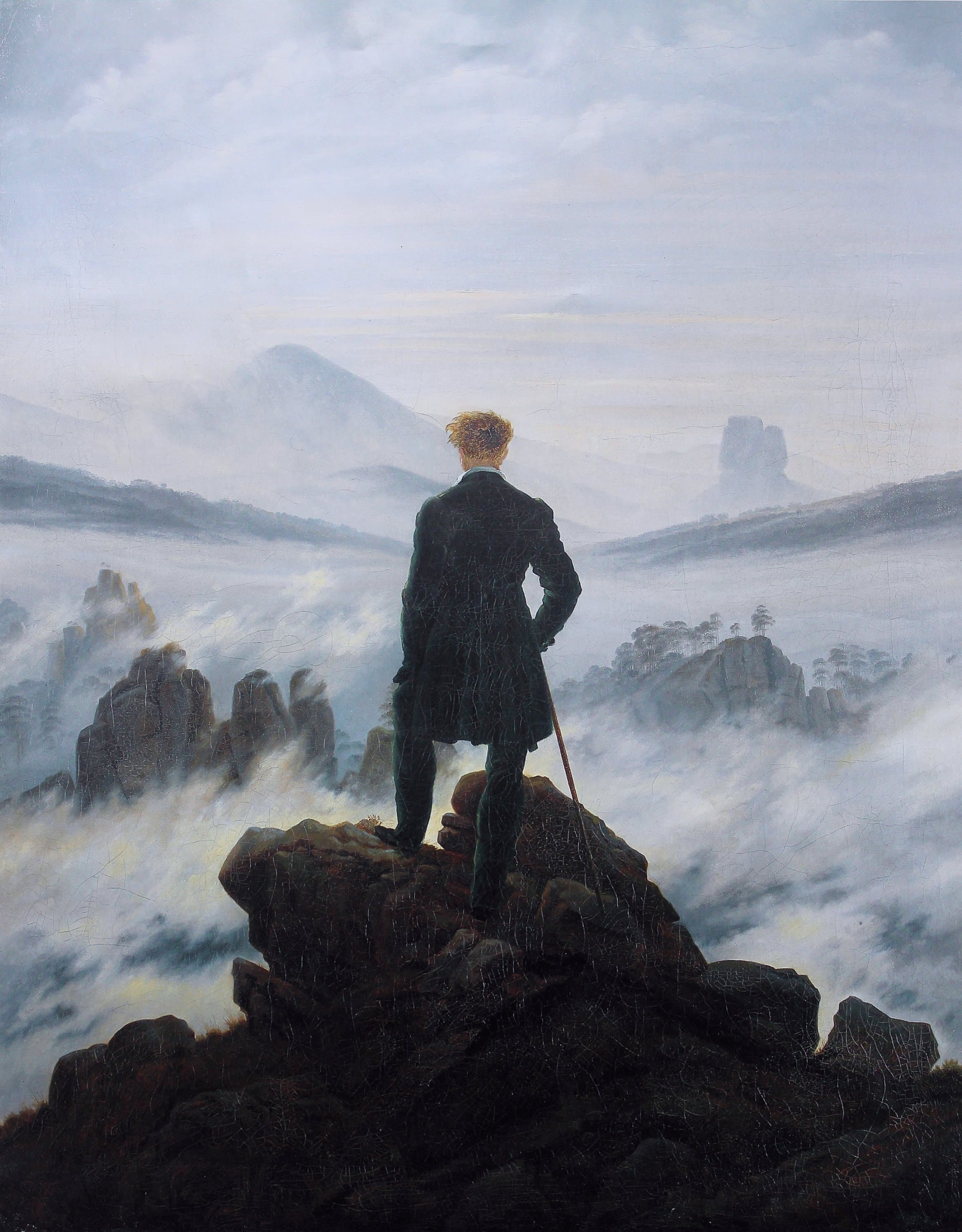
🇩🇪 Caspar David Friedrich - Wanderer above the Sea of Fog (1818)
If Friedrich's Wanderer stands above the fog looking outward with romantic possibility, Vrubel's Demon sits within the fog looking inward with nothing left to hope for. The Wanderer hasn't arrived yet. The Demon has arrived and discovered there was nothing there.
But Vrubel couldn't let the Demon go. In 1899, he began work on "The Demon Flying," and then in 1902, "The Demon Downcast" — a fallen, shattered figure with broken wings, his face distorted, his body collapsing. Vrubel kept repainting the Demon's face. Even after the painting was hung in an exhibition, he would show up at the gallery and start painting over it. His wife described watching him stand at the canvas, muttering, changing the eyes, the expression, the angle of the head, as if he were trying to get the Demon to look back at him the right way.
By 1902, Vrubel was losing his mind. He was committed to a psychiatric clinic, where he was diagnosed with progressive paralysis — likely caused by syphilis, the same illness that had shadowed so many artists and writers of his era. In the clinic, he continued to draw. He drew portraits of doctors, patients, the view from his window. And he drew demons. Always demons.
He went blind in 1906. He died in 1910, in the clinic, at fifty-four years old.
I tell you Vrubel's story not as biography but as thesis. Because what happened to Vrubel — the inability to stop, the compulsive return to the same image, the painting and repainting of something that could never be finished because it was never really about the painting — this is what Freud would call melancholia. And melancholia, unlike mourning, does not end. It becomes you.
Lermontov's Demon: Love as Destruction
Vrubel's painting was inspired by a poem — a long narrative poem by Mikhail Lermontov called simply "The Demon," written between 1829 and 1839. Lermontov was twenty-five when he finished it. He would be dead by twenty-six, killed in a duel, like so many Russian poets of his time, as if Russia consumed its artists the way the city in Kotlyarov's poem consumes its inhabitants.
In Lermontov's poem, the Demon is a fallen angel who flies over the mountains of the Caucasus, alone, exiled from heaven but unable to find a place on earth. He is neither good nor evil — just endlessly, hopelessly outside. He has seen everything and felt everything and none of it has brought him peace. He is, in the most precise sense, a stranger — the perpetual outsider I explored when I wrote about City and the experience of walking through Guadalajara feeling like the city was chasing me like a hungry dog.
Then the Demon sees Tamara — a Georgian princess, young, beautiful, alive in a way that the Demon has forgotten how to be. And he falls in love. But the Demon's love is not redemptive. It is destructive. When he kisses Tamara, she dies. Not because he wants to kill her, but because what he carries inside him — this endless, frozen grief, this exile from everything warm and living — is lethal to anyone who gets close enough to touch it.
This is the melancholic's tragedy, and I recognized it the first time I read it. The inability to love without destroying. Not out of malice but out of weight. You carry something inside you that is too heavy, too cold, too ancient, and when you open yourself to another person, that weight transfers. The breakups I went through before and during Belgium — I won't get into the details because the details are not the point — the point is that pattern. The pattern of wanting to be close and then watching the closeness break things. Of reaching out and leaving frost on everything you touch.
Lermontov understood this. He gave his Demon the most devastating line in Russian Romantic poetry: "I loved as only a spirit can love — with no hope, no reward, no end." And Vrubel painted that line. The Demon Seated is that line made visible: love without hope, without reward, without end. Just sitting there, surrounded by crushed flowers that were once beautiful, holding his own knees like a child holds himself when there is no one else to hold him.
Freud: Mourning and Melancholia
In 1917, Sigmund Freud published an essay called "Mourning and Melancholia" that made a distinction so simple it almost feels rude once you see it.
In mourning, we know what we lost. A person. A relationship. A home. The grief is brutal, but it has an address. Over time — slowly, unwillingly — the bond loosens. Mourning hurts, but mourning moves.
Melancholia is what happens when the loss cannot be clearly named. Freud says the subject may know who is gone but not what vanished in that person. So the loss is not released. It is taken inward. The quarrel that should have been with the world becomes a quarrel with the self. The melancholic does not merely remember the lost object; he installs it inside himself and then lives under its accusation.
This is why melancholia has the posture of self-hatred. Not because the melancholic simply hates himself, but because he cannot tell where he ends and the loss begins. He sits like Vrubel's Demon: arms wrapped around the body, as if trying to hold together something already splitting.
When I read Freud's essay, I thought about Vrubel repainting the Demon's eyes in the gallery, unable to get them right, because the Demon's eyes were his own eyes, and how do you paint your own eyes when you can't see yourself clearly? I thought about Alexei in The Gambler and the Black Square, gambling compulsively not to win but to lose, because losing was the only way to reenact the original loss that he couldn't name. I thought about Stańczyk, sitting with his back to the party, unable to participate in joy because the thing he lost — Smolensk, but really something deeper, something about Poland, something about himself — was inside him, attacking him from within.
And I thought about myself. About the sadness that didn't have a name. About the way I would sit, like Vrubel's Demon, with my arms around my knees, staring at something that wasn't there, feeling the weight of something I couldn't identify pressing me into whatever surface I was sitting on. It wasn't about Belgium. It wasn't about any particular breakup or goodbye. It was about something older, something that preceded all of those losses and gave them their particular flavor of devastation.
Kristeva's Black Sun
Julia Kristeva took Freud's idea somewhere colder. In Black Sun, she writes about what she calls the Thing — la Chose — an archaic loss that precedes language. Not the loss of a person exactly, but the loss of meaning before meaning had a grammar.
That is why, for Kristeva, melancholia is partly a crisis of speech. The loss sits too deep for ordinary naming. Words circle it and fail. Art gets closer because art can work where language frays — through color, posture, rhythm, silence.
This is Vrubel's Demon. Look at him again. He does not shout. He does not gesture. He folds inward. The flowers beneath him are crushed and crystalline at once, as if beauty itself had frozen under pressure. This is the landscape of melancholia: not a dramatic ruin but a world where everything remains visible and nothing remains warm.
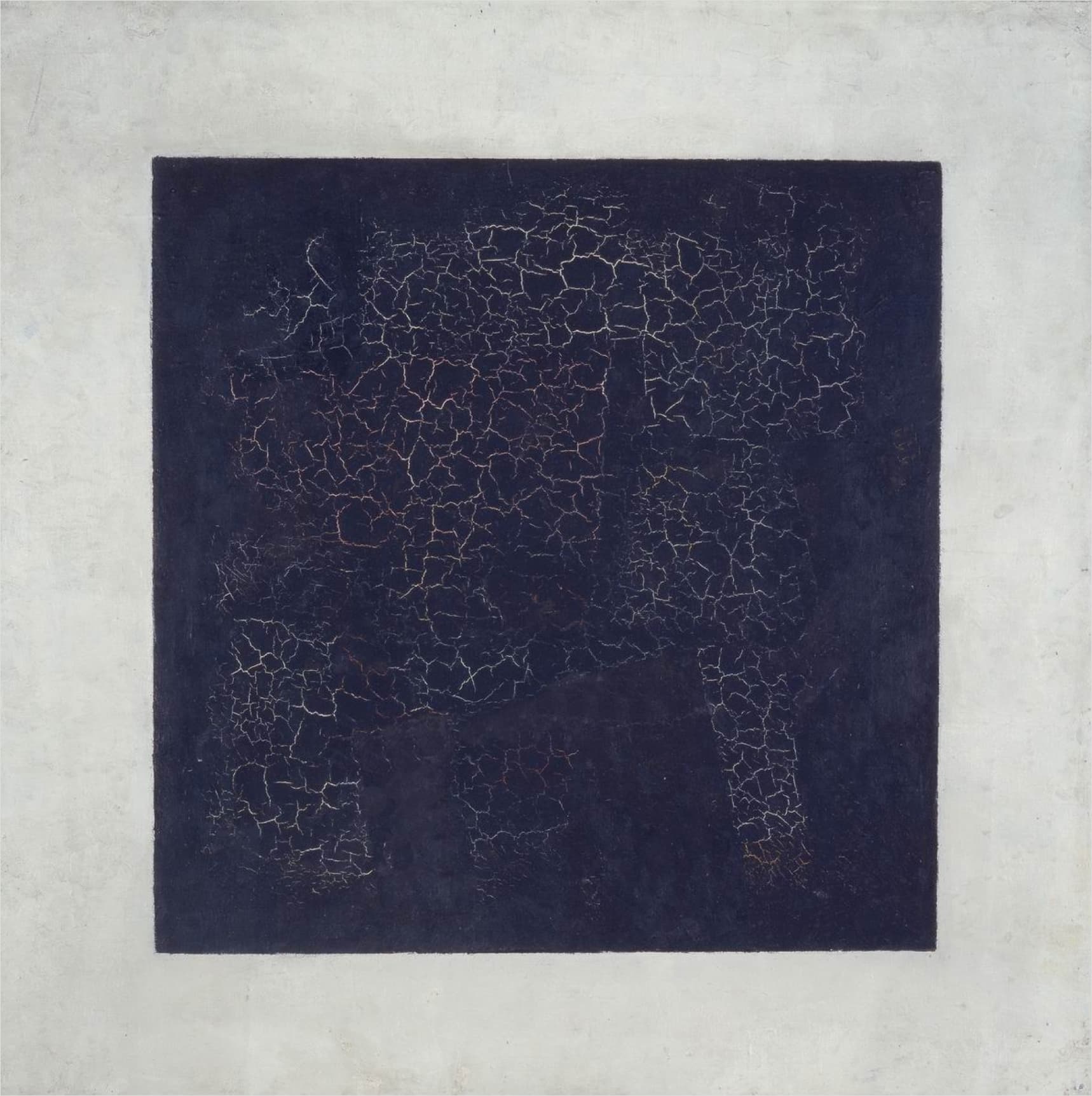
🇺🇦 Kazimir Malevich - Black Suprematic Square (1915)
And if Kristeva's black sun is the invisible center of the melancholic's world, then Malevich's Black Square is its portrait. Not despair exactly. Something prior to despair. A void so old it no longer feels like an event but like a condition.
What Lies Beneath
I promised myself when I started this blog that I would be honest, even when honesty is uncomfortable. So here is what I think lies beneath the things I've written about — the gambling, the scrolling, the inability to cheer myself up, the running away from parties, the cutting my own hair at three in the morning.
Beneath all of those compulsions, there is a loss that I can't name. Not because it's secret but because it doesn't have a name. It's the thing Kristeva calls la Chose — the thing that was lost before I had words for it. Maybe it's the loss of a homeland I never fully had — the experience of growing up Mexican with a name that made people think I was from somewhere else, of never quite being from here or from there. Maybe it's the loss of the mother tongue — because which tongue? Spanish? Arabic? Russian, which I chose because it felt like a language built for melancholy? Maybe it's something even older than that, something that has nothing to do with biography and everything to do with being a creature that knows it's going to die.
I don't know. And I think that's the point. Melancholia is the condition of not knowing what you lost. Of carrying something heavy and not being able to put it down because you can't see what it is, and putting it down would mean losing the last trace of whatever it was, and the last trace is better than nothing.
Vrubel couldn't put the Demon down. He painted it and repainted it and went blind and died and the Demon is still there, in the Tretyakov Gallery in Moscow, still sitting, still heavy, still looking at something we can't see. Lermontov couldn't put the Demon down either — he wrote the poem over ten years, revising and revising, and then he died before he could see it published, killed at twenty-six by a bullet that some say he didn't even try to avoid.
The Demon Doesn't Need to Be Defeated
I want to end this differently than you might expect. I don't want to say "and then I found the cure for melancholy" because I haven't. I don't want to say "and then I learned to let go" because I haven't done that either.
What I want to say is this: maybe the Demon doesn't need to be defeated. Maybe he needs to be understood.
Vrubel's Demon is not evil. Lermontov's Demon is not evil. They are fallen — which is to say, they are beings who once belonged somewhere and now belong nowhere. They carry the weight of that original exile in every cell of their bodies. And the question is not how to lift that weight but how to sit with it. How to be the Demon Seated without becoming the Demon Downcast — without letting the weight crush you, without painting and repainting the same face until you go blind.
Freud would say: name the lost object. Make the unconscious conscious. Kristeva would say: create. Make art from the black sun. Transform the asymbolic into symbol. Lermontov would say: write the poem, even if it takes ten years, even if you die before it's finished.
And I say, from my room in Guadalajara, with the same unnamed weight pressing on my chest: keep writing. Not because writing cures melancholia — it doesn't — but because writing is the only way I've found to sit with the Demon without becoming him. To look at the crushed flowers and say: yes, they were beautiful. Yes, they are gone. Yes, I am still here.
And for tonight, dear reader, that is enough.
🇬🇧 Thank you for reading
Filed under
Keep reading