Essay / EN
anti-intellectualism and the political carnival
on markets that are not capitalism, ladies applauding conquistadors, trumpists discovering Palestine, religious contradictions, and the exhaustion of thinking in public.
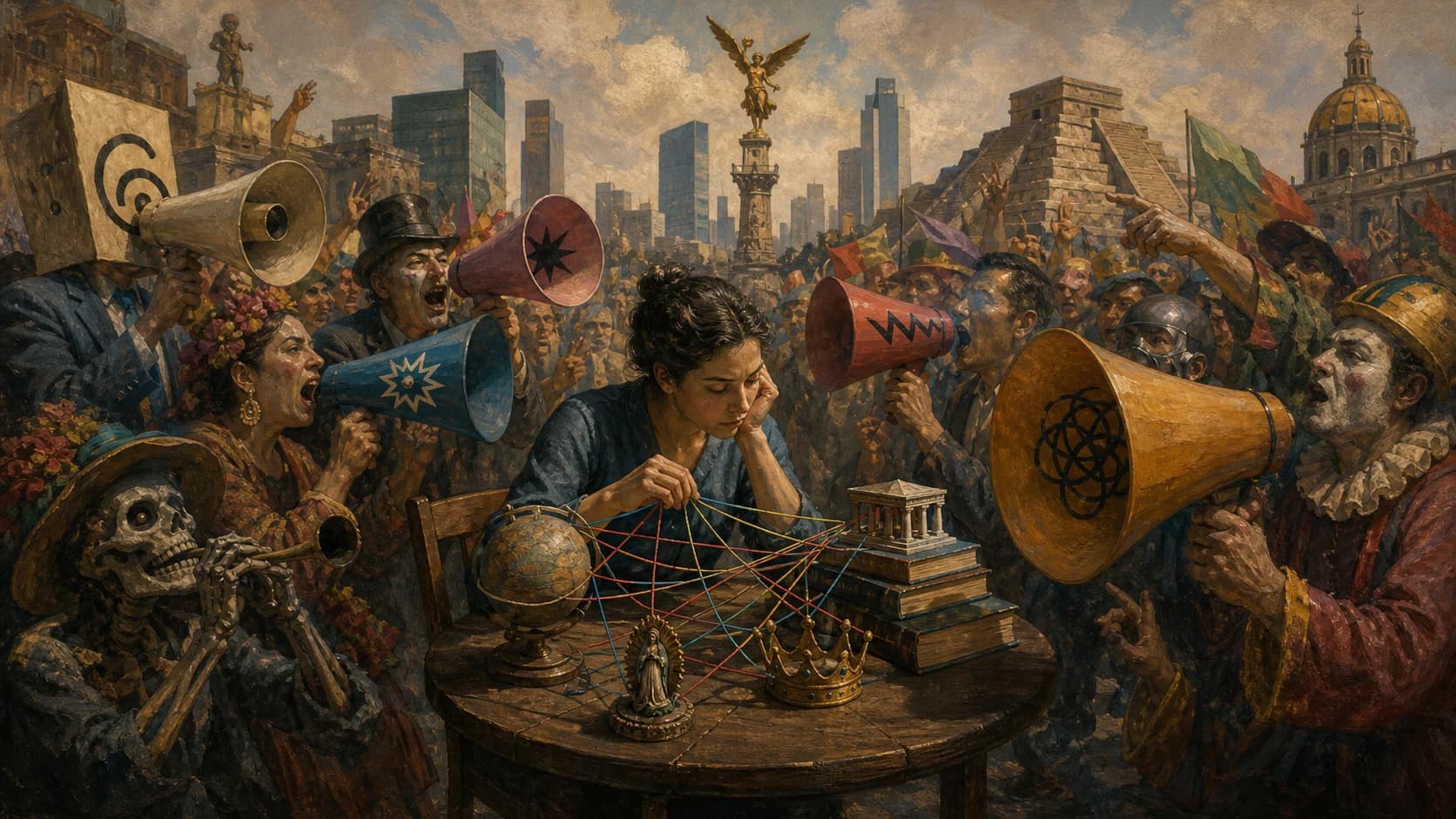
editorial cartoon generated for this essay
There is a form of political stupidity that is not the same as not knowing. Not knowing is almost innocent. All of us fail to know too much. I do not really know how a refinery works, how an elevator is repaired, how an insurance premium is calculated without someone first explaining what the number is supposed to measure. Ordinary ignorance is just the size of the world entering the room. It is not a tragedy. You ask, read, make mistakes, correct yourself. The political stupidity I mean is different. It is ignorance proud of itself, ignorance in a jacket, with a microphone, a paid campaign, and a phrase designed to end the conversation before it can begin.
Anti-intellectualism is not the absence of ideas. It is the active production of a world in which ideas are tolerated only after they have been crushed into slogans. It is the moment when someone hears the word capitalism and answers market, as if a Mexica tianguis, an Ottoman bazaar, a medieval fair, a Venetian trading house, a supermarket in Guadalajara, and a Wall Street financial platform were the same historical animal because all of them involved exchange. It is like saying that every form of kinship is a suburban nuclear family because, in all of them, someone was born. It is nonsense with expensive shoes.
And yet the nonsense circulates with astonishing confidence. The pamphlet right loves saying that markets have always existed, and therefore capitalism is natural, and therefore any criticism of capitalism is a criticism of someone buying tomatoes. It is an old trick: confuse a general human practice with a specific historical form. Exchanging things is not capitalism. Selling is not capitalism. Stalls, trade routes, coins, credit, or long-distance commerce do not by themselves make a society capitalist. Capitalism is a concrete social form: private ownership of the means of production, mass wage labor, accumulation of capital, production organized by profit, the separation of producers from the means they need to live, and the expansion of commodity logic into increasingly intimate areas of life. The point is not that there is a market. The point is that the market begins to command life.
This should be an elementary distinction. One of those things you could write on a school note card: market is not the same thing as capitalism. But contemporary political discourse has developed a deep allergy to elementary distinctions. Distinction is tiring. Distinction demands reading. Distinction ruins the thirty-second clip. So everything gets flattened. Social democracy, communism, unionism, welfare policy, environmental regulation, progressive taxation, public health, minimum wage: all of it becomes Marxism, communism, Venezuela, Cuba, famine, collapse, whatever word happens to be in rotation that day. And on the other side, every human exchange becomes capitalism, liberty, progress, civilization, the West, a mug with an eagle on it, and the same recycled slogan repeated by a man who thinks he is defending Adam Smith but probably could not survive three pages of Adam Smith without asking for a YouTube graph.
I am interested in this operation because it is not merely a conceptual error. It is an emotional defense. If capitalism becomes synonymous with markets, and markets become synonymous with humanity, then criticizing capitalism appears as criticizing human nature. You no longer have to defend miserable wages, patrimonial concentration, housing turned into a financial asset, environmental destruction, or the capture of the state by private interests. You only have to say: “oh, so you do not want people to buy and sell?” And that is it. You go to sleep feeling like Socrates with a credit card.
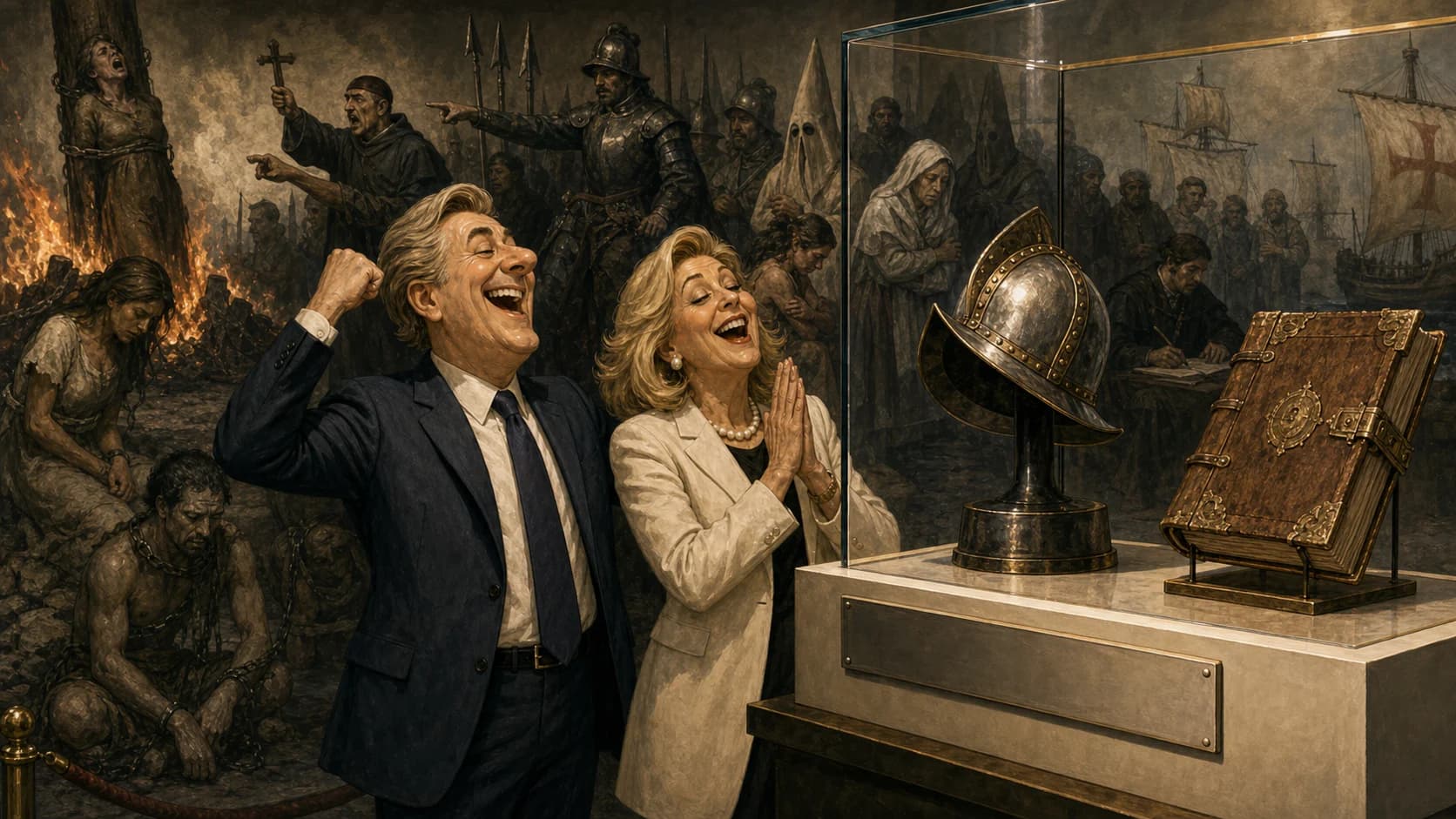
Current politics is full of these shortcuts. Not only in Mexico, of course. But Mexico has its own special way of turning ignorance into a class performance. Here anti-intellectualism arrives perfumed with “common sense,” “civility,” “values,” “freedom,” and a very strange nostalgia for historical periods in which most of the people now defending them would have had no voice, no vote, no property, no mobility, and perhaps not even permission to speak in public. I am thinking of the recent spectacle, almost too perfect not to look like parody, of Isabel Díaz Ayuso attending a tribute to Hernán Cortés in Mexico City alongside Alessandra Rojo de la Vega. In the twenty-first century. In the capital of a country built on the colonial wound, a Spanish regional president and a Mexican conservative mayor found it urgent to applaud the conquistador as though they were attending a club meeting of men in ruffs, swords, and the smell of damp archives.
The scene would be comic if it were not so revealing. One can imagine it as a bad sketch: two contemporary public figures, direct beneficiaries of centuries of liberal, feminist, labor, republican, and civil rights struggles, celebrating a past in which their own rights would have depended on a father, a husband, a crown, a church, or a male permission slip. Modernity gave them the possibility of exercising public power; they thank it by flirting with the political fantasy of returning to the world that would have made that power impossible. It is a level of historical ingratitude that almost deserves a medal, perhaps a rusty one, found in a family trunk next to an encomienda letter.
editorial cartoon generated for this essay
There is not much need to invent. The event happened and caused controversy. Press reports described the tribute to Cortés, the relocation of the event after the cancellation at the Metropolitan Cathedral, the presence of Ayuso and Rojo de la Vega, and the rhetoric of “mestizaje” as if mestizaje erased violence, as if the existence of mixed descendants cancelled the existence of subjugated peoples, exploited bodies, battered languages, and memories still alive. The word mestizaje, in the mouth of a certain Hispanic right, functions as moral detergent: pour it over the Conquest and wait for it to come out clean, fragrant, ready for the museum.
Precision matters here. The point is not that Mexican history is simple, or that Cortés is a flat cartoon villain, or that the Conquest can be understood with an indignant tweet. Exactly the opposite. History is complex. There were Indigenous alliances against the Mexica empire, imperial resentments, epidemics, translations, negotiations, betrayals, Spanish violence, preexisting Indigenous violence, religious orders, legal processes, economic interests, and a world transformation on a scale that is almost impossible to grasp. Complexity exists. But complexity does not authorize turning the conquistador into the patron saint of liberty, and it does not justify reciting mestizaje as a password that lets us avoid talking about domination. One thing is to study the Conquest without nationalist catechism. Another is to cheer for the conquistador in Mexico City as though the country were a fan club for Isabella the Catholic.
The absurdity is not in looking at the past. The absurdity is in looking at the past through souvenir eyes. The reactionary right does not love history; it loves a moral scale model of history. It loves kings without plagues, empires without slavery, religion without inquisition, markets without exploitation, families without domestic violence, nations without inconvenient Indigenous people, freedom without unions, order without prisons, modernity without feminism. It is an aesthetic operation: take what is useful from the past, varnish it, put warm lighting on it, and sell it as civilization. Everything else goes to the basement.
That is why The Handmaid's Tale works so well as a mirror. I am only starting season four, so I am not going to discuss spoilers beyond what the premise itself already makes clear. Gilead is not simply a bad religious regime. It is a reactionary fantasy carried to its logical form. It says it protects women while reducing them to reproductive function. It says it defends the family while destroying real bonds. It says it honors life while governing through terror. It says it obeys God while turning faith into bodily administration. Everything is full of contradictions because moral authoritarianism always lives on contradictions. It needs women but does not want to hear women. It needs reproduction but despises the autonomy of the bodies that reproduce. It needs religion but turns it into bureaucracy. It needs love but can only produce obedience.
The most disturbing thing about Gilead is not that it is completely alien. The disturbing thing is recognizing loose fragments, small particles, sentences we have already heard in ordinary life. The idea that women's freedom was a modern mistake. The idea that civil rights are excesses. The idea that minorities ask for too much. The idea that social order must be restored by returning to a “natural” hierarchy. The idea that cruelty can be justified as protection. Gilead does not fall from the sky. Gilead is built from sermons, resentments, demographic fear, economic crisis, propaganda, family nostalgia, and mediocre men who discover that the word God fits them very well when they want to administer other people's bodies.
And, of course, reactionary women. Serena Joy is interesting precisely because she is not a political casting error. Reaction has always needed women who defend an order that subordinates them, provided that order promises them an exceptional place. Not all will be subordinated in the same way, they tell themselves. I will be the wife, the decorative figure, the moral guardian, the administrator of other women. I will have access to the room where decisions are made. That is the poisonous promise: obedience in exchange for proximity to power. The problem is that the system you build to strip rights never stops exactly where you wanted it to stop. One day you discover that the cage also had your name on it; it was just written in prettier handwriting.
That is why scenes of reactionary nostalgia led by women with public power are so ridiculous and so sad. Without the left, without radical liberals, without the labor movement, without suffragists, without struggles for education, property, divorce, voting rights, labor rights, reproductive health, and public presence, many of these figures would be asking permission to exist in the history they now romanticize. The right often mocks social movements as if they had been an hysterical exaggeration of ugly people shouting in the street. Then it lives inside the rights those movements opened. It uses the room and spits on the key.
Mexico has a sick relationship with that contradiction. The Mexican right, or at least a loud part of it, wants to look liberal when it talks about business, Catholic when it talks about sex, authoritarian when it talks about security, American when it talks about crime, Spanish when it talks about lineage, Indigenous when it needs a tourist photo, democratic when it loses, and republican when useful. It is not an ideology; it is a wardrobe. Open the door and a different costume falls out depending on the morning news.
Lilly Téllez, for example, embodies almost perfectly this politics of moral shouting. She presents herself as a “modern right,” but the repertoire often sounds like reheated Cold War language, moral panic, imported Fox News style, and a fascination with having the United States solve by force what the Mexican state cannot or will not solve. She can rightly denounce criminal violence, because Mexico is devastated by real violence, while also turning the discussion into a theater of broken sovereignty, “narco-state,” “narco-left,” labels that inflame more than they help us think. The problem is not criticizing the government. Criticizing the government is necessary. The problem is replacing institutional analysis with a verbal bonfire where everything burns the same.
Laura Loomer represents another variant, more American, more conspiratorial, more attached to hard Trumpist aesthetics. Her public persona revolves around loyalty, suspicion, immigration, Muslims, internal enemies, betrayals, purity lists. It is not accidental that figures like this prosper when politics becomes a hunt for impurity. The anti-intellectual does not want to understand power; he wants to locate the traitor. The question is not what conditions produced a crisis, but who contaminated the community. There is always someone: migrants, Muslims, universities, judges, feminists, bureaucrats, journalists, Jews, globalists, communists. The name changes; the structure does not.
Then there is Trumpism as the great global laboratory of contradictions. Trump presents himself as the voice of the people against the elites, but governs as an alliance between popular resentment and obscene privilege. He talks about law and order while turning legality into a personal instrument. He talks about Christianity while his public life is almost a catalogue of what preachers used to condemn when the sinner was someone else. He talks about freedom of speech while his movement dreams of punishing universities, media, professors, civil servants, artists, libraries, and anyone who does not applaud with the proper speed. He talks about protecting workers while his economic imagination still worships the strong entrepreneur, the boss, the millionaire as an almost theological figure. It is casino populism: they promise to restore your dignity while the house always wins.
Religion is central here. Not because religion is necessarily reactionary. That would be stupid. There are Christian, Jewish, Muslim, Buddhist, Indigenous, liberationist, mystical, communal, and prophetic traditions that have stood with the poor, migrants, prisoners, women, workers, and the persecuted. The problem is religion as a technology of hierarchy. Religion turned into body police. Religion used to protect property, patriarchy, nationalism, and obedience. There the obvious contradiction appears: groups that claim to follow a poor man executed by empire end up defending empire, the border, punishment, the rich, weapons, and the humiliation of the weak. If Jesus entered many contemporary conservative conventions, they would probably ask him for identification, proof of address, and an explanation of why he keeps spending time with so many undesirable people.
The religious right wants tradition, but not all of tradition. It wants biblical family, not debt jubilee. It wants regulated sexuality, not condemnation of accumulation. It wants female obedience, not community of goods. It wants punishment for the disorderly poor, not suspicion of the rich. It wants prophets when they attack the enemy, not when they discomfort the donor. Sacred text becomes buffet. Take what lets you command; leave what obliges you to share.

editorial cartoon generated for this essay
Israel and Palestine have accelerated many of these contradictions. For decades, much of the American right treated support for Israel as an almost obligatory part of conservative identity. Evangelicalism, geopolitics, Western guilt, military alliance, Islamophobia, memory of the Holocaust, defense industry, lobbying, late Cold War habits: all of it mixed together. But Trumpism opened another channel. “America First” began to look with suspicion at any foreign war, any aid package, any alliance that seemed to demand American sacrifice. Then figures like Tucker Carlson, Nick Fuentes, and Candace Owens pushed criticism of Israel that, in some cases, does not come from moral universalism or a coherent defense of Palestinian rights, but from a mixture of isolationism, resentment against neoconservatives, identity Christianity, theories of influence, and hostility toward “globalists” that too often slides into antisemitic imagination.
This turn confuses many people because, superficially, it looks as though certain sectors of the right have “discovered” Palestine, Iran, or the Muslim world. But be careful. Not every tactical defense of a victim comes from universal ethics. Sometimes the enemy of your enemy is only a rhetorical tool. You can criticize the bombing of Gaza while still hating the Muslims in your own country. You can oppose war with Iran while still defending a border domesticated by civilizational fantasies. You can denounce Israel not because Palestinian rights matter to you, but because you want to replace one imperial mythology with another. In that case there is no emancipation. There is a rearrangement of phobias.
Nick Fuentes is the crude example. He is not an uncomfortable thinker expelled for speaking truths too refined for the room; he is a far-right figure long associated with racism, antisemitism, and white nationalism. That Tucker Carlson interviewed him and that the interview produced an internal war in American conservatism does not demonstrate a flourishing of critical thought. It shows that the door some conservatives claimed to keep closed is now opened, shut, opened again, and inside the room people pretend to be shocked by the smell. When the right spends years playing with insinuations about “global elites,” “replacement,” “internal traitors,” and “enemies of civilization,” it cannot later perform absolute surprise when someone arrives and says the ugly part with less makeup.
Candace Owens represents another twist. She moved from being a very useful figure for American conservative media to becoming an uncomfortable voice inside that ecosystem because of her stance on Israel and her conflicts with Ben Shapiro and The Daily Wire. But precision matters here too. Criticizing Israel does not automatically make someone progressive, anticolonial, humanist, or serious. Criticism can come from a defense of international law, empathy with Palestinian civilians, a political theory of equality, and rejection of occupation and ethnic supremacy. Or it can come from conspiracy thinking, tribal resentment, and the desire to stage a profitable rupture. The same sentence can sound similar and come from opposite moral places.
This matters because public discourse rewards superficial alignment. If someone says “Palestine,” certain audiences applaud. If someone says “Israel has a right to exist,” other audiences applaud. If someone says “Iran,” “terrorism,” “imperialism,” “globalists,” “Zionism,” “antisemitism,” each word activates its corresponding tribe. But the serious question is not which word you used. The serious question is what moral structure sustains your position. Do you defend civil rights for everyone, or only for the enemy of your enemy? Do you reject ethnonationalism in Israel while celebrating it in your own country? Do Palestinian children matter to you, and also Muslim refugees crossing a border? Does antisemitism horrify you, and also occupation? Can you hold two truths without turning one into an excuse to deny the other?
Israel itself is much more plural than both its most fanatical defenders and its laziest critics suggest. Within Jewish Israeli citizenship there are secular people, religious people, ultra-Orthodox people, liberals, right-wingers, residual socialists, nationalists, Mizrahim, Ashkenazim, Russian speakers, Ethiopians, settlers, opponents of settlers, people protesting for judicial independence, people trying to crush it. Within Zionism itself there are socialist, liberal, revisionist, religious, messianic, militarist, democratic, and postliberal traditions. To speak of Israel as if it were a single mass is intellectually lazy. But to speak of that plurality without looking at Palestinians who are excluded, occupied, discriminated against, or governed under different legal regimes is also a form of lying.
There lies the liberal Zionist contradiction: wanting a modern, plural democracy with civil rights, independent institutions, open cultural life, universities, press, marches, sexual diversity, and rule of law, while sustaining a national structure that privileges one group and leaves another in a permanent state of exception. Some Israeli liberals see this contradiction with real anguish. Others manage it as if it were a public relations issue. But you cannot defend modernity inside the Green Line and suspend it in Hebron, Gaza, East Jerusalem, or at checkpoints. You cannot sing democracy in Tel Aviv and accept that another population lives under permits, walls, evictions, settler violence, and military courts. That does not mean denying Israeli trauma, real antisemitism, or the horror of October 7. It means refusing to use trauma as infinite authorization.
Anti-intellectualism appears here again because it hates simultaneity. It wants one emotional truth per screen. Either Israel is the only democracy in the Middle East, and therefore everything it does is covered in moral light; or Israel is only colonialism, and therefore every Jewish fear is propaganda. Either Palestine is pure victim, without Hamas, without internal authoritarianism, without political mistakes; or Palestine is pure threat, without childhood, grief, or rights. Thinking requires holding tensions. War discourse requires destroying them. And today almost all political discourse behaves like war discourse, even when it talks about municipal taxes.
Something similar happens in Mexico with the word left. For a certain right, the left is not a plural tradition with social democrats, communists, national-popular movements, feminists, unionists, egalitarian liberals, populists, progressive technocrats, and professional opportunists. The left is a dark substance that explains everything. If a tax rises, left. If there is corruption, left. If there is crime, left. If there is bureaucracy, left. If a university teaches gender, left. If a museum talks about colonialism, left. If a brown body enters a space that once seemed reserved for other bodies, left. The concept stops describing and starts exorcising.
But let us be fair: anti-intellectualism does not belong only to the right. The right has an especially obscene relationship with it because it has turned it into a global electoral strategy, but the liberal and progressive ecosystem also produces its own simplification machines. Brianna Wu, ContraPoints, Destiny, and other political internet figures show different versions of that problem. Not because they are equivalent or have the same moral weight. No. That would be another false symmetry. But because the internet turned politics into an industry of personalities where thinking often matters less than performing lucidity.
Brianna Wu sometimes appears as a figure of an American liberal sensibility obsessed with distinguishing itself from the “bad” left, with proving responsibility, realism, patriotism, moderation, maturity. That position can have valid criticisms of progressive sectarianism. Of course. Some lefts can become unbearable, moralistic, adolescent, in love with their own purity. But liberal criticism sometimes turns into another form of respectability panic: the need to always stand with the adults in the room, even when the adults are administering a catastrophe with good vocabulary. It is centrism as office aesthetics: everything serious, everything measured, and in the end the same dead remain outside the PowerPoint.
ContraPoints is more interesting because the work has often had intelligence, style, ambivalence, humor, reading, and a theatrical sensitivity that political debate usually lacks. But even there there is a danger: confusing the aesthetic of complexity with complexity itself. The beautiful video essay can become affective authority. The audience learns to feel that it understood because the staging was brilliant. And followers, like all followers, can turn into canon what began as exploration. This is not exclusively the creator's fault; it is the logic of platforms. Thought becomes personal brand. Ambivalence becomes invisible merch.
Destiny represents the opposite extreme: politics as verbal sport, as clip ring, as demonstration of agility. He reads, yes. He knows things, yes. Sometimes he corrects real errors made by people who read nothing. But the debate-bro format tends to turn truth into victory and victory into temperament. The important thing is not only to be right, but to corner the other person, leave them without air, produce a moment that circulates. This form of discourse can be intellectually better than pure slogan, but it remains trapped in the same attention economy. The question stops being “what is true?” and becomes “who looked more stupid on camera?” And that is how public life disappears between editable humiliations.
What unites all these worlds, the religious right, Trumpism, influencer liberalism, debate streaming, moralistic leftism, is the replacement of thought by posture. A posture is something you can hold in front of others. Thought is something that changes you even when nobody is watching. Posture seeks visible consistency; thought accepts internal contradiction. Posture needs clear enemies; thought needs time. That is why posture wins. It is faster, more sellable, easier to reward. Nobody makes a person go viral for saying: “I do not know, I need to read more, perhaps my category is badly built.” And yet that might be the most honest sentence a political person can utter.
Mexican discourse is especially damaged by this economy of posture. Everything becomes identity before it becomes analysis. You are with AMLO or against AMLO, with Sheinbaum or against Sheinbaum, with the opposition or against the opposition, with the Court or against the Court, with the electoral institute or against it, with the people or with the mafia of power, with democracy or with populism, with the nation or with the traitors. These categories can contain truth at certain moments, but then they become cages. One no longer thinks about a problem; one locates the correct side and repeats the package.
That is why the market example seems so useful to me. It is small and huge at once. Saying “markets have always existed, therefore capitalism is natural” looks like a simple social-media stupidity, but it condenses the whole anti-intellectual method. First history is erased. Then conceptual difference is erased. Then the present is turned into nature. Finally, any criticism is presented as madness. The result is a perfect defense of existing power: if what exists is natural, resisting it means denying reality. Argument is no longer necessary. The critic only has to be pathologized.
The same operation happens with family. “Family has always existed,” they say, and with that they mean to defend a specific historical form of patriarchal, heterosexual, proprietary family, with sexual division of labor and male authority. But kinship is not the same as the bourgeois family. Raising children is not the same as Christian marriage. Community is not the same as father as boss, mother as emotional service, children as obedient subjects. Humanity has organized kinship in a thousand ways. The right takes one form, declares it eternal, and then accuses everyone else of destroying civilization for remembering that history was more imaginative than its catechism.
It also happens with religion. “Religion has always existed,” they say, as if that justified the state adopting the prejudices of one particular religious group. But spiritual experience is not clerical power. Community of faith is not theocratic legislation. Ritual is not censorship. One thing is that human beings have sought meaning, transcendence, mourning, celebration, mystery. Another is that a lawmaker wants to regulate other people's bodies because his pastor confused metaphor with public policy.
And it happens with nation. “Nations have always existed,” they say, to defend modern borders as if they were mountains. But nation, state, ethnicity, language, territory, and citizenship are historical configurations, not eternal substances. Mexico itself is a traumatic construction: mestizo, Indigenous, criollo, liberal, conservative, revolutionary, centralist, federalist, Catholic, anticlerical, northern, southern, migrant, American by proximity and anti-American by memory. Anyone who says “Mexico” as if naming a simple essence is selling something.
Anti-intellectualism hates all this because history destabilizes what power wants to present as eternal. If capitalism had an origin, it can have an end or transformation. If the family changed, it can change. If the nation was invented, it can be reinvented. If rights were won, they can be lost. If the market is not destiny, it can be regulated, democratized, subordinated to human ends. That is why the reactionary right needs frozen history. It does not want the past; it wants an alibi.
I sometimes wonder whether the underlying problem is that thinking hurts. Real thinking hurts because it forces you to betray some comfort. It happens to me with the left. It is easy to criticize the right because the right offers scenes so grotesque that one hardly has to work. Ladies applauding conquistadors. Preachers defending millionaires. Trumpists crying for freedom while asking for state persecution. “Pro-life” influencers celebrating policies that abandon actual children. It is almost too easy. But thinking also demands looking at one's own house: the left that justifies authoritarianisms when they wear anti-imperialist clothes, the left that minimizes antisemitism because it comes wrapped in a Palestinian flag, the left that talks about the people without listening when the people vote wrong, the left that replaces class analysis with identity liturgy, the left that believes moral rightness exempts it from building competent institutions.
The difference is that the left, at its best, has tools for self-criticism. Class, ideology, hegemony, coloniality, patriarchy, racialization, political economy, psychoanalysis, critical theory, social history. It can use them badly, of course. It can turn them into unbearable jargon. But they exist as tools for piercing appearance. The anti-intellectual right, by contrast, usually treats every critical tool as a threat. That is why it shouts “indoctrination” when someone teaches colonial history, “gender ideology” when someone distinguishes sex, gender, and power, “cultural Marxism” when a film includes a person who used to be outside the frame. It does not debate the tool. It demonizes it so it never has to use it.
Perhaps that is why political discourse feels so exhausting. We are not only arguing over public policy; we are arguing over the very possibility of making distinctions. Market and capitalism. Religion and clericalism. Criticism of Israel and antisemitism. Defense of Palestine and reactionary romanticization of Iran. Feminism and neoliberalism with inclusive language. Liberalism and actual defense of liberties. People and clientele. Democracy and victory for my side. Security and license to kill. History and nostalgia. Complexity and excuse. These are basic distinctions, and yet each requires an entire fight because the ecosystem rewards whoever erases them.
There is an image from The Handmaid's Tale that follows me, not because of explicit violence but because of its cleanliness. Gilead is always too orderly. Clear colors, precise rituals, repeated phrases, a calmness that covers horror. Authoritarianism loves the aesthetics of order because order allows us not to see the suffering that sustains it. Something similar happens with conservative nostalgia. Look how beautiful the helmet is. Look how solemn the old book is. Look how elegant the mass is. Look how majestic the flag is. Look how civilized the word West is. And behind it: bodies, labor, silences, punishments, exclusions, debts, wounds. The decoration is designed so you do not ask who cleans afterward.
The scene of Ayuso and Rojo de la Vega honoring Cortés works because it condenses that theater. It is not Mexico's greatest political problem, not even close. Mexico has criminal violence, disappearances, inequality, water crises, militarization, corruption, labor precarity, institutional degradation, and many things much more serious than a ridiculous ceremony. But symbols matter because they reveal desires. And that symbol revealed the desire of a Hispanic right to reconcile itself with the Conquest without apologizing too much, to turn historical violence into cultural celebration, to present itself as guardian of civilization against Indigenous people, lefts, and memories that disturb. It is the politics of “get over it already” spoken by those who have never gotten over the loss of their favorite hierarchies.
The final irony is that these same figures depend on the modernity they insult. They depend on liberal rights, global mobility, digital media, constitutional states, women's suffrage, education accessible to women, professional labor markets, modern medicine, secular institutions, press, bureaucracy, passports, international networks, simultaneous translation, microphones, airplanes. They live in the twenty-first century and fantasize about the sixteenth. But not the real sixteenth century, full of disease, illiteracy, mortality, legal dependence, and everyday violence. They fantasize about a boutique sixteenth century: conquistador without blood, crown without hunger, church without fear, hierarchy without mud.
That may be the shortest definition of reaction: wanting the benefits of modern struggles without accepting the legitimacy of those struggles. Wanting to vote while mocking suffragists. Wanting to work in politics while despising feminism. Wanting freedom of speech while censoring professors. Wanting rule of law while applauding exceptions when the accused is an enemy. Wanting global markets while closing borders to the bodies that made those markets cheap. Wanting Christianity without the poor. Democracy without equality. History without victims. Modernity without emancipation.
So what can be done? I do not think answering every stupidity is enough. That is exhausting, and stupidity has reproductive advantage: it multiplies faster than correction. One can spend an afternoon explaining why market is not capitalism and the next day there will be another video with the same phrase, another face, another fake bookshelf background. But I do think the distinction itself has to be defended as a political act. Distinction is humble and revolutionary at once. It says: this is not that. It says: the word matters. It says: history does not fit inside your meme. It says: I will not let you convert my exhaustion into your victory.
Defending distinction does not mean becoming pedantic in the worst sense, the kind of pedant who uses concepts like expensive furniture so nobody sits down. It means recovering patience. Asking: what do you mean by market? What do you understand by capitalism? What kind of freedom do you defend? Freedom for whom, against whom, sustained by which institutions? What rights would you have in the past you celebrate? What do you do with those excluded from your nation? Do you criticize Israel from universal rights or from another ethnic fantasy? Do you defend Palestine or use Palestine to attack your Jewish enemies? Does your Christianity feed the hungry or only discipline women? Does your liberalism tolerate the dissident when the dissident is unpleasant to you?
Some questions destroy more than insults because they force discourse to show its skeleton. And often the skeleton is small. Much contemporary political noise reduces to very simple desires: I want to command, I want my group to keep prestige, I want my fear to be treated as virtue, I want my resentment to be called patriotism, I want my comfort to look like nature, I want history to absolve me without reading it. Intellectual work begins when one dares to say: perhaps my desire is not an argument.
I wish Mexican political discourse could rise to the level of its problems. It does not. Sometimes there are moments, people, books, journalists, academics, organizers, conversations where something more serious appears. But the dominant noise is childish. Government and opposition shout as if the country were an eternal television forum. Networks reward the cruel phrase, not the exact one. Parties seek identity before program. Public intellectuals, when they still exist, are turned into icons or villains. And citizens, tired, precarious, afraid, take refuge in the side that at least offers them an emotional explanation.
I do not feel outside this. I also want emotional explanations. I also want clear villains, clear heroes, clean maps. The difference is that I trust that comfort less and less. When an explanation calms me too much, I become suspicious. When a posture lets me despise without remainder, I become suspicious. When a public figure gives me permission not to think, I become suspicious. At this point, suspicion toward one's own mental ease may be a minimal form of hygiene.
Anti-intellectualism will not be defeated by making everyone read treatises. I wish. It can only be defeated, if at all, by rebuilding respect for complexity without turning complexity into an excuse for cowardice. That is another danger: using “it is complex” as a way not to take a position. Some things are complex and still unjust. Occupation is complex and unjust. Capitalism is complex and produces exploitation. Religion is complex and can serve power. The Conquest is complex and was imperial violence. Security is complex and extermination is not public policy. Free speech is complex and that does not require treating every fanatic as a persecuted philosopher.
Thinking does not mean paralysis. It means acting with less rotten categories. It means refusing to be blackmailed by big words. Freedom. Civilization. People. God. Market. Nation. Family. Democracy. All of them can say something true, and all of them can serve as masks. You have to lift them, look underneath, tolerate the smell of history, and only then decide.
Maybe that is why I keep returning to paintings, Dostoevsky, dystopian series, Marx, cartoons, and these essays too long for the internet. In the middle of the carnival, one has to create spaces where the sentence does not have to win in five seconds. An essay is slow. A painting is slow. A novel is slow. Thinking is slow. And precisely for that reason it becomes intolerable to a politics built on reflexes.
The market existed before capitalism. Women existed before feminism, but many could not govern their lives. Religion existed before the religious right, but it was not always police. Israel contains real plurality, but that plurality does not cancel Palestinian exclusion. Palestine deserves rights, but not everyone who says Palestine is defending universal ethics. The right speaks of freedom, but often dreams of hierarchies. The left speaks of emancipation, but sometimes administers dogmas. History does not fit inside one side, but every side tries to kidnap it.
At the center of all this remains the simplest question, the one political noise tries to cover with megaphones: do we want to understand or do we want to win? Understanding and winning are not always opposed. Sometimes one must win so that something decent survives. But when winning requires not understanding, when winning requires making one's own public stupid, when winning requires turning every word into a weapon and every nuance into treason, victory begins to look too much like Gilead: orderly, solemn, full of moral phrases, and dead inside.
I prefer something else. Not lukewarm neutrality, not the centrism that watches a house burn and asks everyone to lower the tone, not the false moderation that confuses balance with cowardice. I prefer a politics capable of thinking with rage without becoming stupid. Capable of mocking power without lying. Capable of distinguishing between market and capitalism, faith and theocracy, criticism and prejudice, memory and nostalgia, people and mass, freedom and permission to dominate.
Maybe that is too much to ask. Maybe the carnival will continue. It probably will. There will be another absurd tribute, another streamer discovering geopolitics as if he had just invented it, another senator shouting communism at a blender, another preacher defending the rich in the name of the poor carpenter, another liberal influencer explaining maturity while the world collapses with good manners. But even inside the noise there remains the possibility of a more careful sentence. A distinction. A refusal to applaud the shiny helmet without asking who was left underneath.
That, for now, seems like enough of a beginning. Not enough to save anything, of course. But enough not to participate obediently in the ceremony. Faced with the boutique conquistador, the eternal market, the police God, debate as spectacle, and Trumpism discovering that Palestine can serve another culture war, perhaps the minimal task is this: do not hand them the words. Do not let “freedom” mean obedience, “market” mean capitalism, “history” mean nostalgia, “faith” mean control, “civilization” mean hierarchy.
Words are territory too. And if Mexican, American, Israeli, Russian, Spanish politics, and almost any politics one looks at patiently, teach us anything, it is that whoever captures the words can begin to capture everything else. That is why they must be defended stubbornly. Not like a solemn academic guarding display cases, but like someone who knows that, when words rot, public life begins to smell the same.
reading notes
- On the distinction between capitalism, markets, and economic history: Britannica, “Capitalism” and Britannica, “Economic system: historical development”.
- On Isabel Díaz Ayuso's tribute to Hernán Cortés in Mexico City with Alessandra Rojo de la Vega: El País México.
- On the fracture in the American right around Tucker Carlson, Nick Fuentes, Israel, and Iran: Axios, The Guardian, PBS NewsHour, and CNN on Candace Owens and The Daily Wire.
- On Israel, its institutions, its internal divisions, and Palestinian exclusion: Freedom House, Israel 2025, Freedom House, West Bank 2025, Human Rights Watch 2025, and Pew Research Center on divisions in Israeli society.
- On Lilly Téllez and the recent Mexican right: El País México and speeches published by PAN Senado.
- On Laura Loomer as a Trumpist figure and her recent Pentagon access: AP News.
Filed under
Keep reading