Essay / EN
What Is Marxism and Why It Still Matters
On Class, Capital, and the Ghost That Refuses to Stay Dead
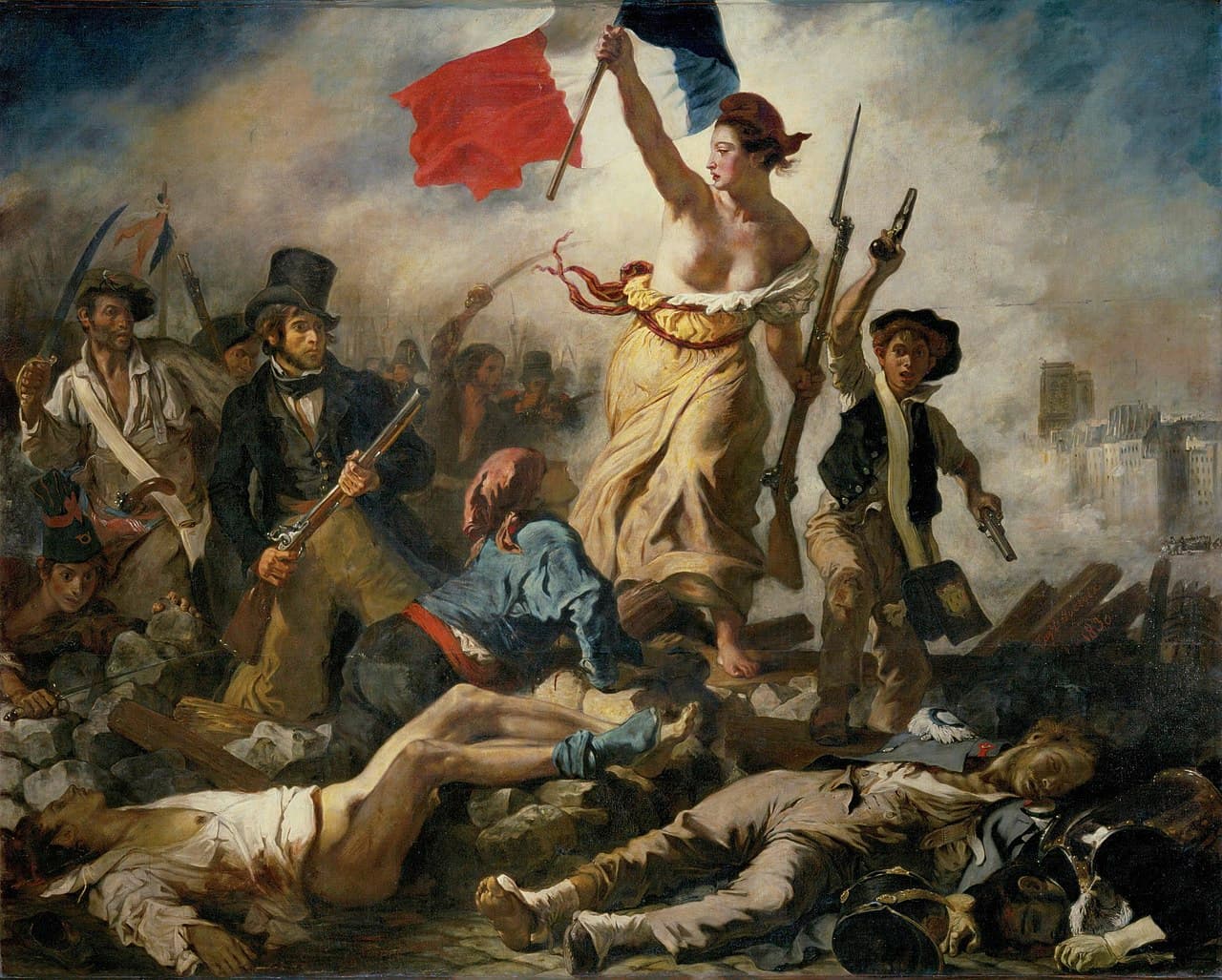
🇫🇷 Eugène Delacroix - La Liberté guidant le peuple (Liberty Leading the People) (1830)
There is a sentence that opens the most famous political pamphlet ever written, and it goes like this: "A spectre is haunting Europe — the spectre of communism." Marx and Engels wrote that in 1848. It is now 2026, and the spectre is still here. It didn't go away when the Berlin Wall came down. It didn't go away when Francis Fukuyama declared the end of history. It didn't go away when we all got smartphones and started ordering groceries through apps built by people working twelve-hour shifts for companies valued at billions while their employees can't afford rent. If anything, the spectre got stronger. It just changed clothes.
I want to talk about Marxism. Not as ideology — not as the thing your uncle argues about at Thanksgiving or Nochebuena, not as the thing that gets thrown around on Twitter like a slur or a badge depending on which algorithmic bubble you inhabit. I want to talk about it the way I talk about everything on this blog: as something I encountered, sat with, and found uncomfortably true in ways I wasn't expecting.
I first read the Communist Manifesto in a coffee shop in Guadalajara. I was maybe twenty-two, and I was reading it not because I was politically radicalized but because I had run out of Dostoevsky and the used bookstore on López Cotilla had a cheap edition of Marx's selected writings nestled between a Gabriel García Márquez novel and a self-help book about manifesting abundance. The irony of those three books sitting together was not lost on me even then. I bought the Marx because it was forty pesos and because I figured I should probably read the thing that half the world spent the twentieth century fighting over before I had an opinion about it.
What I was not expecting was that Marx would make me angry — not at Marx but at everything else. Not the righteous, marching-in-the-streets kind of angry. The quiet, corrosive kind. The kind where you're sitting in a coffee shop reading about surplus value and then you look up at the barista and realize she's been standing there for six hours making drinks that cost more than she earns in an hour, and you think: oh. He was right about this. This specific thing that is happening right now, in this room, in this city, in this century — he described it in 1867 and it's still exactly the same.
That is what this article is about. What Marx actually said, what he got right, what he got wrong, and why — in a world of gig workers, housing crises, and billionaires launching themselves into space while their warehouse employees pee in bottles — his ghost refuses to be buried.
The Man Who Dissected Capitalism Like a Cadaver
Karl Marx was born in 1818 in Trier, a small city in the Rhineland that was then part of Prussia. His father was a lawyer who converted from Judaism to Lutheranism to keep his job — which, if you think about it, is already a pretty Marxist origin story. The system forces you to change who you are in order to survive within it. Marx would later describe this as the relationship between base and superstructure, but his father lived it before Karl had the vocabulary.
Marx studied law, then philosophy, then got kicked out of journalism for being too radical, then got kicked out of France for the same reason, then Germany, then Belgium. He spent most of his adult life in London, where he lived in crushing poverty, buried three of his children, and spent nearly every day in the reading room of the British Museum writing Das Kapital, a book so massive and so dense that he didn't finish it before he died. Engels had to assemble volumes two and three from Marx's notes, which is probably the greatest act of friendship in the history of Western philosophy.
Friedrich Engels deserves his own paragraph because without him, Marx would have starved. Engels was the son of a wealthy textile manufacturer — a factory owner, a capitalist — and he used his father's money to fund Marx's life and work. He also wrote The Condition of the Working Class in England in 1845, based on what he saw in the factories of Manchester, and that book is still one of the most devastating descriptions of poverty ever written. There's something almost unbearable about the fact that the man who co-authored the Communist Manifesto knew capitalism intimately because he profited from it. Engels didn't look away from that contradiction. He sat with it. He wrote from inside it.
I think about Engels a lot, actually. About what it means to see the machine clearly and still be a gear inside it. About whether understanding a system excuses you from participating in it, or whether participation is exactly what gives your understanding its weight. Every time I write this blog on a laptop assembled in a factory in China by workers whose conditions I will never know, I am sitting inside the same contradiction that Engels sat in. The difference is that Engels did something about it. I just write about paintings.
What Marx Actually Said (The Short Version That Is Still Very Long)
Marxism is, at its core, a theory of how societies work. Not a theory of how they should work — Marx was remarkably uninterested in utopian blueprints — but a theory of how they actually function, who benefits, and why.
The foundation is historical materialism: the idea that the economic structure of a society — who owns what, who works for whom, how things are produced and distributed — determines everything else. The laws, the culture, the religion, the art, the philosophy — all of it sits on top of the economic base like a building sits on its foundation. Marx called the economic structure the base and everything else the superstructure. Change the base, and the superstructure changes with it. Keep the base the same, and no amount of cultural progress will alter the fundamental relationships of power.
This is why Marx was so dismissive of reformists who wanted to make capitalism nicer without changing its structure. You can put flowers on the factory floor, but if the workers don't own the factory, they're still alienated from their labor. You can elect progressive politicians, but if the means of production are still privately owned, the politicians will serve the owners. This was Marx's most radical claim and, honestly, his most persuasive one: that the problem isn't bad people running the system. The problem is the system itself.
Then there is class struggle. "The history of all hitherto existing society is the history of class struggles." That's the opening line of Chapter 1 of the Manifesto, and it's one of those sentences that either sounds obviously true or obviously false depending on where you're standing when you read it. If you're standing in the reading room of the British Museum in 1848, watching children die in coal mines while the factory owners build mansions, it sounds self-evident. If you're standing in a WeWork in San Francisco in 2019, drinking oat milk and calling yourself a "founder," it sounds like something from another planet.
But here's the thing: the WeWork founder and the coal mine owner are doing the same thing. They are extracting value from other people's labor. The mechanism is different — stock options instead of whips, kombucha on tap instead of company scrip — but the structure is identical. One class owns the means of production. Another class sells their labor to survive. The owners extract surplus value — the difference between what the workers produce and what they get paid — and that surplus value becomes profit, becomes capital, becomes the wealth that accumulates at the top while the bottom stays the same or sinks.
This is not a conspiracy theory. It's arithmetic. If you make widgets that sell for a hundred pesos and you get paid twenty, the other eighty goes somewhere. Marx's entire project was following that money and asking: where does it go, who takes it, and what happens to the person it was taken from?
Alienation, or Why Your Job Makes You Feel Like a Stranger in Your Own Body
What happens to that person is alienation. Marx wrote about this in his early manuscripts — the Economic and Philosophic Manuscripts of 1844 — and it is, I think, the most emotionally devastating part of his work. More devastating than the economics, more devastating than the politics. Because alienation is not about money. It's about what work does to your soul.
Marx described four types of alienation:
First, alienation from the product of labor. You make something, but it doesn't belong to you. The barista makes coffee she can't afford to drink. The construction worker builds houses he'll never live in. The programmer writes code that will be used to surveil people he'll never meet. You pour yourself into something, and it gets taken from you, and it goes out into the world carrying your labor but not your name.
Second, alienation from the process of labor. You don't decide what to make or how to make it. Someone else tells you what to do and when to do it. Your creativity, your intelligence, your capacity for thought — none of it matters. You are a function, a pair of hands, a set of keystrokes per minute. Marx said that under capitalism, work becomes something you do not to express yourself but to survive, and so the worker "feels himself freely active only in his animal functions — eating, drinking, procreating — and in his human functions he is nothing more than an animal."
Third, alienation from your species-being — your nature as a creative, social, thinking creature. Humans are, according to Marx, fundamentally producers. Not in the capitalist sense of productivity metrics and quarterly targets, but in the deeper sense that we are creatures who make things, who transform the world through our labor, who see ourselves reflected in what we create. Capitalism takes that away. It makes labor a commodity, something to be bought and sold, and in doing so it turns the most human thing about us — our capacity to create — into the thing that destroys us.
Fourth, alienation from other people. Because if your labor is a commodity, then so are you. And if you're a commodity, then every other person is either a competitor or a customer. The social bond between human beings is replaced by the cash nexus. You don't have neighbors; you have a housing market. You don't have friends; you have a network. You don't have lovers; you have a dating app that gamifies intimacy and monetizes loneliness.
When I read Marx on alienation, I thought about every job I've ever had. I thought about writing code at three in the morning for a product I didn't believe in, for a company that would lay me off the moment the numbers dipped. I thought about the specific feeling of sitting in an open-plan office surrounded by people I saw every day but didn't know — not because they were bad people but because the structure of our relationship was transactional. We were there to produce. We were resources. Human resources. The language tells you everything.
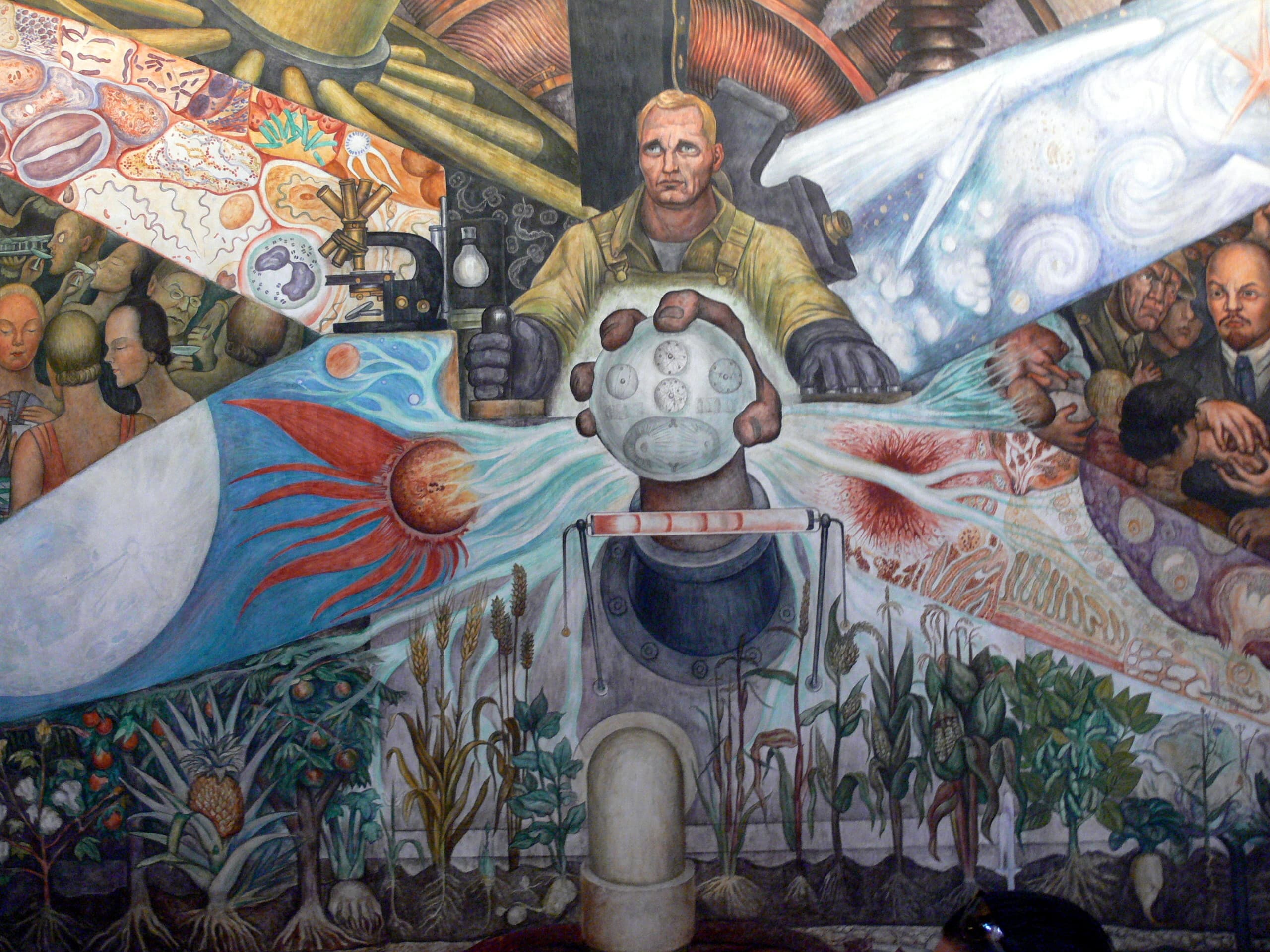
🇲🇽 Diego Rivera - El hombre en el cruce de caminos / Man, Controller of the Universe (1934)
Rivera and the Mural That Got Destroyed (Then Got Resurrected)
I need to talk about Diego Rivera because you cannot talk about Marxism and art without talking about Rivera, and you cannot talk about Rivera without talking about Mexico, and Mexico is where I'm sitting right now, writing this, so the connections are not academic. They are geographic. They are personal.
Rivera was a Marxist. Not a salon Marxist, not a Twitter Marxist, not someone who read the Manifesto once and put a hammer and sickle in their bio. He was a member of the Mexican Communist Party. He traveled to the Soviet Union. He hosted Trotsky in his own home in Coyoacán — yes, that Trotsky, the one Stalin had assassinated with an ice axe in Mexico City in 1940, in a house you can still visit, where the bullet holes are still in the walls. Rivera's politics were not abstract. They lived in his house. They died in his house.
But Rivera's greatest political act was not party membership or revolutionary tourism. It was painting. The Mexican Muralist movement — Rivera, Orozco, Siqueiros — was explicitly, consciously, unapologetically Marxist art. They painted on public walls, not in private galleries, because they believed art should belong to the people, not to collectors. They painted workers, farmers, indigenous people, factory lines, revolutions — the subjects that European art had ignored or romanticized for centuries. They painted history from below, from the perspective of the people who actually made things with their hands rather than the people who owned things from their offices.
"Man, Controller of the Universe" — or "El hombre en el cruce de caminos" — is perhaps Rivera's most famous mural, and it has one of the most incredible stories in art history. In 1933, Nelson Rockefeller commissioned Rivera to paint a mural in the lobby of 30 Rockefeller Plaza in New York City. Rivera, being Rivera, included a portrait of Lenin in the mural. Rockefeller, being Rockefeller, asked him to remove it. Rivera refused. Rockefeller had the mural destroyed. Rivera went back to Mexico City and repainted the entire thing — larger, more political, more defiant — in the Palacio de Bellas Artes, where it still hangs today.
There is something profoundly Marxist about this story beyond its content. A capitalist commissions an artist, then destroys the art when it threatens the capitalist's ideology. The artist recreates the work in a public building owned by the state. The mural survives. The Rockefeller Center lobby has a different mural now. Nobody remembers it.
I have stood in front of Rivera's mural in Bellas Artes. If you are ever in Mexico City, go see it. Stand in the middle of the hall and look up. The mural wraps around you. On one side, the world of capitalism: war, exploitation, the rich at their leisure while the workers suffer. On the other side, the world Rivera imagined: workers united, science in service of humanity, Marx and Engels and Lenin looking toward a future that hasn't arrived yet and maybe never will but is still, somehow, visible. The mural doesn't ask you to choose a side. It shows you both sides and trusts you to see which one you're standing on.
Walter Benjamin wrote in 1935 that "the Work of Art in the Age of Mechanical Reproduction" loses its aura — its unique presence in time and space — when it can be copied and distributed infinitely. But Rivera's murals resist this. You cannot reproduce a mural. You have to go to it. You have to stand in front of it. It is art that insists on your physical presence, your body in the room, your labor of traveling to see it. In that sense, muralism is the most anti-capitalist art form ever invented: it cannot be commodified, cannot be hung in a billionaire's living room, cannot be auctioned at Christie's. It belongs to the wall and the wall belongs to the public.
The Spectre at the Supermarket
Let me bring this back to 2026 because Marx did not write for the nineteenth century. He wrote for every century that capitalism survives, and capitalism has survived all of them so far.
I think about this when I see delivery riders lined up outside apartment towers in Guadalajara, their phones lit up on their handlebars, waiting for the next instruction from an app that calls them "partners" while tracking them like replaceable parts. They carry all the risk in their own bodies: the heat, the traffic, the rain, the possibility of getting hit by a car for a payment so small it vanishes by the end of the day. If Marx had seen this, he would not have needed it explained to him. He would have recognized the old structure wearing new software.
The richest one percent of the world's population owns more wealth than the remaining ninety-nine percent combined. Thomas Piketty showed, in the driest possible economic language, what Marx understood in angrier prose: money makes money faster than work makes money. If you own capital, you grow richer by holding still. If you own only your labor, you are always moving and still falling behind.
The same logic extends outward into everything else. Housing becomes an asset class before it remains a human need. Whole cities become investment vehicles that happen to contain tenants. Climate change becomes the bill for an economic system that treats the natural world as something to be burned now and accounted for later, if later comes at all. Marx did not write an environmental treatise, but he did understand the moral structure of a system that turns land, labor, and life itself into inputs for accumulation. That is why he still feels contemporary: not because he predicted every platform or crisis, but because he described the appetite beneath them.
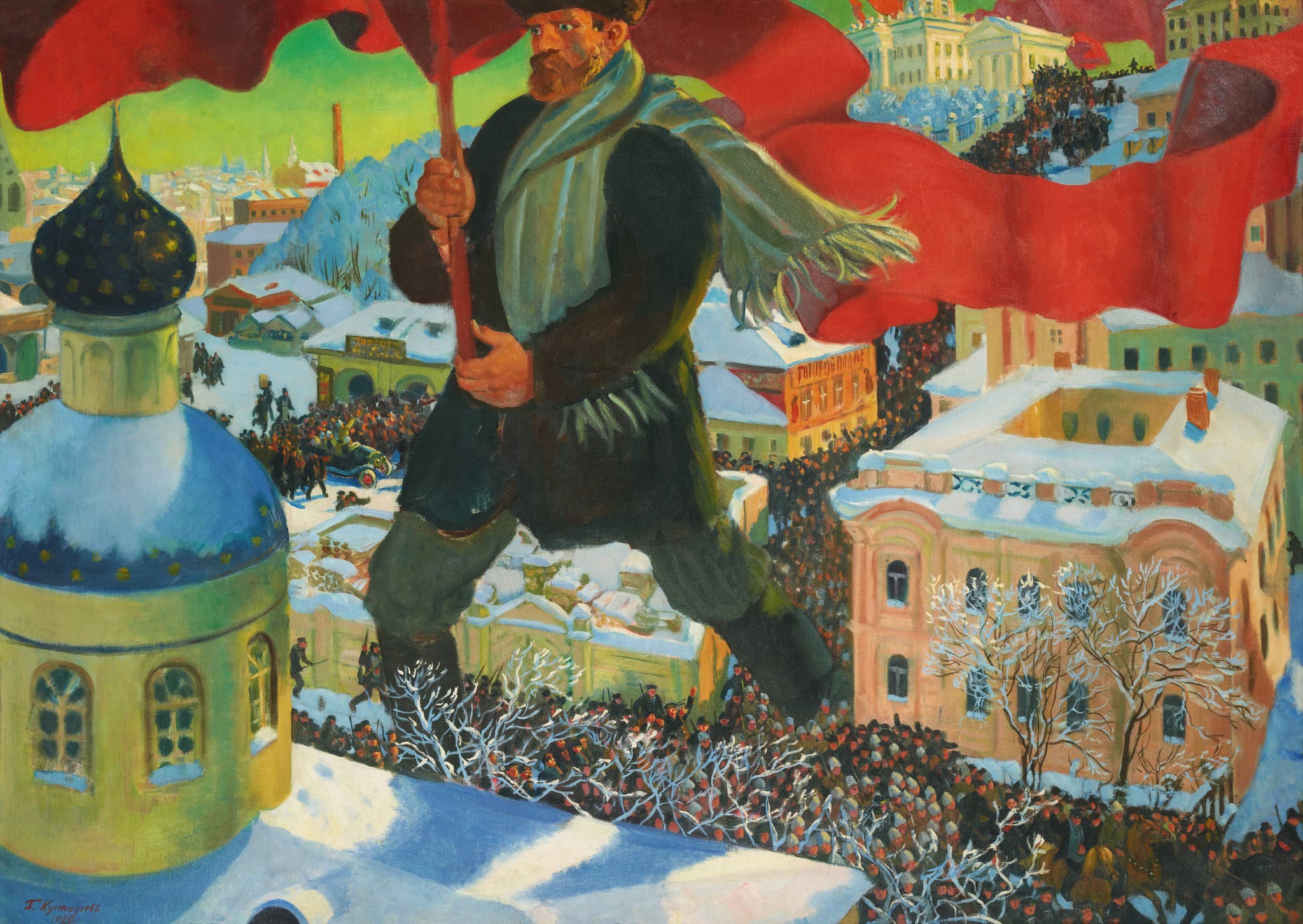
🇷🇺 Борис Кустодиев - Большевик (Boris Kustodiev - The Bolshevik) (1920)
The Russian Connection (Because There Is Always a Russian Connection)
I cannot write about Marxism without writing about Russia, because Russia is where Marxism was first implemented at scale, and because Russian is the language I chose to learn, the language I write in sometimes on this blog, and the culture I have been circling around like a moth around a lamp for years.
Kustodiev painted "The Bolshevik" in 1920, three years after the October Revolution. The painting shows an enormous figure — a giant — striding over a Russian city with a red flag billowing behind him. The streets below are filled with tiny people, a crowd, a demonstration. The Bolshevik is larger than the buildings. He is larger than the churches. He is an idea that has become a body, a theory that has become a man, and he is walking over the world with the confidence of someone who believes history is on his side.
I find this painting both thrilling and terrifying, and I think that's the correct response. Because what happened in Russia after 1917 is both the greatest vindication and the greatest condemnation of Marx's ideas. The revolution happened. The workers took power. And then — as Marx himself might have predicted, if he had been more honest about the difficulties of what he was proposing — the revolution ate its children. Stalin's purges, the Gulag, the famine in Ukraine, the crushing of dissent, the transformation of a workers' state into a totalitarian nightmare — all of it done in Marx's name, all of it a betrayal of everything Marx wrote about human emancipation.
The honest Marxist has to sit with this. You cannot wave it away by saying "that wasn't real Marxism" — the most overused phrase in leftist discourse, and the most intellectually cowardly. Of course it was real Marxism, in the sense that real people who really read Marx really did those things. The question is not whether the Soviet Union was Marxist but whether the failures of the Soviet Union disprove Marx's analysis of capitalism. And the answer, I think, is no. You can have the right diagnosis and the wrong treatment. A doctor who correctly identifies cancer but prescribes the wrong chemotherapy has not been proven wrong about the cancer. The cancer is still there.
And the cancer — to stretch this metaphor to its breaking point and then a little further — is still here. The conditions Marx described in 1867 are not gone. They have evolved, metastasized, gone global. The factories that Engels documented in Manchester are now in Shenzhen, in Dhaka, in Guadalajara's industrial parks. The exploitation hasn't ended; it has been outsourced. It has been hidden behind supply chains so long and so complex that the person buying the shirt cannot see the person who sewed it, and that invisibility is not accidental. It is structural. It is designed.
What Marx Got Wrong (Because Intellectual Honesty Requires This Section)
Marx predicted that capitalism would collapse under the weight of its own contradictions. It hasn't. Not because the contradictions aren't there — they are, and they're worse than ever — but because capitalism has proven far more adaptable, far more resilient, far more capable of absorbing its own crises and turning them into opportunities for further accumulation than Marx anticipated.
Marx predicted that the working class would become more and more conscious of itself as a class and would eventually unite to overthrow the system. Instead, the working class has been fragmented — by nationalism, by racism, by consumer identity, by social media, by the very technologies that were supposed to connect us. The American factory worker does not identify with the Chinese factory worker. He identifies with the American CEO because they share a flag. Marx underestimated the power of nationalism and overestimated the power of class consciousness.
Marx also had remarkably little to say about what comes after. The "dictatorship of the proletariat" is mentioned but never fleshed out. The withering away of the state is asserted but never explained. The communist society — where, as Marx once wrote, a person could "hunt in the morning, fish in the afternoon, rear cattle in the evening, criticize after dinner" — sounds beautiful but has the structural detail of a dream. And dreams, when implemented by committee, tend to become nightmares.
Friedrich Hayek and Ludwig von Mises argued that centrally planned economies cannot work because they cannot solve the calculation problem — the problem of allocating resources efficiently without market prices to guide decisions. They were, on this point, largely correct. The Soviet economy was a monument to inefficiency, waste, and perverse incentives. But — and this is important — the existence of market failures in planned economies does not mean that markets are efficient. Markets are efficient at maximizing profit. They are not efficient at distributing well-being, preserving the environment, or keeping people alive. The question is what we're optimizing for.
Francis Fukuyama declared in 1989 that liberal democracy and free-market capitalism represented the "end of history" — the final form of human government. Thirty-seven years later, liberal democracy is in retreat on every continent, free-market capitalism has produced levels of inequality that rival the Gilded Age, and Fukuyama himself has walked back much of his thesis. History, it turns out, is not over. It never is. Marx would have laughed at the idea. History, for Marx, is a process — a dialectical process, driven by contradictions that are never fully resolved but only superseded by new contradictions. The end of history is not a Marxist concept. It is a liberal fantasy, and it has aged about as well as a tulip bubble.
The Ghost in the Room
I said at the beginning that the spectre is still here, and I want to end by sitting with that spectre for a moment.
I am not a Marxist. I say this not as a disclaimer but as a fact. I do not belong to any party, I do not attend meetings, I do not have a program for the transformation of society. What I am is a person who reads and thinks and looks at paintings and tries to understand why the world is arranged the way it is, and who finds, again and again, that Marx's descriptions of how capitalism works are uncomfortably accurate.
I look at Delacroix's "Liberty Leading the People" and I see the revolutionary tradition that Marx inherited and tried to give a theory to — the tradition of people saying "enough" and taking to the streets and dying for the idea that things could be different. I look at Rivera's mural and I see what happens when an artist takes that theory seriously and puts it on a wall for everyone to see — and I see what happens when capital destroys what threatens it, and what happens when the artist paints it again, larger, angrier, more beautiful. I look at Kustodiev's Bolshevik and I see the terrifying grandeur of an idea that became a revolution that became a state that became a horror, and I see that the horror does not negate the idea, any more than the Inquisition negates the Sermon on the Mount.
Marx is not a prophet. He is not a god. He is a man who sat in a library for thirty years and tried to understand why some people starve while others feast. He got many things wrong. He got the essential thing right: that the way we organize our labor determines the way we organize our lives, and that an economic system built on the extraction of value from the many by the few will produce, over and over, the same patterns of exploitation, alienation, and crisis that he described in 1867.
The spectre is still here because the conditions that summoned it are still here. It will remain here as long as there are people who work and people who own, people who produce and people who profit, people who build the houses and people who buy them as investments. Marx did not invent class struggle. He described it. And you cannot exorcise a ghost by pretending it doesn't exist.
You can only sit with it, like the Demon. You can only look at it clearly, like Stańczyk. You can only paint it on the wall, like Rivera, and trust that the wall is stronger than the money that wants to tear it down.
And for today, that will have to be enough.
🇬🇧 Thank you for reading
Filed under
Keep reading