Essay / EN
The Cards and the Couch
On Tarot, Psychoanalysis, and the Things We Already Know but Cannot Say
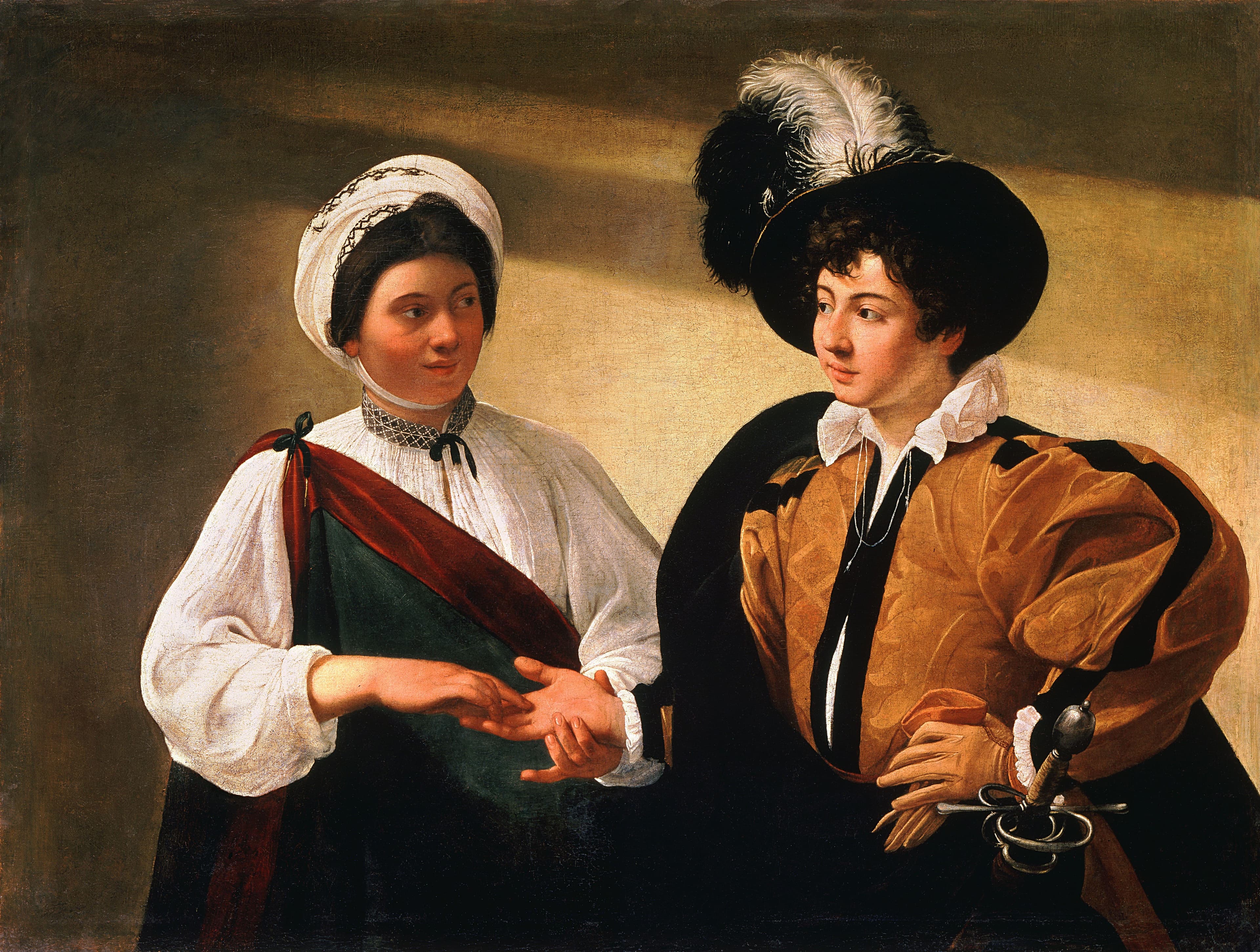
🇮🇹 Michelangelo Merisi da Caravaggio - La diseuse de bonne aventure (The Fortune Teller) (c. 1594)
There is a moment in every tarot reading — whether you believe in it or not, whether you're sitting across from a reader in a candlelit room or pulling a card from an app on your phone at two in the morning — when something happens that you cannot explain rationally. A card appears, and it says something that it should not be able to say. Not because the card is magic. But because you are.
I need to be clear about this from the beginning: I do not believe that tarot cards predict the future. I do not believe that shuffling a deck of seventy-eight illustrated cards and laying them out in a pattern gives you access to information about events that haven't happened yet. I am, as I've said on this blog before, a Lacanian atheist. I do not believe in the supernatural. I do not believe in fate. I do not believe that the universe is trying to tell you something.
But I do believe in the unconscious. And the unconscious, as Freud and Jung and Lacan spent their entire careers demonstrating, is stranger and more powerful and more terrifyingly intelligent than any tarot deck could ever be. The cards don't know you. But you know you — in places you can't reach, in languages you don't speak, in images you've never consciously seen but that have been shaping your life since before you had words.
This is an article about the place where tarot and psychoanalysis meet. Which is, I think, the same place where Caravaggio's fortune teller looks into the young man's eyes and sees something real while performing something false. The con is real. The insight is also real. Both things can be true at the same time, and the inability to hold that contradiction is what keeps most people from understanding either tarot or psychoanalysis.
The Deck and the Divan
Tarot cards appeared in northern Italy in the fifteenth century, originally as a card game called tarocchi. They were not designed for divination. They were designed for play — a trick-taking game for the aristocracy, painted on expensive hand-made cards, featuring allegorical figures from Christian and classical tradition. The Pope. The Emperor. The Wheel of Fortune. Death. The Devil. Judgement. The World.
It wasn't until the eighteenth century that tarot became associated with the occult, when a French writer named Antoine Court de Gébelin claimed — with absolutely no evidence — that the tarot was an ancient Egyptian book of wisdom, the lost Book of Thoth, preserved through the centuries by Romani travelers. This was complete nonsense. But it was compelling nonsense. It gave the cards a mythology, a lineage, a sense of hidden depth that the simple Italian game had lacked. And once people believed the cards contained secret knowledge, they started finding secret knowledge in them. This is how meaning works. It is not discovered. It is projected.
Sigmund Freud, born four decades after Court de Gébelin's death, would have recognized this mechanism immediately. Projection — the unconscious transfer of one's own thoughts, feelings, and desires onto an external object — is one of the foundational concepts of psychoanalysis. You look at a Rorschach inkblot and you see a butterfly or a monster or your mother's face, and what you see tells the analyst not about the inkblot but about you. The inkblot is just a surface. You are the content.
Tarot cards work the same way. Not because they are designed as projective instruments — the Rider-Waite-Smith deck, the most popular deck in the English-speaking world, was designed in 1909 by Arthur Edward Waite and illustrated by Pamela Colman Smith, both members of the Hermetic Order of the Golden Dawn, both sincere occultists who believed in the cards' divinatory power. But regardless of what Waite and Smith believed they were creating, what they actually created was one of the most sophisticated projective systems in history: seventy-eight images rich enough in symbolism, ambiguous enough in meaning, and emotionally resonant enough in their depictions of human experience to serve as mirrors for the unconscious.
This is not an insult to tarot. This is the highest compliment I can give it.
Jung and the Archetypes
Carl Gustav Jung — Freud's most brilliant student and most devastating apostate — understood this better than anyone. Jung broke with Freud in 1913 over many disagreements, but the central one was this: Freud believed the unconscious was primarily a repository of repressed personal experiences — memories, desires, traumas pushed out of awareness because they were too painful to hold. Jung agreed that this personal unconscious existed, but he argued that beneath it lay something deeper, vaster, older: the collective unconscious.
The collective unconscious, Jung proposed, is not personal. It does not contain your memories or mine. It contains the memories of the species — the accumulated psychological patterns of hundreds of thousands of years of human experience, preserved not in individual brains but in the structure of the psyche itself. These patterns are what Jung called archetypes: primordial images that recur across all cultures, all mythologies, all religions, all dreams. The Great Mother. The Wise Old Man. The Trickster. The Shadow. The Hero. The Self.
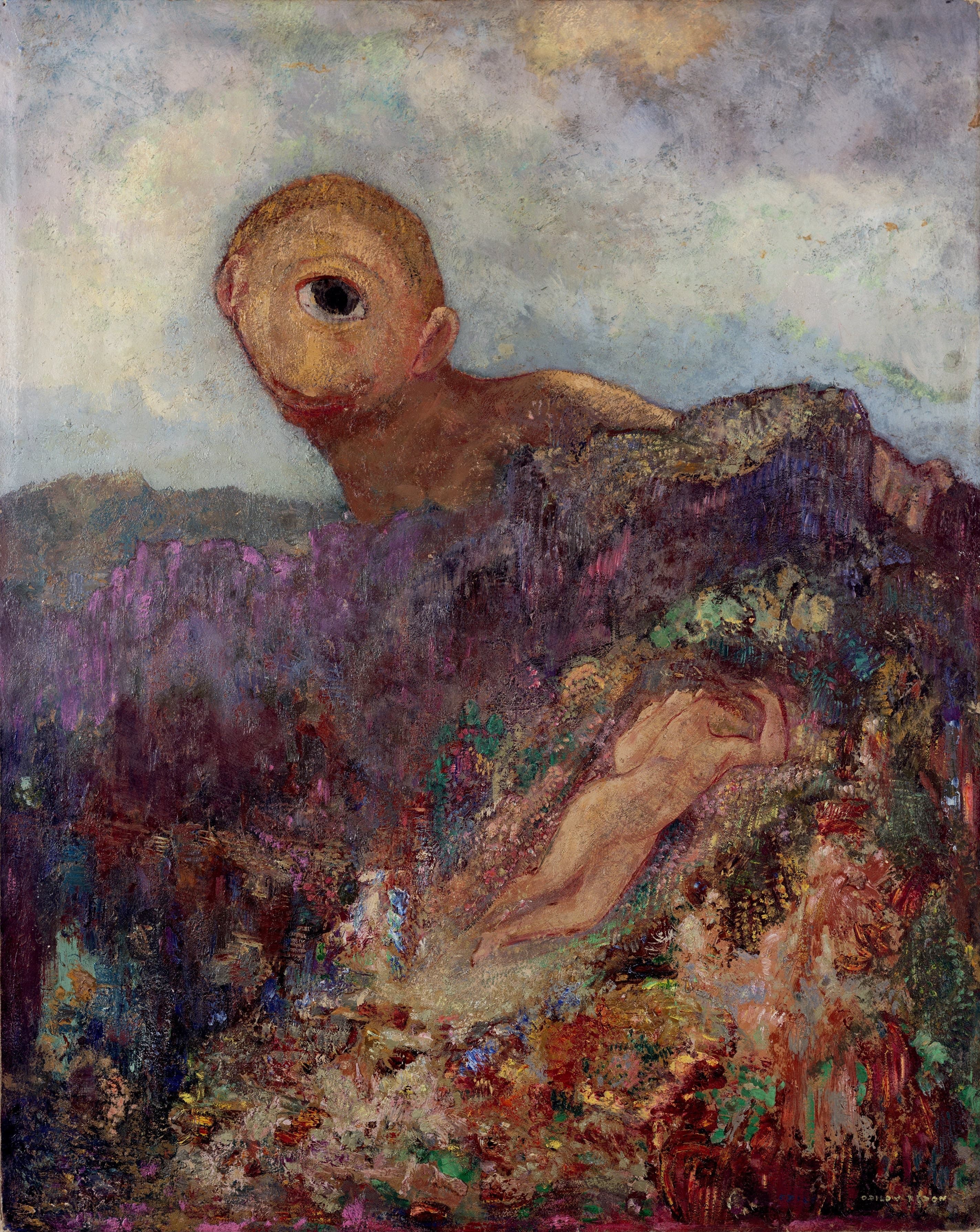
🇫🇷 Odilon Redon - Le Cyclope (The Cyclops) (c. 1898-1914)
Look at Redon's Cyclops. The single eye that sees what others cannot. The gaze that penetrates beyond the surface of things to the invisible world beneath. Redon was painting archetypes before Jung had a name for them — painting the seer, the visionary, the one who looks with an inner eye at the hidden patterns of existence. The Cyclops sees Galatea the way the analyst sees the patient, the way the tarot reader sees the querent: not as they present themselves, but as they are beneath the presentation.
Now look at the Major Arcana of the tarot. Twenty-two cards. The Fool. The Magician. The High Priestess. The Empress. The Emperor. The Hierophant. The Lovers. The Chariot. Strength. The Hermit. The Wheel of Fortune. Justice. The Hanged Man. Death. Temperance. The Devil. The Tower. The Star. The Moon. The Sun. Judgement. The World.
These are not random images. They are archetypes. Not because the fifteenth-century Italian cardmakers who first painted them had read Jung — obviously they hadn't, Jung wouldn't be born for another four hundred years — but because archetypes don't need to be read to be recognized. They emerge naturally from the collective unconscious like flowers emerge from soil. The Italian painters who created the first tarot trumps drew on the same reservoir of human psychological imagery that Jung would later map. They didn't invent the Fool. The Fool was already there, in every culture's mythology, waiting to be drawn.
Jung himself was deeply interested in tarot, though he was characteristically cautious about saying so in his published works. In his letters and seminars, he referred to the tarot cards as containing "archetypes of transformation" — images that map the process of psychological development that he called individuation: the journey from an unconscious, fragmented self to a conscious, integrated one. The Major Arcana, read in sequence from The Fool (0) to The World (XXI), can be understood as a symbolic narrative of this process.
The Fool's Journey
This is what tarot practitioners call the Fool's Journey, and whether they know it or not, they are describing Jung's concept of individuation.
The Fool begins at zero — unnumbered, unnamed, standing at the edge of a cliff with a small bag and a dog at his heels, about to step into the unknown. The Fool is the ego before it has encountered the world. He is pure potential, pure beginning, the psyche at the start of its journey toward selfhood.
The first cards he encounters are the parental archetypes: The Magician (the active, creative masculine principle), The High Priestess (the receptive, intuitive feminine principle), The Empress (the nurturing mother), The Emperor (the structuring father), The Hierophant (the cultural father, tradition, institutional authority). These are the figures that shape the Fool's early development — the same figures that psychoanalysis identifies as the primary objects of childhood: the parents, the family, the social order into which we are born and by which we are formed.
Then come the challenges: The Lovers (the first encounter with desire and choice), The Chariot (the will to power, the ego's assertion of control), Strength (the confrontation with instinct and the need to integrate rather than suppress it). These are the developmental tasks of adolescence and early adulthood — the same tasks that Freud described in his theory of psychosexual development, though Freud would have blushed at the tarot's imagery and Jung would have smiled.
The Hermit marks a turning point. The Fool withdraws from the world, turns inward, seeks illumination through solitude and introspection. This is the beginning of what Jung called the second half of life — the period when the ego, having established itself in the world, begins to question the foundations on which it was built. The Hermit is the analysand who walks into the analyst's office and says: "Something is wrong, and I don't know what it is."
The Wheel of Fortune introduces the concept of fate — forces beyond the ego's control that determine the course of life. Justice confronts the Fool with the consequences of his actions. The Hanged Man suspends him upside down, forcing a radical reversal of perspective — seeing the world from a position of surrender rather than control. This is what happens on the analyst's couch: you stop trying to manage your narrative and let something else speak through you.
And then Death. Card XIII. The card that everyone fears and that every tarot reader hastens to explain does not mean literal death. It means transformation — the death of the old self, the dissolution of the ego's attachments, the clearing away of everything that is no longer needed so that something new can emerge. Freud would call this the death drive — Thanatos, the force that works against Eros, the force that seeks to return the organism to an inorganic state. Jung would call it the nigredo — the blackening, the first stage of alchemical transformation, the necessary destruction that precedes rebirth.
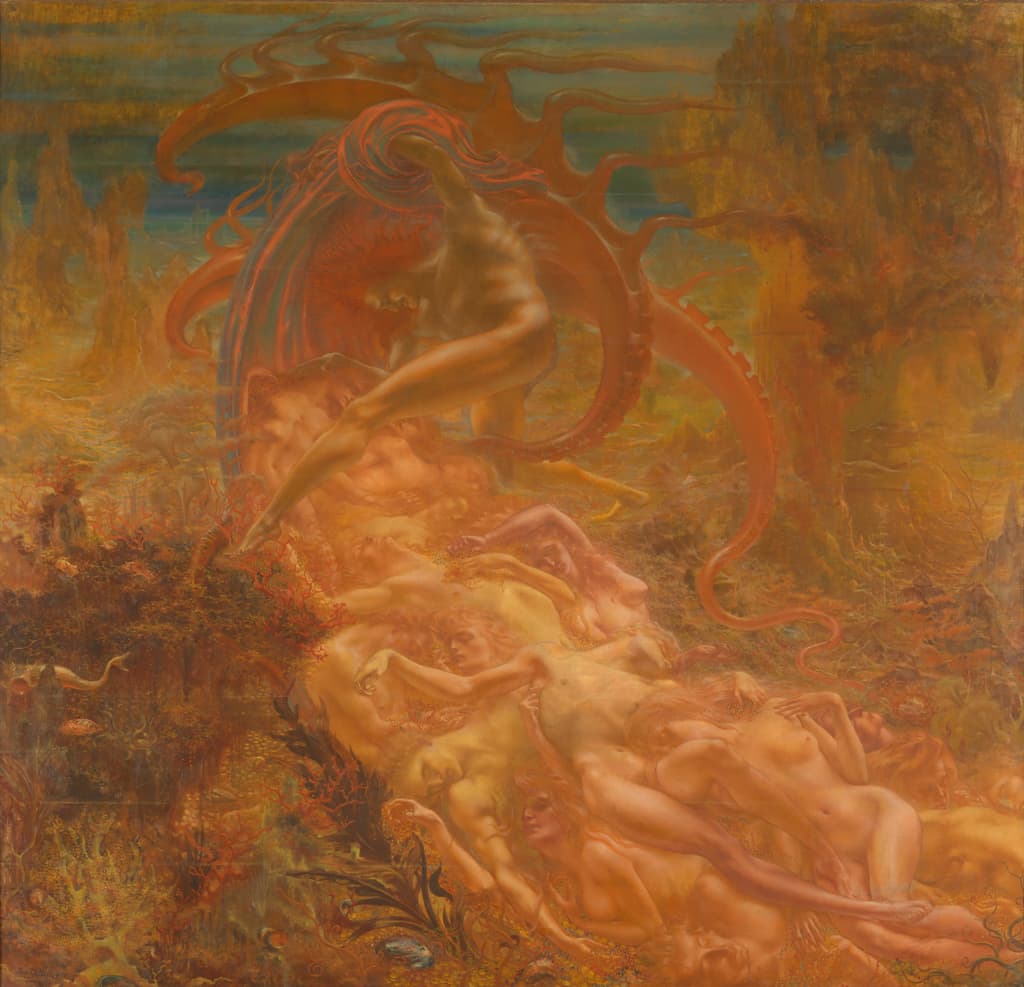
🇧🇪 Jean Delville - Les Trésors de Sathan (The Treasures of Satan) (1895)
The Shadow and the Devil
After Death comes The Devil — card XV — and this is where tarot and psychoanalysis converge most powerfully. Look at Delville's painting. Look at the souls chained in sensual pleasure, slumbering in an oceanic abyss, surrounded by treasures they mistake for freedom. This is the Shadow.
Jung's concept of the Shadow is simple to state and devastating to encounter. The Shadow is everything about yourself that you refuse to acknowledge — the desires you suppress, the impulses you deny, the parts of your personality that you have exiled into the unconscious because they don't fit the image you want to present to the world. The Shadow is not evil. It is simply everything you have decided is unacceptable about yourself.
The Devil card in the tarot depicts precisely this. In the Rider-Waite-Smith deck, a horned figure sits on a pedestal while two naked human figures stand below, chained loosely to the pedestal by chains they could easily remove. They are not imprisoned. They are attached. They stay in bondage not because they cannot leave but because they believe they cannot — or because the bondage itself has become comfortable, familiar, preferred to the terrifying freedom of removing the chains and facing what lies beneath.
This is what Freud called resistance. The patient comes to analysis seeking relief from suffering, but when the analyst begins to approach the unconscious material that causes the suffering, the patient resists. They change the subject. They arrive late. They cancel sessions. They argue with the analyst. They do everything possible to avoid seeing what the analysis is trying to reveal — because what lies in the Shadow is not just painful but identity-threatening. To see your Shadow clearly is to realize that you are not who you think you are. And most people would rather stay chained to the Devil's pedestal than face that realization.
In a tarot reading, The Devil card performs the same function. When it appears, it asks: what are you attached to that you mistake for necessity? What chains are you wearing that you could remove if you were willing to see them? What part of yourself have you exiled into the darkness, and what would happen if you brought it into the light?
These are psychoanalytic questions. They are the questions that Freud asked from his chair behind the couch, that Jung asked in his tower at Bollingen, that Lacan asked in his seminars at the Ecole Normale Supérieure. The tarot reader asks them with pictures instead of words, with symbols instead of concepts, with the logic of images instead of the logic of language. But the questions are the same. And the resistance they provoke is the same.
The Soothsayer's Recompense
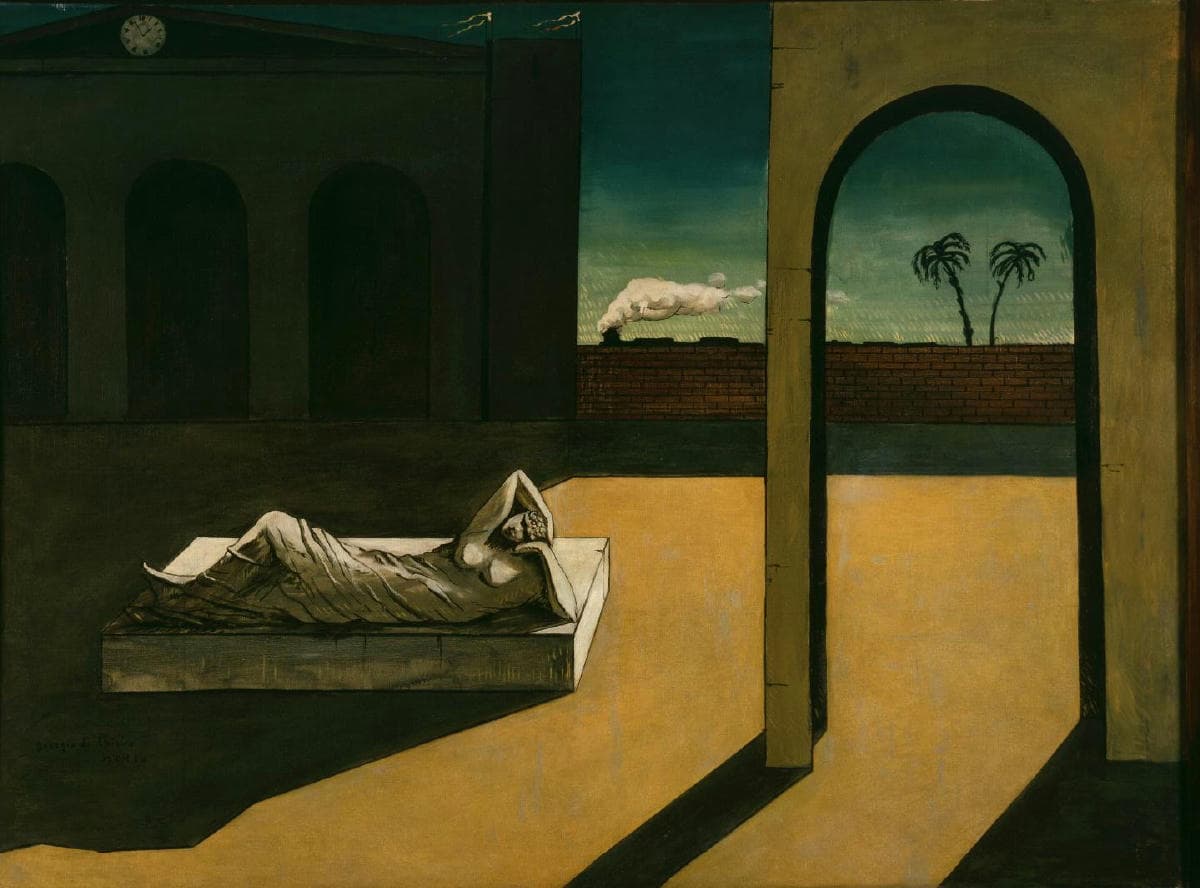
🇮🇹 Giorgio de Chirico - La ricompensa dell'indovino (The Soothsayer's Recompense) (1913)
De Chirico painted this in 1913 — the same year Jung broke with Freud, the same year the unconscious split open and poured its contents across European art and thought like a river breaking its banks. The sleeping Ariadne in the deserted piazza. The clock that has stopped. The train departing toward an unknown destination. The shadows falling at impossible angles.
What is the soothsayer's recompense? What does the one who sees receive for seeing?
I think the answer is loneliness. The analyst sits behind the couch and listens to the patient's associations, hearing the unconscious speak through the gaps and repetitions and slips of the tongue, and the analyst cannot share what they hear without destroying the process. The tarot reader looks at the cards and sees patterns that the querent cannot yet see, and if the reader speaks too directly, the querent's defenses will go up and the reading will fail. The seer is always alone with what they see. This is Ariadne's fate: to have the key to the labyrinth but to be abandoned by the one she helped escape it.
De Chirico's metaphysical paintings are the visual equivalent of free association — the psychoanalytic technique in which the patient says whatever comes to mind, without censorship, without logic, without the ego's organizing principles, and lets the unconscious speak through the disorder. The deserted piazzas, the long shadows, the trains going nowhere, the statues of sleeping mythological figures — these are images from the space between waking and sleeping, the space that Freud called the preconscious, the space where the unconscious reveals itself in disguise.
This is also the space of tarot. When you shuffle the cards and lay them down, you are creating a visual field of free association. The images on the cards are not your thoughts, but your thoughts attach to them, wrap around them, use them as scaffolding. The Tower is not your crisis, but when The Tower appears, your crisis suddenly has a shape, a name, a position in a narrative that makes it comprehensible. The Star is not your hope, but when The Star appears after The Tower, the sequence tells you something your conscious mind could not have articulated: that destruction precedes renewal, that the darkest moment is followed by light, that the pattern of your suffering has a structure, and structures can be understood.
The Talking Cure and the Reading
Freud called psychoanalysis "the talking cure" — a phrase he borrowed from his patient Bertha Pappenheim, who called it that before Freud did. The patient talks. The analyst listens. The talking itself is the cure — not because the analyst provides answers, but because the act of speaking aloud, of putting the unspeakable into words, of allowing the unconscious to express itself through language, transforms the relationship between the patient and their suffering. What was unconscious becomes conscious. What was unnamed becomes named. What was controlling you from the darkness can now be seen in the light, and what can be seen can be — if not controlled — then at least negotiated with.
A tarot reading is the same process, translated from the medium of words to the medium of images. The querent looks at the cards and speaks. They say: "The Tower — yes, I see it, everything is falling apart, my relationship, my job, the foundation I built my life on." And in saying it, in seeing the image and naming the correspondence, they do what the analysand does on the couch: they make the unconscious conscious. They see the pattern. They name the thing.
I have felt this myself on nights when I did not want prophecy, only a way of admitting what I already knew. You lay the cards out on the table hoping for surprise, and instead they return you to yourself. Not because cardboard can diagnose a life, but because there are evenings when an image permits an honesty that ordinary speech keeps postponing. The card lands. You look at it. And suddenly the thing you had been carefully calling confusion has the shape of a tower, or a devil, or a fool standing too close to the edge.
I am not saying that tarot is psychoanalysis. Psychoanalysis is a rigorous clinical practice with a century of theoretical development, and tarot is a deck of illustrated cards. The analyst has years of training, a supervisory structure, an ethical framework, a body of theoretical knowledge that informs every interpretation. The tarot reader may have all of these things or none of them.
But I am saying that they operate on the same territory. They both work with the unconscious. They both use symbolic systems to access material that direct questioning cannot reach. They both rely on the human capacity for projection — for seeing yourself in something outside yourself — to bring hidden truths into awareness. And they both know that the truth, once seen, cannot be unseen, and that this seeing is both the cure and the wound.
What the Cards Know
I said at the beginning that I don't believe tarot cards predict the future. I want to amend that slightly.
I don't believe the cards know the future. But I believe you might. Not in the sense of prophecy — not in the sense of receiving information from a supernatural source about events that haven't happened yet. In the sense of pattern recognition. In the sense that your unconscious, which processes vastly more information than your conscious mind, which notices the micro-expressions your partner makes when they're lying, which registers the tension in your boss's voice when they say "everything's fine," which tracks the trajectory of your choices with a mathematical precision that your conscious mind could never match — your unconscious already knows where things are heading. It has already done the calculations. It has already seen the Tower falling. It just can't tell you in words, because the unconscious does not speak in words. It speaks in images. In dreams. In symptoms. In slips of the tongue.
And in tarot cards, if you let it.
When you shuffle the deck and a card falls out — the card you didn't choose, the card that chose itself — and it says something that makes your breath catch, something that names the thing you've been avoiding, something that describes with uncanny precision the situation you've been pretending doesn't exist — that is not the universe speaking to you. That is you speaking to you. Through the cards. Through the images. Through the ancient, pre-verbal language of symbols that your unconscious has been fluent in since before you learned to talk.
Jung called this synchronicity — the meaningful coincidence of an outer event with an inner psychological state. The card that appears is not caused by your unconscious (unless you believe in psychokinesis, which I don't). But the meaning you find in it is caused by your unconscious. The card is the inkblot. You are the patient. The reading is the analysis.
And sometimes — not always, but sometimes — what the analysis reveals is something you needed to see. Something you already knew but couldn't say. Something that was sitting in the darkness of your psyche like Vrubel's Demon, like the melancholic who carries a weight they cannot name, waiting for an image to give it form so it could finally be looked at, finally be understood, finally be — if not put down — then at least held with both hands and full awareness.
This is what the cards know. Not the future. You. The parts of you that you have forgotten, or repressed, or exiled, or simply never had the language for. The cards give you the language. Not in words — in pictures. And pictures, as Redon knew, as de Chirico knew, as Delville knew, as every painter on this blog knows, can reach places that words cannot.
The Reading Ends
I want to end this the way a tarot reading ends — not with a conclusion but with an invitation.
The last card of the Major Arcana is The World — card XXI. A figure dances inside a wreath of laurel, surrounded by the four fixed signs of the zodiac: the angel, the eagle, the lion, the bull. The journey is complete. The Fool has traveled through all twenty-one stations of transformation and arrived at a place of integration, of wholeness, of the Self — which is what Jung called the archetype of totality, the center of the psyche that encompasses both the conscious and the unconscious, both the persona and the Shadow, both the light and the dark.
But here's the thing about The World: it is not the end. The tarot is a cycle. After The World comes The Fool again — card zero, the beginning, the cliff edge, the dog at the heels, the step into the unknown. Individuation is not a destination. It is a process. You don't arrive at the Self and stay there. You arrive and begin again, older, more conscious, carrying everything you learned on the previous journey, but still stepping off the cliff. Still falling. Still trusting that the fall is part of the design.
Psychoanalysis knows this too. Analysis does not end with a cure. It ends — if it ends — with the capacity to continue the work without the analyst. The patient leaves the couch and walks back into the world carrying the tools of self-examination that the analysis provided. They will still dream. They will still have symptoms. They will still encounter their Shadow in unexpected places. But now they know how to read the signs. Now they have the language — or the images — to understand what the unconscious is trying to say.
This is what tarot offers, at its best. Not answers. Not predictions. Not magic. A mirror. A set of images rich enough and old enough and deep enough to reflect the parts of yourself that you cannot see directly. A language for the unspeakable. A map of the territory that Freud and Jung spent their lives exploring — the territory of the psyche, the unconscious, the place where everything you are and everything you refuse to be lives together in the dark, waiting for a light.
Shuffle the cards. Lay them down. Look at what appears.
You already know what it means.
🇬🇧 Thank you for reading
Filed under
Keep reading